It's only a matter of time before terrestrial flora and fauna finally find their way to Mars. Though to survive and thrive there, they will need some traditional Frankenstein treatment. As a recent NASA article explains: “On Mars, plants would have to tolerate conditions that usually cause them a great deal of stress — severe cold, drought, low air pressure, soils that they didn't evolve for.” Like humans, the article also explains, plants suffer from stress: “They produce a chemical signal -- superoxide (O2-) — that puts the rest of the plant on high alert. Superoxide, however, is toxic; too much of it will end up harming the plant.” The first step to get plants to grow on Mars, then, is to relieve their anxiety.
And scientists find their Prozac pill in Pyrococcus furiosus, a microbe that “lives in a superheated vent at the bottom of the ocean, but periodically it gets spewed out into cold sea water. So, unlike the detoxification pathways in plants, the ones in P. furiosus function over an astonishing 100+ degree Celsius range in temperature. That's a swing that could match what plants experience in a greenhouse on Mars.”
Scientists also hope to transfer genes from other extremophile organisms that not only will help plants cope with extreme conditions such as drought, cold temperatures, low air pressure, and low light levels but also thrive to be able to sustain settlements on Mars.
Meanwhile, how about some botanical illustrations of these Floral Frankensteins? They would be the most amazing botanical illustrations ever, even if they were to look merely common and not the post-terrestrial species that futurists love to imagine them as.
For this slow, languorous Midwestern autumn Sunday, here are some Soviet Glasnost neoavant-garde paper architecture by Brodsky & Utkin.
“In their designs, by turns funny, cerebral, and deeply human, Brodsky & Utkin borrow from Egyptian tombs, Ledoux’s visionary architecture, Le Corbusier’s urban master palns, and other historical precedents, collaging these heterogeneous forms in learned and layered scrambles. Underlying the wit and visual inventiveness is an unmistakable moral: that the dehumanizing architecture of the sort seen in Russian cities in the 1980s and 1990s, and elsewhere around the globe, takes a sinister toll.”
Obviously, the next step is to investigate whether the pair had once lived in a brothel, done the occasional cross-dressing, and cavorted with scantily clad nuns, and if so, then confect a screenplay to complement our Lequeu biopic. It will be a trilogy on visionary builders, the conceit being their works are unbuilt, unbuildable masterpieces thwarted by politics, economics, and gravity.
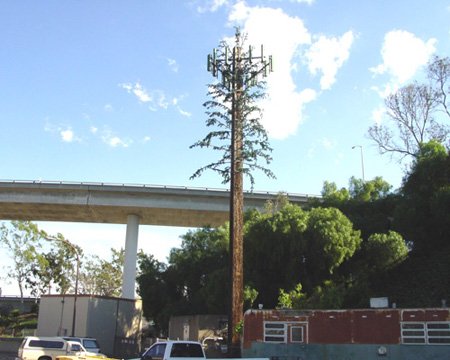
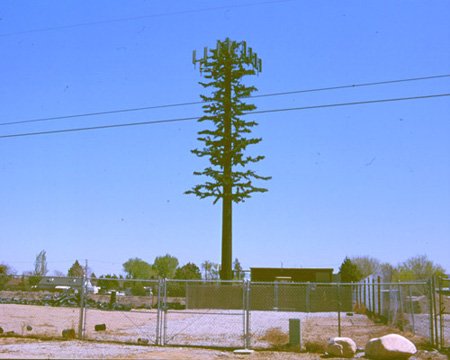
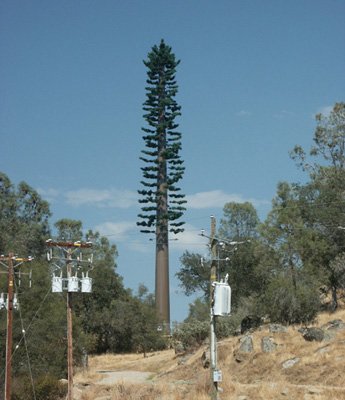
A brief stop at the always marvelous Polar Inertia yielded these two photos of cell towers disguised as trees.
Polar Inertia writes that “over four million citizens are now connected to the cellular phone network. Through the individual itineraries of its citizens Los Angles reinvents itself daily, creating an ephemeral urban identity in its airwaves. The boundaries of the city are blurring further as the interactions that used to happen in face to face transactions have now been transplanted by distance shrinking telephone conversations, e-mail and network connections.”
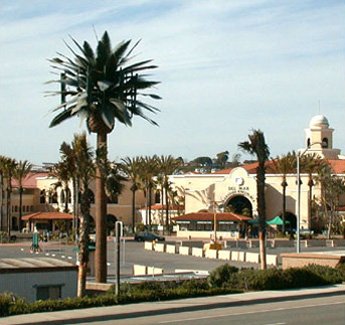
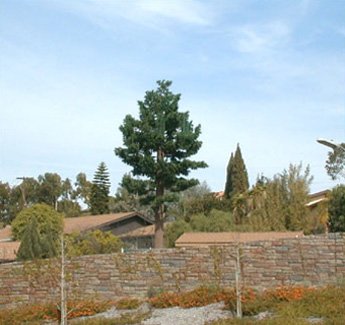
Here are some more photos gathered from Googledom.
From one company: “The tremendous increase in demand for wireless towers has generated great opposition to the use of conventional, unconcealed structures. Both community and zoning requirements for high quality concealment are on the rise. Today, concealment issues may be the greatest obstacles to obtaining zoning approval. Preserved TreeScapes International's botanically correct tree tower products will help speed the approval process.” Arcadia Ersatz as a function of zoning ordinances.
POSTSCRIPT #1: As provided by a commenter, more fantastic photos here.
For its new season, PBS's perennial home improvement show, This Old House, takes the task of remodeling its first ever mid-century modern house. In typical TOH fashion, host Kevin O'Connor and his cohorts guide you to every conceivable facet of a total house remodeling project, from the initial client meeting to the post-construction/housewarming party in brutally dense 30-minute episodes. Away from the drawings and AutoCADs and into the trenches. Every trade gets some screen time: architects, landscape architects, carpenters, plumbers, electricians, interior designers, preservationists, suppliers, painters, engineers, etc.
And arborists? Yes, they show you how to cut down a three-story tree safely away from a neighbor's house, though they make it clear that it should only be done by professionals (at quite an astounding price). And historians? Yes, one gives O'Connor a guided tour of Walter Gropius's house in Lincoln, Massachusetts.
In other words, its holistic approach to televised presentation sets it apart from the cluttered world of home improvement shows.
Which inevitably leads us to fabricate a new reality show, The Surreal Life: Bungalow Edition, starring a medley of architects, landscape architects, urbanists, artists, academics, and critics. Their task is to redesign a Chicago bungalow house and its gardens in an historic South Chicago neighborhood, and they must do so amidst cramp conditions and formica kitchen flooring. There is just one bathroom and a half.
EPISODE 1: OPEN BAR
The gang arrives for introduction, booze, and merriment. Highlight of the episode is the first encounter between Peter Walker and Rem Koolhaas. Peter, blinged out in his recently awarded Jellicoe Medal, the designated Nobel of Landscape Architecture, tries to strike up a conversation with the Pritzker Laureate, but was instantly emasculated: “And you are?” asks Rem. Michael Arad, PW's de facto pussy, tries to salvage the conversation and asks: “So, what does Remment mean?” Koolhaas: “None of your fucking business.” And Arad, as it was in the WTC Memorial Project, is never to be seen or heard from in the series again. Peter the Elder blisters into a tirade: “You know, nobody really believes your Lagos fairy tales.”
EPISODE 2: SITE VISIT
The gang moves into the bungalow. Still nursing a massive hangover from last night's bacchanalia, Frank Gehry exclaims: “What this house needs is a little bit of that old time Quaker minimalist sensibility: clear and immediate spatial clarity, but still respectful of its vernacular forms. Straight lines are the new curves.” The Herzog-Meuron agrees: “Yes, but let's change nothing in the kitchen. The laminated floors, red vinyl chairs, formica-topped table, avocado wallpapering, flourescent fixtures — these must all stay.” David L. Hays: “I hate it. I love it.”
But pretty boy Matthew Barney wonders: “What am I doing here?” John Dixon Hunt replies: “Tu ne sais donc point ce que c'est que la matière.” In the corner, delighting in the sight of the former high school football player, Lucy Lippard lets out a mischievous smirk: “Oh yeah, that's what you're here for.”
EPISODE 3: CHARRETTE
The gang gets down to business. But it soon becomes apparent that the multidisciplinary, single team format might not be the best thing.
Thom Mayne: “What do you DO exactly?”
Walter Hood: “You know nothing of context!”
Thom Mayne: “You mean, Nicolai Ouroussoff knows nothing of you?”
Walter Hood: “My gardens will engulf de Young.”
Thom Mayne: “We actually discovered landscape.”
Walter Hood: “5 years ago.”
Kathryn Gustafson: “Don't touch my plaster casts!”
A bit later.
Adriaan Geuze: “Tumuli earthforms again?”
Michael van Valkenburgh: “Post-industrial homage again?”
Adriaan Geuze: “Tell me Michael, were you in Groundswell?”
And still a bit later.
Al Gore: “Have you accepted Nature yet?”
Martha Schwartz: “I hate Nature.”
William A. McDonough: “Lacrimosa dies illa, qua resurget ex favilla judicandus homo reus. Huic ergo parce, Deus.”
Martha Schwartz: “Fuck you!”
At the end of the episode, everyone goes to their corner to lick their wounds.
EPISODE 4: MISTRESS ZAHA
Zaha Hadid, inexplicably with a flock of chinchillas on leashes, arrives a week late: “'Sup bitches!” Inexplicable as well, she heads straight to the above-ground hot tub, which the owners recently won on The Price is Right, in the backyard, and begins to drown down some mai tais. At the end of the day, she leaves for Dubai to wrestle some projects away from the presently preoccupied Rement. No one notices because of a minor incident earlier.
Agents from Toll Brothers were speculating whether it would be better to simply raze the entire bungalow and plop down in its place a mini McMansion, something Colonial or a Mediterranean-style ranch perhaps. “We could even do the same for every bungalow in the neighborhood.” Upon hearing this, James Howard Kunstler implodes, leaving only a bowtie behind to identify the mangled carcass on the sidewalk as belonging to The Kunstler.
EPISODE 5: CAVORTING WITH THE TRADES
The gang meets with the gang from This Old House. Saskia Sassen pairs off with Kevin O'Connor to inspect the master bedroom. No cameraman was with them, but fortunately, they still had their mics on. And in what will certainly become an instant reality TV classic moment, a “slurp” sound is heard.
EPISODE 6: HALLOWEEN SPECIAL
The ghosts of designers past come to haunt the bungalow. Borromini heaps praises upon praises on Gehry: “Guggenheim Bilbao. Que bello, la nuova Chiesa di San Carlo.” And Olmsted on Peter Latz: “Duisburg-Nord is the new Central Park.” But not every spectral emanation was as flattering nor even civil. Ian McHarg takes possession of Ken Smith. Frank Lloyd Wright takes on Norman Foster. Many limbs are twisted, contorted; much sushi and Veuve Clicquot vomited. Double exorcism is ordered. Holy water gets splashed. The room starts to quiver. The house heaves. The garden convulses. And then suddenly, everything contracts into a singularity before finally phasing out of the space-time continuum.
The following day, Sanford Kwinter arrives as a guest critic: “Architecture-less. Landscape-less. Urban-less. Brilliant!”
Says another guest critic, an untenured journeyman: “No designers. Marvelous!”
Since starting this blog, I've developed a certain fetish for botanical illustrations. For one, they're beautiful, stunningly gorgeous. Their colors are often lush in the way that Matthew Barney's Cremaster Cycle is lush; the pigments practically bleed out of the parchment.
Although they are meant to be faithful (nay, exact) replicas of the real thing as demanded by scientific methodology, the process unwittingly translates biological matter into an abstract concept. Cells, tissues, stomata into data, lines, and RGB. The material into the immaterial. And in their uprooted, dissected, defoliated, trimmed, sectioned, decontextualized (yea, the whole shebang) representation, they're practically, to my eyes, extraterrestrial.
Check out this Area 51 post-floral specimen. It's a pineapple, but it might as well be part of the Predator's Torquemadan arsenal or Ellen Ripley's next generation human-botanical-alien hybrid.
And in their Victorian, Linnaean, even Darwinian fetish for cataloguing and display and certainly in their cabinet-of-curiosities sensibilities, these botanical illustrations closely mirror the blogosphere. We had this idea of an installation involving a series of computers, hundreds of them, in a gallery. Or perphaps in hypermedia Times Square or in the TV showrooms of a Radio Shack. Or better still, at a botanical garden, the 4D sibling of botanical illustrations. In any case, each computer would feature one specific blog. As bloggers record their missives, their posts get disseminated immediately onto the computer screens. Rows upon rows of virtually illustrated detritus of contemporary life, each blogger's notion of the natural, lived world. Titled. Dated. Classified. Collated. Barcorded. Catalogued. Ready for perusal.
Which brings up an interesting scenario: you could actually follow a meme or popular news item or even this installation propagating throughout the entire blogosphere, like a pandemic of sorts. Blogs cannibalizing other blogs in real-time.
Meanwhile, here's another extraterrestrial specimen from the Missouri Botanical Library from which the images in this post were taken.
The assassination of former Lebanese Prime Minister Hariri resurfaced on the front pages of major newspapers this week when the UN Security Council released a report that implicated Syria in his death.
What had resurfaced as well from our archives is the following photo by Stephen Banham of a child's diorama of the Hariri car bomb site in Beirut. It is arguably one of the most remarkable images we've seen online.
Check out the detail of the two toy cars in plastic bags.
We're reminded of two things: 1) Landscape sketching. You take construction paper, scraps from your old models or pillagings from other people's models, whatever materials you can scrounge up, and using these garbage, you cut and glue a concept, a scheme and even a program together. You can even built it up to form the beginnings of a final 3D model. It's cheap and a speedy process in the beginning when you have so many ideas running through your head. Primitive rapid prototyping, if you will. In any case, you'll have a collage to donate for some future silent auction.
And 2) Cancer Gardens or Healing Gardens, which some have called a “clash of nobility of purpose and banality of expression.” Or as we like to call it at Pruned, psychoneuroimmunobabblelogy. Or the tyranny of incomprehensible symbolics and methaphorics. Or the Las Vegas malignancy of landscape design. In other words, we're big fans. But are there enough scientific data on their physiological and psychological benefits to justify expenditures of public funds? We ask, since there seems to be a cheaper alternative, one with extensive field use, i.e., the simple act of drawing by kids after a traumatic event. Making diorama and landscape sketching would be the 3D version.
Assignments: Post-Katrina Astro Dome. Post-Tsunami Banda Aceh village. Post-Earthquake Islamabad. Post-Fire Parisian Immigrant Apartment.
Landscapes blow people into smithereens, but it can cure as well.
In a remarkable stroke of decontextualization, our favorite developers in Dubai have concocted the largest indoor snow park in the Mall of the Emirates, itself one of the largest malls in the world.
Ski Dubai, as it is called, comes complete with ski lifts, tobogganing hills, a twin track bobsled ride, and a snow cavern with interactive, multimedia delights. There is even a Swiss chalet. We haven't seen any images of it yet, but we imagine it to be straight right out of Heidi. And for all the migrant workers and petrocrats unaccustomed to frolicking in the snow, there is the Snow School, the first in the region.
And all of these will be chilled precisely to -2˚ Celcius.
The snow will be 100% real, we are told, meaning you can build real snow men, have real snow ball fights, make real snow angels and perhaps even get real frostbites. We imagine it falling as soft, gentle flurries on suntanned cheeks. It may even bring back fond memories, if you've got some, of winter wonderlands from childhood.
But they should also program a Midwestern zero visibility blizzard and a New England Nor'easter ice storm (you would need defoliated trees for this, preferably ones that break easily for that recognizable twig snapping and crashing sound), and even a Swiss avalanche to match the quaint alpine cottage.
A totality of tundral experience like nowhere else: you've just been on a Lawrence of Arabia desert tour, under the sun for a week, lips blistering and peeling and there's sand in every crevices of your body; you then shower, put on a jacket and a pair of boots; and a mere hour after getting off a camel, you're tearing down the slopes of the Matterhorn.
Even during the bitter winters here in Chicago, it would be quite a chore to replicate most of what you can do at Ski Dubai.