Pruned —
On landscape architecture and related fields —
Archives —
Future Plural —
@pruned —
Offshoots —
#Chicagos —
@altchicagoparks —
@southworkspark —
|
|
||

|
||
|
New Meteorwrongs

 With the search for fragments of the meteor that streaked over Chelyabinsk continuing, I thought I'd point readers out to a project, titled Dark Flight: Meteorwrongs, by Ryan Thompson, whose Glacial Erratic Monuments project was previously featured here on Pruned. Quoting the artist's brief statement in full: Within one of the most well-known collections of meteorites in the world, at the Center for Meteorite Studies at Arizona State University, is a collection of rocks of mistaken identity. Once identified by professional and amateur meteorite hunters as meteorites, they were later proven to be of terrestrial origin. Dark Flight: Meteorwrongs is a series of photographs of 21 of these false positives. They range in size from just a few inches to more than one foot in diameter and they all have one thing in common—they are not meteorites. The collection stands as a testament to the evolution of the science of meteoritics and to the limits of human knowledge. As Thomson also remarks elsewhere, “these meteorwrongs reflect the hopes and wishes of the individuals who found them.” It seems interesting, then, to note here that while the sky happening, captured as it were on dash-cams and then multiplied exponentially on the social web, has been canonized into the annals of the New Aesthetics and the New Normal, the treasure hunters combing the fields of the oblast, dreaming of profit and some fleeting fame or simply manifesting an antediluvian pathology (“meteor fever”), remind us that the New Cultural Cycle, in this case, may ultimately just be a temporary veneer on an immutable bedrock of primordial desires.  The staff at the aforementioned Center for Meteorite Studies “receives nearly 1000 inquiries from curious and hopeful rockhounds. The vast majority of the samples submitted for inspection turn out to be terrestrial rocks, affectionately known as 'meteorwrongs'. In fact, only two or three of the samples sent in every year turn out to be meteorites.” I'm unfortunately quoting from one of their newsletters published in 2010, the same year they suspended their free identification program. Fortunately, there are still places where you can send specimens for identification, such as the Robert A. Pritzker Center for Meteoritics and Polar Studies at The Field Museum in Chicago. There are also online collections of false positives to help you ID your curious finds yourself. To finish on a positive note, here are some radar-generated images of Asteroid 2012 DA14, a true extraterrestrial object, which reached its record close approach to earth on the same day as the Chelyabinsk meteor event.  Curiously, the low resolution of the images doesn't at all diminish the object's authenticity, as if, here compared with the meteorwrongs, distance has a counter effect on validity. Galaxies at the edges of the universe appearing as red smudges, exoplanets and exomoons dipping and spiking multiple lines of detection, infinitesimal particles skimming the border of knowability, and now a pixelated asteroid: they may be at the breaking point of human vision, but we still deem them to be genuine. Objects that we can hold, feel their grit and sharp edges, smell and taste: they're chucked off as fake. The greater the resolution, again at least in this case, the greater the fiction.
Forests as Paleoastronomical Observatories
 Scientists have theorized that a gamma-ray burst may be responsible for “an unusual level of a radioactive type of carbon known as carbon-14” found in ancient cedar trees in Japan. “These enormous emissions of energy,” explains BBC News, “occur when black holes, neutron stars or white dwarfs collide - the galactic mergers take just seconds, but they send out a vast wave of radiation.” If the source is within our galactic neighborhood, it might trigger an extinction event, or even something far worse. If much farther afield, say, in another galaxy, most of the radiation is absorbed by the atmosphere, where it triggers an increased production of radioactive elements, which rain down on waiting trees. Botanical daguerreotypes chemically etched with the remnants of dead celestial spheres; an organic archive of cosmic megaspectaculars. In a sense, then, forests don't constrict your vision, rather they add perspectives, telegraph your gaze into deep space-time. I can't resist the temptation here of imagining ancient Druidic sects of silviculturists, spread out all over the world, tending to patches of dark woods, steamy jungles and rain forests, astronomical observatories each manned by a hermetic crypto-astronomer recording supernovas, solar flares, the death pangs of black holes, and intergalactic jets of many dark brightnesses. And centuries later, Jodie Foster in the guise of Indiana Jones go out looking for their remnants, an orchid hunter in search of the rarest of rarest astral efflorescences.
A Proposal for an Ideas Competition Seeking Design Proposals for a Pavilion for Viewing the Coming Intergalactic Collision between Andromeda and the Milky Way
      How will you concern yourself with issues of materials, technology, politics and economics, waxing and waning through countless eons? How do you imagine your users, your many million-times great-grandchildren, will come to experience it, being ultra-post-human as they are? Will you be that optimistic and not include a built-in fail safe monument to our extinct species? How will it endure such unimaginable timescales, when any potential site is subject to the hyper-migration of rivers and oceans, the deep exhalations of mountains, and continents splitting and evaporating? In an era of apocalypses, perhaps the only solution to our problems is to subject ourselves to the terrifying sublimity of deep time.
Double Positive
 We have not come here for a rendezvous.  We have come here simply to rest.  We are refugees, en route to less troubled terrains with only a thin film protecting our caravel from the fallout. Thinking this ancient swimming pool a safe harbor, we berthed our diaphanous spaceships within its partitioned terminal.  Our stay will be brief, but the vaseline landscape might just convince us to strike our Utopia here.
A Crater for Eavesdropping on Exoplanetary Auroras
 According to the Royal Astronomical Society, “scientists at the University of Leicester have shown that emissions from the radio aurora of planets like Jupiter should be detectable by radio telescopes such as LOFAR, which will be completed later this year.” At first we thought it would be cool to plug a modified radio into their database and then all night long listen in to the sonic broadcast of exoplanetary auroras. Just a fizzy shower of static from some lonely, out-of-state AM radio station, your roommates will think. But no, it's actually the gravitational whirligigs of exoplanets, exomoons, magnetic fields and ionized gases. Ambient drones for when you're writing or coding. But you know what? Screw the radio! What we actually want are subterranean listening chambers. Arecibo crossed with Roden Crater crossed with the Super-Kamiokande. Deep underground, these antechambers vibrate extraterrestrial landscapes — crackling and warbling, hissing and bleeping, UFOing and theremining, or however the translation matrix is rendering the data.   But could the sonic fog actually be hiding more than one aurora-crowned Hot Jupiter? To find out, the task of mining the noise dump will be crowdsourced to audiophiles with super sensitive hearing. Distributed radio astronomy in dormant calderas. Acoustically quarantined each in their own symphony hall for one, these citizen scientists will monitor for the tell-tale chordfront in the electromagnetic storm. Jodie Foster spelunking with Jules Verne in James Turrell's caverns, planet hunting by podcast. 
Supernova Early Warning System
 Last week Tim Maly tweeted, “I live in a world where I own a machine that chimes whenever a new planet is discovered.” But how about a machine that alerts you to an impending supernova? There's already the Supernova Early Warning System (SNEWS), a network of five subterranean neutrino observatories, two of which we've covered here before: Super-Kamiokande and the recently completed IceCube. Neutrinos are produced in huge quantities before a massive star explodes into a supernova, and are blasted out in advance of the visible light. Since these “ghost” particles travel very close to the speed of light, they can reach us hours before we see the explosion. The proposal here, then, is to create an app that will vibrate mobile devices when SNEWS sends out a supernova alert. Fuck making the invisible hertzian rain visible. It's just the pitter-pattering of @justinbieber's followers. Physicalize and spatialize an interstellar neutrino super-hurricane instead. Tell us when trillions and trillions and trillions of neutrinos, birthed by one of the greatest shows in the universe, are passing through us, though very rarely, if ever, does even a single one of those particles hit an atom in our body. When telescopes finally see the star's spectacular death, we hear a melodic chime.
Blue Sunset
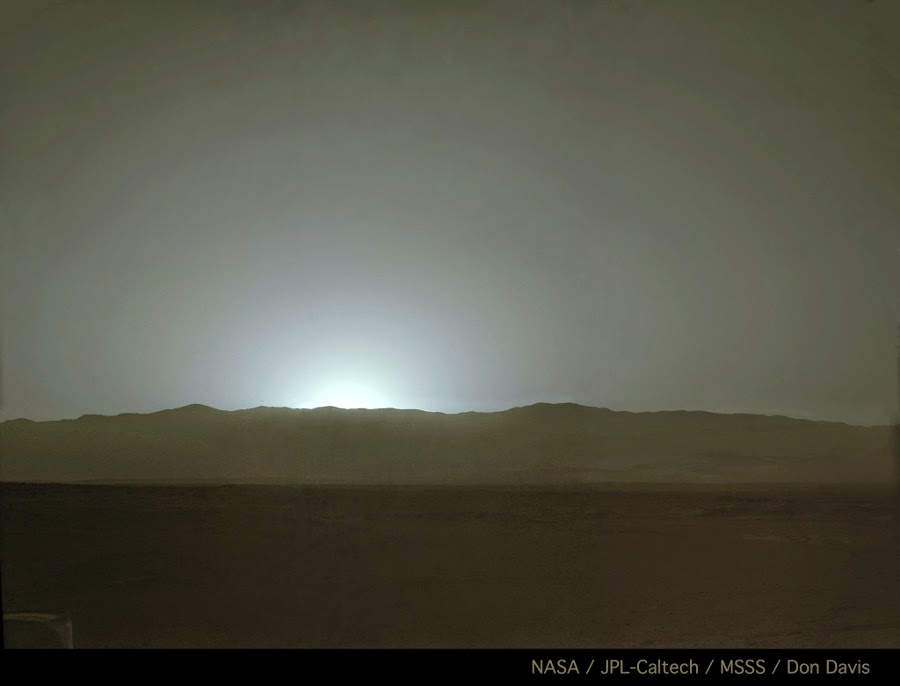
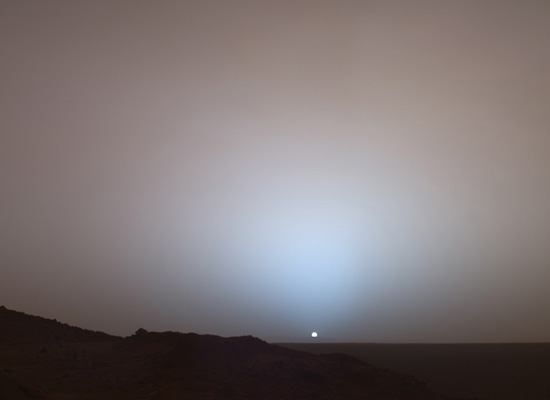
We ended last year with one of our favorite photos of the decade: an extraterrestrial sunset photographed in 2005 by the Mars Exploration Rover Spirit. We thought we'd end this year with another Martian sunset. This one was captured last month by Spirit's twin, Opportunity, in a series of photographs, which the rover science team combined and enhanced to create a seamless simulated descent. A bonus footage included in the embedded video above shows the moon Phobos passing in front of the sun. Watch it with music here.
Designing a Lunar Capital City
 Still need something to do this summer? How about revisiting some of your much cherished childhood (or yesterday's) dreamscapes of a fantastical lunar city and then propping it (or not) with a bit of scientific credibility for SHIFTboston's Moon Capital competition. When considering the moon destination, competitors are welcome to explore any concept, however, we recommend the submission address one of the following criteria: This might be just the perfect opportunity for you to team up with those civil engineering students on the other side of campus to help you better understand constructing on indigenous soil material. If you're thinking of designing a lunar food system, surely you would want to exploit the expertise of a lunar farmer. Are you wondering if the entire moon could be turned into a gigantic battery? No doubt our readers already know who to consult first. In any case, it's probably no different from designing for extreme environments here on earth, or a second Phoenix in a much harsher desert. Perhaps it's better to conceptualize your city as a company mining town, after all an independent moon would be more likely be supported by an exo-natural resource-based economy than tourism or scientific research, right? Submission deadline is September 3, 2010.
Solar Garden
 If we were multibillionaires, we would thumb our noses at yachts, the ubiquitous Picasso and Old Master, a seat on the board of The Met, invitations to mingle with the Veuve Clique at Davos, and yes, even at orphanages. We would devote all our money and time instead into buying a disused subterranean neutrino observatory and retrofitting it into a kind of 3D IMAX theater. Filling this vast negative would be a technicolorized 3D projection of our sun in (near) real-time, languorously spinning, soundtracked, prominences and coronal loops efflorescing. No cumbersome glasses needed. Naturally, we'd then dig a tunnel, at the end of which we'll hollow out a second antechamber for a different star. And then yet another access tunnel to another solar aviary. Because our vast fortune would have definitely caused us to go unhinged, we'd keep on excavating more naves, naves within naves within even larger naves, naves filigreed with vestibules and internal buttresses, all terminating in abysses of spherical bosquets sprouting rhizomatic subways bulbous with Lequeus and Boullées. Why buy an island in Dubai when we could have an interior constellation of flaming islands, a lithospheric Versailles braceleted with burning fountains of many brightnesses.
Meteoric Space Dust Particles Colliding With the Earth's Ionosphere
 Above is the spectrogram to this richly textured five-minute sound file of space dust particles hitting Earth's ionosphere as they are received and recorded on Thomas Ashcraft's forward scatter radio array. We could probably listen to it over and over, replace our CADing music with an extended version lasting hours. All night long eavesdropping on the earth infinitesimally accruing new terrain expelled by extraterrestrial landscapes. It's like Haydn's The Creation re-composed by Ligeti. Is Eyjafjallajökull producing similarly marvelous soundscapes?
Older Posts ——
Home
|
|
|