Pruned —
On landscape architecture and related fields —
Archives —
Future Plural —
@pruned —
Offshoots —
#Chicagos —
@altchicagoparks —
@southworkspark —
|
|
||

|
||
|
REPOST: Deep Space Public Lighting, Chilean Copper-Gold Mines, Rare Earths Geopolitics, and iPhones as Portable Artificial Suns

[First posted November 4, 2010. In the latest mining disaster in China, about 50 miners are said to be trapped in a 760-metre-deep shaft.]
 For the past few months, I-Weather.org, developed by Philippe Rahm and fabric | ch, has been churning up a pastel maelstrom here on this blog for use by our spatially and temporally displaced readers to restore their circadian rhythms, whether this is actually possible or not. You, too, can embed this artificial sun on your website to blast your asynchronous readers into metabolic normality. Its open source code is freely available. At the recent 01SJ Biennial in San Jose, California, we saw a less earthbound and less private platform for this quasi-light therapy: a flickering light tower for “confined and conditioned environments of space exploration vehicles” and “speculative public spaces of distant colonies.” To distribute and synchronize these pockets of simulant terrestrial cycles of day and night across vast distances, fabrica | ch proposes using a theoretical Deep Space Internet.   By coincide, we first learned about this project just as the first reports about the trapped miners in Chile started trickling in to our attention, specifically, the news that NASA scientists have been flown in by the Chilean government to offer advice on how to help the men stay physically and mentally healthy during the weeks-long rescue.  Al Holland, a NASA psychologist, says during a press conference: One of the things that's being recommended is that there be one place, a community area, which is always lighted. And then you have a second area which is always dark for sleep, and then you have a third area which is work, doing the mining, and the shifts can migrate through these geographic locations within the mine and, in that way, regulate the daylight cycle of the shift. It occurred to us that one should make a portable version of Deep Space Public Lighting for future mining disasters. It should be able to fit through bore holes and then easily assembled by survivors in the murky depths of a collapsed tunnel. A deployable piazza for subterranean “distant colonies.”  Rather than being illuminated by the anemic brightness of a hard hat or video camera, one bathes in soothing electromagnetic wavelengths from a technicolor torch. Or from an i-weatherized iPhone.  And yes, considering the high demand for coal and industrial minerals, there will be many more mining disasters, many more trapped miners and, depending on various fortunate circumstances, more tunnels to be reconfigured. In fact, only a few days after the last Chilean miner was brought to the surface, 11 miners were trapped at a coal mine in China after a deadly explosion. Consider, too, the recent export ban by China on shipment of rare earth elements to Japan after a kerfuffle between the two countries involving a collision between a Chinese fishing trawler and Japanese Coast Guard patrol boats near some disputed islands. The ban may have been brief, and China may have denied having instituted one in the first place, nevertheless, the incident points again that China is willing to use its near resource monopoly of rare earth metals as a political tool, to get its way, in other words. Other countries have again taken notice, and are scrambling to develop alternative sources, if not already, to ensure future supply. With new mines opening and even old mine operations being restarted, there are more potentials for disasters. Reformatted in this context, Deep (Inner) Space Public Lighting engages not just with issues such as “public space, public data, public technology and artificial climate” but also with the geopolitics of natural resources, globalization and our collective networked boredom that seemingly can only be satiated by an epic spectacle of natural and man-made disasters and the ensuing heroic rescue of survivors.
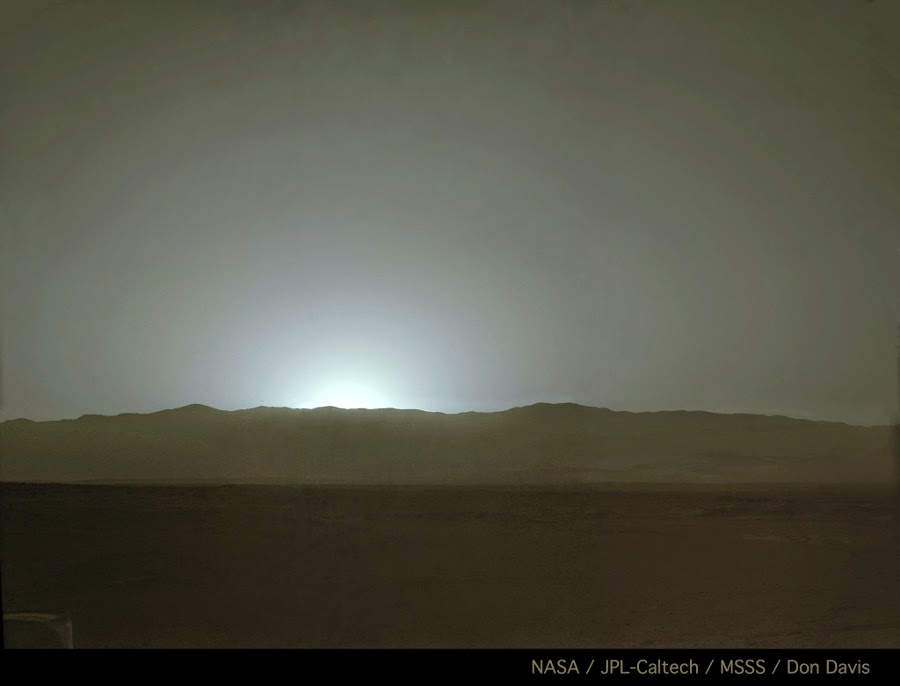
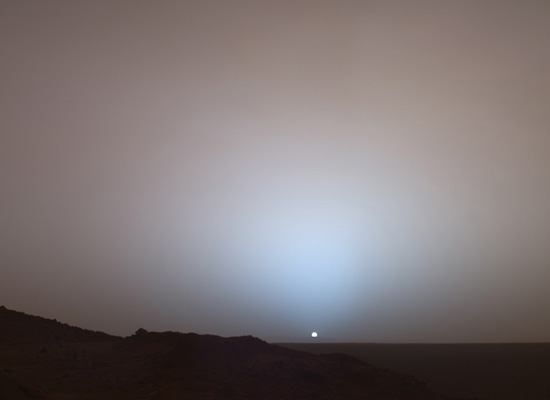
Blue Sunset
We ended last year with one of our favorite photos of the decade: an extraterrestrial sunset photographed in 2005 by the Mars Exploration Rover Spirit. We thought we'd end this year with another Martian sunset. This one was captured last month by Spirit's twin, Opportunity, in a series of photographs, which the rover science team combined and enhanced to create a seamless simulated descent. A bonus footage included in the embedded video above shows the moon Phobos passing in front of the sun. Watch it with music here.
Deep Space Public Lighting, Chilean Copper-Gold Mines, Rare Earths Geopolitics, and iPhones as Portable Artificial Suns
For the past few months, I-Weather.org, developed by Philippe Rahm and fabric | ch, has been churning up a pastel maelstrom here on this blog for use by our spatially and temporally displaced readers to restore their circadian rhythms, whether this is actually possible or not. You, too, can embed this artificial sun on your website to blast your asynchronous readers into metabolic normality. Its open source code is freely available. At the recent 01SJ Biennial in San Jose, California, we saw a less earthbound and less private platform for this quasi-light therapy: a flickering light tower for “confined and conditioned environments of space exploration vehicles” and “speculative public spaces of distant colonies.” To distribute and synchronize these pockets of simulant terrestrial cycles of day and night across vast distances, fabrica | ch proposes using a theoretical Deep Space Internet. By coincide, we first learned about this project just as the first reports about the trapped miners in Chile started trickling in to our attention, specifically, the news that NASA scientists have been flown in by the Chilean government to offer advice on how to help the men stay physically and mentally healthy during the weeks-long rescue. Al Holland, a NASA psychologist, says during a press conference: One of the things that's being recommended is that there be one place, a community area, which is always lighted. And then you have a second area which is always dark for sleep, and then you have a third area which is work, doing the mining, and the shifts can migrate through these geographic locations within the mine and, in that way, regulate the daylight cycle of the shift. It occurred to us that one should make a portable version of Deep Space Public Lighting for future mining disasters. It should be able to fit through bore holes and then easily assembled by survivors in the murky depths of a collapsed tunnel. A deployable piazza for subterranean “distant colonies.” Rather than being illuminated by the anemic brightness of a hard hat or video camera, one bathes in soothing electromagnetic wavelengths from a technicolor torch. Or from an i-weatherized iPhone. And yes, considering the high demand for coal and industrial minerals, there will be many more mining disasters, many more trapped miners and, depending on various fortunate circumstances, more tunnels to be reconfigured. In fact, only a few days after the last Chilean miner was brought to the surface, 11 miners were trapped at a coal mine in China after a deadly explosion. Consider, too, the recent export ban by China on shipment of rare earth elements to Japan after a kerfuffle between the two countries involving a collision between a Chinese fishing trawler and Japanese Coast Guard patrol boats near some disputed islands. The ban may have been brief, and China may have denied having instituted one in the first place, nevertheless, the incident points again that China is willing to use its near resource monopoly of rare earth metals as a political tool, to get its way, in other words. Other countries have again taken notice, and are scrambling to develop alternative sources, if not already, to ensure future supply. With new mines opening and even old mine operations being restarted, there are more potentials for disasters. Reformatted in this context, Deep (Inner) Space Public Lighting engages not just with issues such as “public space, public data, public technology and artificial climate” but also with the geopolitics of natural resources, globalization and our collective networked boredom that seemingly can only be satiated by an epic spectacle of natural and man-made disasters and the ensuing heroic rescue of survivors.
Personal Artificial Sun
 When we set out to upgrade our Blogger Classic Template to Blogger Layouts (or is it Blogger Design?), we planned on streamlining the layout down to just one column. But then we accidentally stumbled upon an embeddable personal artificial sun. We were instantly smitten, and knew we had to incorporate it into the new design, single column be damned. Courtesy of Philippe Rahm and fabric | ch, this sun Accessible everywhere and to everybody thanks to the Internet, this artificial climate called i-weather makes it possible to live in a situation completely removed from natural locations by producing an artificial circadian rhythm synchronised to match the inner cycle of the human hormonal and endocrine system. In the absence of the natural terrestrial cycle of day and night, it becomes apparent that this inner cycle in fact lasts around 25 hours, and that body temperature, the alternation between sleep and wakefulness, and the accumulation and secretion of substances such as cortisone and oligopeptides, all depend on it. Hopefully, then, if you stare for a while at our twinkling blog, any temporal and spatial displacement resulting from marathon coding or CADing sessions might be mitigated. Of course, you could also hack a TV to blast your room with a pastel maelstrom. At airports all over the world, there could also be coin-operated Artificial Weather Rooms for One in which the eternally jet lagged stabilize themselves with a refreshing technicolor shower. Should such enclosures be considered a security threat, perhaps an iPhone reconfigured as a portable weather machine might be enough to spatially and temporally normalize yourself. POSTSCRIPT #1: New layout and new look implemented today. Tropicalia Deep Space Public Lighting, Chilean Coper-Gold Mines, Rare Earths Geopolitics, and iPhones as Portable Artificial Suns
The Second Sun
 A team led by Alex Lehnerer from the University of Illinois at Chicago won first prize in Mine the Gap, the ideas competition which asked entrants for ideas on how to adaptively reuse the hole excavated for the foundation of Santiago Calatrava's Chicago Spire. The winning entry, titled The Second Sun, envisions the hole as a home base for a yellow hot air balloon. As a whimsical twin to the ferris wheel (or the AeroBalloon) across the way in Navy Pier, it would be a fantastic addition to the Chicago skyline, whose sharp lines and pallid complexion would be awesomely contrasted by its voluptuous curves and cheery brightness. Watching it slowly bobbing up and down amid a static forest of glass and concrete would certainly be a marvelous sight, perhaps not unlike Alexander Calder's red Flamingo in its Miesian aviary.  Attached to this bubble monument to the bubble era is a disc-shaped swimming pool. While frolicking about in the water, you can enjoy the panoramic lakefront views from the ghost condominiums of a ghost skyscraper, the promise of those enchanting marketing brochures at last fulfilled. (We can't fully make out what's printed on the bottom of the pool — nor can we read the text, so we'll just fantasize that it's an actual floor plan.) Surrounding the hole is an artificial beach where you can soak in the sunlight from the real sun or the reflected rays from a latex sun. The beach actually extends beyond the project site, going under bridge and into the adjacent and still undeveloped DuSable Park, where a circular soccer pitch is added.
Solar Garden
 If we were multibillionaires, we would thumb our noses at yachts, the ubiquitous Picasso and Old Master, a seat on the board of The Met, invitations to mingle with the Veuve Clique at Davos, and yes, even at orphanages. We would devote all our money and time instead into buying a disused subterranean neutrino observatory and retrofitting it into a kind of 3D IMAX theater. Filling this vast negative would be a technicolorized 3D projection of our sun in (near) real-time, languorously spinning, soundtracked, prominences and coronal loops efflorescing. No cumbersome glasses needed. Naturally, we'd then dig a tunnel, at the end of which we'll hollow out a second antechamber for a different star. And then yet another access tunnel to another solar aviary. Because our vast fortune would have definitely caused us to go unhinged, we'd keep on excavating more naves, naves within naves within even larger naves, naves filigreed with vestibules and internal buttresses, all terminating in abysses of spherical bosquets sprouting rhizomatic subways bulbous with Lequeus and Boullées. Why buy an island in Dubai when we could have an interior constellation of flaming islands, a lithospheric Versailles braceleted with burning fountains of many brightnesses.
Aurora Bibliothèque
 “For reasons not fully understood by scientists,” NASA tells us, “the weeks around the vernal equinox are prone to Northern Lights.” This is a bit of a puzzle. Auroras are caused by solar activity, but the sun doesn’t know what season it is on Earth. So how could one season yield more auroras than another? To better understand auroras, NASA sent five satellites, collectively called THEMIS, or Time History of Events and Macroscale Interactions during Substorms. During the mission's first year of operations, the satellites have “observed one geomagnetic storm with a total energy of five hundred thousand billion (5 x 10^14) Joules,” which is “approximately equivalent to the energy of a magnitude 5.5 earthquake.” And then there are those so-called magnetic ropes, which are magnetic fields that are “organized much like the twisted hemp of a mariner’s rope connecting Earth's upper atmosphere directly to the sun. Solar wind particles flow along the ropes in whirligig trajectories leading from the sun to Earth.” To repeat: Solar wind particles flow along the ropes in whirligig trajectories leading from the sun to Earth.  Having recently been alerted by BLDGBLOG to these proposals for the George W. Bush Presidential Library — speculative architecture via air mail; manifestos for $0.41 — we can't help but wonder: Can you build a library out of auroras? Can these shimmering ribbons of earthly solarity be turned into a repository of knowledge? Using a translation matrix yet to be programmed and actuators yet to be invented, you could digitize, say, the entire content of BLDGBLOG into charged electrons and protons, which you would thereafter eject from a fleet of satellites orbiting between the earth and the sun. These particles would then hitch a ride on solar winds, eventually colliding with artificially produced charged particles floating in a finely reconfigured magnetosphere. Writing in the sky with remnants of stars. Or you could use the satellites to weave and unravel those “magnetic ropes” to manipulate the flow of solar wind particles, as one would strum the strings of a cello to create certain photonic vibrations. Alternatively, instead of satellites, you could have a gigantic circular struts floating above the poles. Through millions of spray nozzles, charged particles will be exhaled, the amount and timing and direction being determined by a complex algorithm yet to be conceived.  When all things are working (or not working), the polar regions will be alight with the transliterated works of Mr. Manaugh. The whole landscapes singing Homeric tales of undiscovered subterranean rooms, lunar urbanism, buttressed buttresses and magmatic Baroque churches. The still waters of the Icelandic fjords and the hushed glacial fields of Alaska filled with the geomagnetic crackling of encoded artificial islands and algal farms. However, in order to listen to them — i.e., to read them — patrons would need to use sensors yet to be developed located in spaces yet to be spatialized.  A couple of things: 1) Going back to the original question, should that now ask: can you make auroras out of libraries? 2) Not in a million years did we think that we would ever reference Babylon 5 and Diller+Scofidio in a single sentence in this landscape architecture blog, but our description above reminded us of the Shadow Planet Killer and the Blur Building.  Could Dani Karavan's Negev Desert observatory serve as a model for the library's access terminals?  “But shouldn't libraries be universally accessible?” you might object. “Not everyone can afford the trip. A few can't even stand the cold.” Very well then. Forget BLDGBLOG — sorry, G! — this will be the new wing of the Vatican Secret Archives, open only to scholars with academic credentials and well-funded fellowships. In fact, forget our north pole, let's make them even more inaccessible and file them on other planets. Heretical gospels howling by Jupiter's magnetic fields.  For more photos of auroras, check out this Flickr pool. Goodbye, Alaska! Vapour City
What if Africa was Europe's power plant?
 Last week, The Guardian reported that Europe is looking to Africa to serve part of its energy needs by basically turning the continent into one giant solar power plant. Europe is considering plans to spend more than £5bn on a string of giant solar power stations along the Mediterranean desert shores of northern Africa and the Middle East. Of course, one is compelled to wonder here what would happen if Africa provided Europe with all of its electricity? Most likely that won't happen; no European country would want to subject their whole energy security to regional volatility. However, one could imagine a fairly optimistic scenario wherein this energy cooperation would provide a stabilizing force to unstable states, help cure both continents' post-colonial hangover, counteract China's growing geopolitical influence in the region — and all the while reducing carbon emissions to zero.  But, as always, what we are immediately most interested in is this: in what ways would this energy pact be physically manifested in Africa? As but one illustration of how energy consumption is spatialized, there is the so-called mountaintop mining, whereby whole mountains are leveled off, literally grounded down, to get at coal deposits instead of using tunnels. The erased geology would then be dumped nearby, chocking streams and old growth forests. In one of the best (and certainly longest) articles on the subject that we have ever come across, Eric Reece, in Harpers Magazine, writes: Where once there were jagged forested ridgelines, now there is only a series of plateaus, staggered grey shelves where grass struggles to grow in crushed rock and shale. When visitors to eastern Kentucky first see the effects of this kind of mining, they often say the landscape looks like the Southwest - a harsh tableland interrupted by steep mesas. In other words, heating up your ex-urbian McMansion is right now turning Appalachia into Arizona and New Mexico.  One can easily picture Julie Bargmann and her D.I.R.T. Studio, like ambulance chasers circling a scene of devastation, salivating over photos of negative mountains, scheming away at plans to reclaim them from destruction, waiting for that commission. Unless, of course, Alan Berger and his Project for Reclamation Excellence (P-REX) don't beat them to the job. But returning back to our question: what will Google Earth tourists see when they point their vigilant eyes towards an electrified North Africa? Will they come upon vast plantations of coronal fields, perfect geometries arrayed in similarly perfect arrangement, irrespective of terrain but nevertheless finely attuned to the sky? Pure form, pure function coexisting without contradiction. And what about the people on the ground? Where once was desert, might they now enjoy newly sprouted oases fed with water from solar-powered desalination plants? An Emerald Necklace of Olmstedian design inscribed in the Saharan landscape.  Will foreigners descend en mass to undertake a Bowlesian journey, trekking from one incomprehensible terrain to another equally unfathomable recess of the desert, utterly unprepared for the otherness of it all but obviously so seduced that they travel on, even while in the grips of dysentery, losing themselves psychologically and literally to the sands? All bearings and comfort are lost.  And then just as things couldn't get any stranger, they will come upon a stand of solar updraft towers; there are hundreds of them, possibly thousands, forming a kind of arid rainforest mechanically evapotranspirating. But in their parched and hallucinatory conditions these adventurers will mistake them for Persian tower tombs, divining the surrounding air into a vortex, the whirring blades resonating ghostly howls.
Attack of the Parabolic Façade?
 We return again to the surface of the sun, whose radiant energy has been parabolically concentrated onto a patch of turf somewhere in California. From what we can gather, the photo above blazed through a sizeable portion of the interweb last month. And in all the blogs and forums where it was posted, there was one common point of departure for all of the discussions: that the photo depicts the constant and often catastrophic confrontation between Landscape and Architecture, with the former clearly loosing to its “foe.” Obviously, we will digress. The overriding narrative here isn't “architecture gone wrong” or “landscaping gone wrong”, and it's definitely not “building architecture vs. landscape architecture”. And certainly no one is reenacting psychotically disturbed periods of their childhood, involving ants and a magnifying glass. No one, too, is attempting to infuse in the workplace a sense of domesticity, collegiality, community and patriotism by infrastructurally facilitating American-style barbecue picnics. In actuality, both architect and landscape architect are paying homage to Ancien Régime garden design. Specifically, with their purposefully programmed failures — Landscape as a water-guzzling lawn in hydrologically-challenged California; Architecture positioned in a gas-guzzling solar orientation — the two have conspired to create dazzling arabesque parterres. Blackened curlicues. Charcoaled guillochés. The nearly dead and the really dead resolving into patterns of rosettes and sunbursts. Grassless geometries, muddied or parched and cracking. The Tuileries gardens etched in full scale by Apollo.  Of course, we cannot really talk about parabolic façades without briefly mentioning The Temple at the University of Illinois Urbana/Champaign. Housed inside this campus building are the various studios, faculty offices and main offices of the Departments of Architecture, Landscape Architecture and Urban Planning. And for three excruciating and glorious years, it was our de facto home.   Of interest here is its west side. Although not that apparent in the photos above, in person, it's noticeably parabolic. And not only is it curved, but it's curved to a more southwestern orientation. In other words, during the steamy Midwestern summer months, that part of the building—a whole side made entirely of glass—faces the sun during the hottest part of the day. Call it a greenhouse with AC, and we won't object. Meanwhile, we're not sure if “sustainability” had made its way into department curricula when it was built over ten years ago, but now that it has, the building must now seem to the faculty as the worst building to teach “green practices” in. Or maybe it is, since here is a perfect example to use to illustrate solar orientation and climate design, key concepts in old school regionalism, which if properly considered and taken advantage of, you can probably save a lot on heating and coolings bills before you even think about wind turbines and green roofs.
Tropicalia
 Considering that 1) public squares in northern climes generally turn lifeless during winter; 2) people become even deader once seasonal depression leads to suicides; and 3) landscape architects et al. are always looking for ways to improve the livability of urban landscapes — Perpetual (Tropical) SUNSHINE is thus worth investigating.  “This space is out of sync both temporally and climactically. A spatial screen, composed of 300 infrared light bulbs, transposes the state and image of a summer sun on the 23rd South parallel, thanks to live information transmitted by a network of weather stations all the Tropic of Capricorn and around the globe. “Thus, the spectator can constantly track the path of the sun, thereby experiencing an abstract and never-ending, planetary form of day and of summer, across longitudes and time zones.”    Next up: Millennium Park's LED-tiledCrown Fountain gets retrofitted into blazing Prozac towers by CDC-licenced landscape architects. Let there be light! The “45.5 Meteorite Craters Made by Humans on Their 45.5 Hundred Million Year Old Planet” Fountain
Older Posts ——
Home
|
|
|