A meme self-organized itself in my bookmarks recently, clustering together internet detritus around the subject of city lights.
Included is a satellite image, published on NASA's Earth Observatory, of North America and its constellations of urban brightnesses at night. It's a classic image that most have probably seen before in many iterations, but this particular one received more than the usual attention because of the large, luminous smudge in North Dakota. Sprawled out over an area equal to, if not larger than, Chicago's but over one of the least-densely populated parts of the country, it's the “home to the Bakken shale formation, a site where gas and oil production are booming.” While some, including me, have mistakenly thought the lights were all due to gas flaring, only “a few are evidence of gas flaring.” In fact, most are “associated with drilling equipment and temporary housing near drilling sites.”
There's also the image of New York in complete darkness save for the Milky Way in all its possible brilliance in the night sky. Several other cities are also rendered as their parallel world selves aglow with galactic light. Though Chicago isn't among them, images of the city's grid at night — the greatest built landscape in the world, in my opinion, second only to the Public Land Survey System and Central Park, and maybe Greater Los Angeles and Florida, but it's up there — pop in now and then in my Tumblr dashboard, most recently this amazing photo by Jim Richardson, part of a series that also includes this more panoramic view of the city irradiating some passing clouds. In other words, the Milky Way may be blotted out, but you can still go to the top of Sears Tower and watch the Andromeda Galaxy spread outover the prairie, half-swirling around the gravity well of the supercloverleaf in the West Loop, flinging motorists into and out of the city.
Before I come around to the photos decorating this post, I want to point out the photos taken from the International Space Station by its current commander, Canadian astronaut Chris Hadfield (@Cmdr_Hadfield), who I recently started following on Twitter. Many of his orbital snaps got snagged by the meme, among them are of Kolkotta (“at night, definitely not the 'Black Hole of Calcutta' of legend”); Lisbon (“at night - black water, intricate spiderweb of surrounding towns”); Pyongyang; and Tehran with its “bright blue oval” bracelet.
Though he hasn't tweeted a photo of it yet, the residents of Hadfield's hometown of Sarnia in Ontario, lit up their city last Friday night, sprucing themselves up in a coordinated effort for their remote portrait, as it were. Light pollution has never been so tinge with romanticism and nostalgia: earthbound creatures sending out beacons out to spacefarers plying through “orbital darkness,” reminding them of home.
As opposite to the photo-poetics of Hadfield and Sarnia as one can possibly get, BBC News reported last week the “rise in the number of incidents in which handheld lasers are being used to distract airline pilots flying over London.” The statistics are quite astonishing: “in 2010 there were 145 reported incidents. In 2012 the number rose to 252.” Enraging astronomers, turning urban wildlife into insomniacs and aggravating the nature deficit syndrome of other city dwellers are one thing, but this part of the photonic smog spectrum causing airplane crashes is horrifyingly another.
To add to this meme, then, are these images of moonlight towers in Austin, Texas, photographed by Andy Mattern “at their most visible moment just after they turn on at dusk.” Quoting the project statement:
In 1895, the City of Austin acquired a novel street-lighting system from Detroit consisting of thirty-one 165-foot tower lights. Their cool glow and looming height earned them the popular moniker “Moonlight Towers.” In the 1930s, however, the towers were all but obsolete due to the advent of newer, brighter street lamps that were closer to the ground. Over the years for a variety of reasons including public safety and urban growth, more than half of the original towers have been removed.
Indeed, to also quote our go-to reference:
The structures were popular in the late 19th century in cities across the United States and Europe; they were most common in the 1880s-1890s. In some places they were used when standard street-lighting systems — using smaller, shorter, and more numerous lamps — were impractically expensive. Other times they were used in addition to existing gas street lighting. The towers were designed to illuminate areas often of several blocks at once. Arc lamps were the most common method of illumination, known for their exceptionally bright and harsh light.
Of the cities that once used to operate such a street-lighting system, Austin is “the only city in the world known to still” do so.
Since this is winter, the chronic period of Seasonal Affective Disorder (SAD), I am reminded of, firstly, the Austrian town of Rattenberg and its unrealized plans to install heliostats that would have redirected sunlight to “a dozen 'hotspots' — areas not much bigger than a front yard scattered through the town, where people can gather and soak up rays.” Even more awesome, these Sunlight Towers also would have shone light “onto building facades to show daylight slowly turning to dusk.” In other words, buildings in the mountain's shadows are turned into public cinemas playing artificial weather spectacles everyday. (Except on cloudy days.)
Secondly, I'm reminded of Perpetual (Topical) SUNSHINE, a public installation by fabric | ch. A screen composed of 300 infrared light bulbs, this Tropical Tower allows winter sun bathers to soak in “an abstract and never-ending, planetary form of day and of summer, across longitudes and time zones.” You might be “out of sync both temporally and climactically” from the rest of the city, but perhaps this asynchronous urban space will light blast your mental health back into some semblance of normality.
Picking up the possible psychiatric benefits of these light towers, Moonlight Towers could be reinstalled in sun-deprived northern cities, turning downtown plazas, city parks, and the everyday sidewalks and alleyways into solar sanitariums for the depressives, the moody and the bipolars. Usually dead spaces in the winter, they'll teem with people in search of light therapy. In other words, Prozac Plazas. Not a deterrence against thieves and rapists but against fatal mood swings.
You won't be able to see the stars at night, but at least you're not going to kill yourself.
Last month, I tweeted four psychological syndromes named after cities, and I think it's worth briefly mentioning them here, with the links for further investigation.
1)Paris Syndrome: wherein mainly Japanese tourists experience severe culture shock.
2)Jerusalem Syndrome: wherein tourists become religious zealots to the point of acting like ancient prophets.
3)Florence Syndrome (aka Stendhal's): wherein tourists become overwhelmed by art.
I've asked then, and I'll ask again: what other mental disorders are named after cities, particularly ones that are induced by a specific city? Peer reviewed, urban legends, literary, etc.
Could there be such a thing as a Berlin Syndrome, wherein you attach abnormal levels of affections to a barrier wall or a security fence? Could there be an epidemic of this, of which Banksy is Patient Zero, in the West Bank? How might a New York City Syndrome manifest itself? Chicago Syndrome?
In any case, I'd love to see a department of speculative urban syndromes at the Center for Disease Control, tucked away in the basement, crowded with filing cabinets and a poster, manned by two agents, one convinced of the growing aberrant psychosomatic effects of cities on a now mostly urban global population, the other a skeptic; you know them already, I think.
For reasons I haven't investigated yet, goats seem to be popular pharm animals. At the University of California at Davis, researchers have genetically modified a herd of goats to produce milk that could greatly enhance one's ability to fight off diarrhea-causing bacteria. At Texas A&M University, meanwhile, researchers are planning to turn goats into malaria vaccine factories. So while some are being corralled as eco-mowers-cum-performance artists into the feral voids of post-econopocalypse cities, these super-goats might someday be saving sick kids.
Perhaps the most famous are the BioSteel™ Goats, which were augmented with spider genes to produce milk containing silk protein. When processed, this “silk milk” is transformed into microfibers for use in making bullet-proof vests and medical sutures. When the company that created these goats went bankrupt, some were sent off “far away from people” to the old Plattsburgh Air Force Base in Plattsburgh, NY. There, they were housed in possibly the most restricted part of the base: inside a Cold War-era bunker that used to contain a sizable arsenal of nuclear bombs.
A couple ended up at the Canada Agriculture Museum. The status of the other goats appears to be unknown. And therein lies my recurrent spatial fantasies about transgenic goats.
Once their usefulness as test subjects has depleted — or their owners go bankrupt, the animals are redacted from the record and then sent to pastoral meadows. No sign anywhere on the property gives any hint as to their genetic peculiarities. There are no electric fences, no surveillance monitors, and no sirens for use when these quarantined transgenic storms escape and wreak havoc on the surrounding chromosomal landscape. Even the agents from the Department of Agriculture assigned to look after the herd are disguised as shepherds. So generically Arcadian are these pastures that genetic purists smelling for a pogrom will pass them by unaware. Sun-dappled they may be, but they're biogeographical dark spots under a perpetual total genomic eclipse.
[First posted November 4, 2010. In the latest mining disaster in China, about 50 miners are said to be trapped in a 760-metre-deep shaft.]
For the past few months, I-Weather.org, developed by Philippe Rahm and fabric | ch, has been churning up a pastel maelstrom here on this blog for use by our spatially and temporally displaced readers to restore their circadian rhythms, whether this is actually possible or not. You, too, can embed this artificial sun on your website to blast your asynchronous readers into metabolic normality. Its open source code is freely available.
At the recent 01SJ Biennial in San Jose, California, we saw a less earthbound and less private platform for this quasi-light therapy: a flickering light tower for “confined and conditioned environments of space exploration vehicles” and “speculative public spaces of distant colonies.”
To distribute and synchronize these pockets of simulant terrestrial cycles of day and night across vast distances, fabrica | ch proposes using a theoretical Deep Space Internet.
By coincide, we first learned about this project just as the first reports about the trapped miners in Chile started trickling in to our attention, specifically, the news that NASA scientists have been flown in by the Chilean government to offer advice on how to help the men stay physically and mentally healthy during the weeks-long rescue.
Al Holland, a NASA psychologist, says during a press conference:
One of the things that's being recommended is that there be one place, a community area, which is always lighted. And then you have a second area which is always dark for sleep, and then you have a third area which is work, doing the mining, and the shifts can migrate through these geographic locations within the mine and, in that way, regulate the daylight cycle of the shift.
It occurred to us that one should make a portable version of Deep Space Public Lighting for future mining disasters. It should be able to fit through bore holes and then easily assembled by survivors in the murky depths of a collapsed tunnel.
A deployable piazza for subterranean “distant colonies.”
Rather than being illuminated by the anemic brightness of a hard hat or video camera, one bathes in soothing electromagnetic wavelengths from a technicolor torch.
And yes, considering the high demand for coal and industrial minerals, there will be many more mining disasters, many more trapped miners and, depending on various fortunate circumstances, more tunnels to be reconfigured. In fact, only a few days after the last Chilean miner was brought to the surface, 11 miners were trapped at a coal mine in China after a deadly explosion.
Consider, too, the recent export ban by China on shipment of rare earth elements to Japan after a kerfuffle between the two countries involving a collision between a Chinese fishing trawler and Japanese Coast Guard patrol boats near some disputed islands. The ban may have been brief, and China may have denied having instituted one in the first place, nevertheless, the incident points again that China is willing to use its near resource monopoly of rare earth metals as a political tool, to get its way, in other words. Other countries have again taken notice, and are scrambling to develop alternative sources, if not already, to ensure future supply. With new mines opening and even old mine operations being restarted, there are more potentials for disasters.
Reformatted in this context, Deep (Inner) Space Public Lighting engages not just with issues such as “public space, public data, public technology and artificial climate” but also with the geopolitics of natural resources, globalization and our collective networked boredom that seemingly can only be satiated by an epic spectacle of natural and man-made disasters and the ensuing heroic rescue of survivors.
Mrs. Blumenthal, 55, of Florida, has been driving around the city for hours now. Since landing at O'Hare, she's taken in the fleeting sights of the northern and western neighborhoods. This afternoon, she'll barrel along the inexorable super-linearity of Western Avenue all the way down to the city limit before making a U-turn and returning to her hotel for the night. Tomorrow and for the rest of the week, she'll make the same perambulations.
Meanwhile, at a cavernous control room in one of the buildings at the Illinois Medical Super-Complex, doctors and technicians have been monitoring her driving through a mesh network of surveillance cameras scoping for the early tell-tale signs of a neurodegenerative disease. Every micro murmuration, every nano-flux, every subtle correction in her navigation is being recorded. Every speed, every acceleration, every direction — indeed her every reaction to this city turned diagnostic tool will be plotted. Then her medical tour of Chicago will be data mined.
At the end of the week, she'll be given her diagnoses report, although her consultation with the doctors will be a little hurried, as the FBI will be taking over the network for their annual probe for pederastic and terrorist behaviors.
For the past few months, I-Weather.org, developed by Philippe Rahm and fabric | ch, has been churning up a pastel maelstrom here on this blog for use by our spatially and temporally displaced readers to restore their circadian rhythms, whether this is actually possible or not. You, too, can embed this artificial sun on your website to blast your asynchronous readers into metabolic normality. Its open source code is freely available.
At the recent 01SJ Biennial in San Jose, California, we saw a less earthbound and less private platform for this quasi-light therapy: a flickering light tower for “confined and conditioned environments of space exploration vehicles” and “speculative public spaces of distant colonies.”
To distribute and synchronize these pockets of simulant terrestrial cycles of day and night across vast distances, fabrica | ch proposes using a theoretical Deep Space Internet.
By coincide, we first learned about this project just as the first reports about the trapped miners in Chile started trickling in to our attention, specifically, the news that NASA scientists have been flown in by the Chilean government to offer advice on how to help the men stay physically and mentally healthy during the weeks-long rescue.
Al Holland, a NASA psychologist, says during a press conference:
One of the things that's being recommended is that there be one place, a community area, which is always lighted. And then you have a second area which is always dark for sleep, and then you have a third area which is work, doing the mining, and the shifts can migrate through these geographic locations within the mine and, in that way, regulate the daylight cycle of the shift.
It occurred to us that one should make a portable version of Deep Space Public Lighting for future mining disasters. It should be able to fit through bore holes and then easily assembled by survivors in the murky depths of a collapsed tunnel.
A deployable piazza for subterranean “distant colonies.”
Rather than being illuminated by the anemic brightness of a hard hat or video camera, one bathes in soothing electromagnetic wavelengths from a technicolor torch.
And yes, considering the high demand for coal and industrial minerals, there will be many more mining disasters, many more trapped miners and, depending on various fortunate circumstances, more tunnels to be reconfigured. In fact, only a few days after the last Chilean miner was brought to the surface, 11 miners were trapped at a coal mine in China after a deadly explosion.
Consider, too, the recent export ban by China on shipment of rare earth elements to Japan after a kerfuffle between the two countries involving a collision between a Chinese fishing trawler and Japanese Coast Guard patrol boats near some disputed islands. The ban may have been brief, and China may have denied having instituted one in the first place, nevertheless, the incident points again that China is willing to use its near resource monopoly of rare earth metals as a political tool, to get its way, in other words. Other countries have again taken notice, and are scrambling to develop alternative sources, if not already, to ensure future supply. With new mines opening and even old mine operations being restarted, there are more potentials for disasters.
Reformatted in this context, Deep (Inner) Space Public Lighting engages not just with issues such as “public space, public data, public technology and artificial climate” but also with the geopolitics of natural resources, globalization and our collective networked boredom that seemingly can only be satiated by an epic spectacle of natural and man-made disasters and the ensuing heroic rescue of survivors.
Beneath the city is the world's largest and most powerful particle accelerator, interlocking or in tangents with the next dozen on the list of the highest-energy accelerators.
Everyday they collide particles to produce a steady supply of Higgs bosons, which are stabilized, concentrated and routed as a beam to one of the many gantries located throughout the city. Able to rotate 360º, each three-story gantry can shoot the subatomic particle beam in the correct angle at the cancer patient lying inside its treatment chamber. Precisely calibrated, the Higgs bosons decay the moment they hit the tumor, and in the process of decaying or escaping into other dimensions, they degrade the mutant cells.
This super-machine, then, is one giant medical device, the most expensive in the history of medicine. A second under its therapeutic beam can bankrupt a small nation. In the aftermath of the repeal of health care reform acts, treatment regimes have leapfrogged into mindboggling territory.
Practically everyone in the metropolitan area is employed to support these machines, either as administrators, research scientists, the army of engineers who maintain and repair the thousands of complex parts strewn throughout the city, the security staff who police the miles of tunnels and profile saboteurs, or the cooks who feed them all.
The infrastructure to generate their massive energy requirements might as well be another city, complete with its own support staff.
An urban legend most likely but it is often said that so powerful and so many are the magnets used in the machines that Chicago is slightly out of phased with the space-time continuum of the rest of the country.
What isn't an urban legend though are the rocks levitating in some neighborhoods.
What you're seeing in these photographs isn't an underground refugee camp for people escaping from some surface fracas nor is it a commune for those made homeless by the Great Foreclosure. These people are not card carrying members of the Freegan Establishment nor are they the many-times great-grandparents of a future race of mole people. While the reason for them slumbering amid an ambient symphony of fluorescent flickers is medical in nature, they are not volunteers in a scientific experiment inspired by the research of MaurizioMontalbini, the Italian sociologist who lived in caves for long periods of time to study the effects of total isolation on the body's natural cycles.
Rather, these are people suffering from asthma or other respiratory diseases undergoing speleotherapy in a salt mine near the village of Solotvyno in Ukraine.
The photographs were taken by the London-based Russian artist Kirill Kuletski, and he writes of this underground clinic and alternative therapy:
This therapy was discovered in Poland in the 1950s when it was noticed that salt mine workers rarely suffered from tuberculosis. Scientists found that the salt-permeated air of the working salt mine helped to dissolve phlegm in the bronchial tubes and also killed the micro-organisms which caused infections — and that this greatly helped patients who were undertaking treatment for asthma.
The clinic at Solotvyno salt mine is unique because its tunnels, which are 300 metres below ground level and remain at a steady 22°C (72°F) all year round, are the deepest in the world to be used for such purposes. Around three to five thousand people are treated here every year and there is often a waiting list — in fact, at any one time up to 200 people, a third of whom are usually children, can be receiving therapy. Patients spend an average of 24 days at the facility, using a lift to travel underground for afternoon or overnight sessions. During this time they talk, read or sleep on beds, grouped together in alcoves which are carved out of the rock and lit by fluorescent tubes.
It's nice to hear of subterranean landscapes not in the context of nuclear and biological apocalypses or as the domiciles of the subhuman. Pure geology not as a devour of the self but as an antidote to the aberrant.
When we set out to upgrade our Blogger Classic Template to Blogger Layouts (or is it Blogger Design?), we planned on streamlining the layout down to just one column. But then we accidentally stumbled upon an embeddable personal artificial sun. We were instantly smitten, and knew we had to incorporate it into the new design, single column be damned.
Courtesy of Philippe Rahm and fabric | ch, this sun now flickering above is simply the background color mutating through a 25-hour cycle of bright hues, from warm oranges to fresh greens and cool blues, then back again. These retinal oscillations are an attempt at creating an artificial climate, one which satisfies “the metabolic and physiological requirements of a human being in an environment partially or completely removed from earthly influences: mediated reality, networks and netlag, the disruption of the body clock that comes with air travel, as well as with extra-terrestrial trips and holidays.”
Accessible everywhere and to everybody thanks to the Internet, this artificial climate called i-weather makes it possible to live in a situation completely removed from natural locations by producing an artificial circadian rhythm synchronised to match the inner cycle of the human hormonal and endocrine system. In the absence of the natural terrestrial cycle of day and night, it becomes apparent that this inner cycle in fact lasts around 25 hours, and that body temperature, the alternation between sleep and wakefulness, and the accumulation and secretion of substances such as cortisone and oligopeptides, all depend on it.
Hopefully, then, if you stare for a while at our twinkling blog, any temporal and spatial displacement resulting from marathon coding or CADing sessions might be mitigated.
Of course, you could also hack a TV to blast your room with a pastel maelstrom. At airports all over the world, there could also be coin-operated Artificial Weather Rooms for One in which the eternally jet lagged stabilize themselves with a refreshing technicolor shower. Should such enclosures be considered a security threat, perhaps an iPhone reconfigured as a portable weather machine might be enough to spatially and temporally normalize yourself.
POSTSCRIPT #1: New layout and new look implemented today.
Akvo (from the Esperanto word meaning “water”) is a non-profit foundation committed to bringing low-cost, sustainable water and sanitation technology and approaches to local communities. It's sort of like Open Architecture Network but with a more focused infrastructural concern.
In the same vein as OAN's open source ethos, Akvo maintains a wiki, naturally called Akvowiki. It's goal is “to improve water and sanitation projects through knowledge exchange on smart and affordable technical solutions and effective approaches.”
Additionally, Akvo helps projects get funding through partner organizations and through crowdfunding.
Typically, quarantine is thought of in the context of disease control. It is used to isolate people who have been exposed to a contagious virus or bacteria and, as a result, may (or may not) be carrying the infection themselves. But quarantine does not apply only to people and animals. Its boundaries can be set up for as long as needed, creating spatial separation between clean and dirty, safe and dangerous, healthy and sick, foreign and native—however those labels are defined.
As a result, the practice of quarantine extends far beyond questions of epidemic control and pest-containment strategies to touch on issues of urban planning, geopolitics, international trade, ethics, immigration, and more. And although the practice dates back at least to the arrival of the Black Death in medieval Venice, if not to Christ’s 40 days in the desert, quarantine has re-emerged as an issue of urgency and importance in today’s era of globalization, antibiotic resistance, emerging diseases, pandemic flu, and bio-terrorism.
An opening reception will be held this week on Tuesday, March 9. It's free and open to the public.
Meanwhile, we did some curating again and hashtagged 10 relevant posts: #quarantine.
If the U.S. Department of Homeland Security leaves its labs on Plum Island — “America's first line of defense against foreign animal diseases” — for swankier digs on the mainland where researchers would be able to handle the most dangerous animal pathogens, what would you do with the abandoned island?
An editor for Nature offered up some suggestions, including using the site for a “future museum on Craig Venter and his synthetic life form” and an “organic plum farm,” of course. But maybe instead of giving it to Craig Venter, the government deeds the buildings and the entire island to Richard Pell for his PostNatural History Museum.
Geoff, Mette and Mark's intensive design studio on Cockatoo Island ended a couple of weeks ago, with the next one in 2011 (or so we hear), so perhaps in the interim they'll island hop to Plum Island next summer (or post-abandonment). How would students respond to this particular island, once described as a “ticking biological time bomb” located so close to so many major population centers? What projects would they confect after rambling about the place where outbreaks of three infectious diseases (for instance, the West Nile virus in 1999) were alleged to have started; where wild animals are killed on sight but a habitat for several bird species is nevertheless supported; and where the serial killer Hannibal Lecter would have enjoyed a brief respite from his incarceration but one which he sneeringly rejected?
Detached physically and conceptually from the everyday and the larger landscapes in so many ways — away from the “mainland” way of doing things and into the avant-garde realms of Dr. Moreau and Dr. No and even into the off-grid DIYs of Giligan's castaway mates and still yet into the seemingly supradimensional fantascapes of Ricardo Montalban and Tattoo: what wildly experimental terrains will they terraform?
Disease is in the air, so we thought we'd offer up all our disorganized musings on spatializing health by way of tags. You can scan through tidbits about the politics of pollen, disease tours, subterranean pharmlands, reconfiguring the sky to combat suicides and the hilarious 2007 World Infection Tour of Andrew Speaker.
Tagging our posts is something we have always wanted to implement here but have only recently done so when we redesigned the blog's layout. In other words, there may be some stray epidemiological posts that we haven't yet labeled — in fact, there are still so many posts that need tagging — but what has already been stamped with the health tag should be enough to encapsulate our M.O. in this subject.
Meanwhile, as we are wont to do, we decorated this post with a couple of images taken from an old New York Timesarticle about a cancer therapy using proton accelerators.
The machines accelerate protons to nearly the speed of light and shoot them into tumors. Scientists say proton beams are more precise than the X-rays now typically used for radiation therapy, meaning fewer side effects from stray radiation and, possibly, a higher cure rate.
If a particle accelerator calls to mind the Large Hadron Collider, then you can imagine the sheer gargantuan size of these anti-cancer machines. One of these machines can weigh 222 tons, costs $100 million and requires “a building the size of a football field with walls up to 18-feet thick in which to house it.” In other words, it's “the world’s most expensive and complex medical device.”
One wonders how much energy it needs, and whether hospitals had simply connected it to the electrical grid or had to build a dedicated power generator. If it's the latter, did they also put up another building to house it in?
We may be overimagining the logistics here as usual, but our minds are reeling into hyperdrive as they imagine clusters of buildings connected together by arrays of electromagnets and miles of wirings, swarming with technicians and operators, buzzing with the grinding gears of three-story tall gantries, all overseen from a cavernous control room of wall-to-wall LED monitors. And the central focus in the entire sprawling complex is just a narrow beam of invisible protons.
Given the extent some people in the U.S. are willing to go through to cure their illnesses despite the costs, and how the medical industry is an all-too willing pill pusher — and of course, these proton accelerators just prove that — we can't help but wonder when we might see a new cancer treatment regimen so incredibly complex, an entire city has to be built for it. When a patient starts treatment, it draws energy from all around, even from deep inside the earth. The whole landscape shudders and contracts.
Have you seen the planet destroyer in the trailers for the new Star Trek movie? Will it be like that, though with a finer but still mindbogglingly powerful beam? Somehow we think the indescribably absurd American health care system will make it happen and beat the equally preposterous American military industry to the punch.
This simple enough map by the BBC News illustrates the spread of cholera in Zimbabwe and, by extension, the years of infrastructural neglect, failed land policies, and a world community too impotent to deal with humanitarian crises. Confirming that no disease cares much for arbitrary lines drawn on pieces of (digital) paper, it also shows the epidemic crossing international borders into South Africa.
The abstraction is powerfully unnerving, for it belies the human tragedies on the ground: barren farms, shuttered schools, empty hospitals. In Harare, “manhole covers in the streets hemorrhage water because underground pipes have burst” only to be mirrored inside homes, during the night, by bodies draining of fluids.
As a review and a prediction, this is the year nearly finished and will be the year nearly here.
The New York Times paid a visit this week to a national biological defense lab. Scientists there will “do research into some of the nastiest diseases on the planet, among them Ebola, anthrax, tularemia, West Nile virus, drug-resistant tuberculosis, bubonic plague, avian influenza and typhus.”
If that isn't fascinating enough, the lab's “gleaming new building” happens to be located in one of the most unstable types of landform and where hurricanes regularly make a mess of things: the barrier island of Galveston, Texas.
Built atop concrete pylons driven 120 feet into the ground, the seven-floor laboratory was designed to stand up to 140-mile-an-hour winds. Its backup generators and high-security laboratories are 30 feet above sea level.
Says the lab's deputy director, “The entire island can wash away and this is still going to be here.”
A gleaming biological bunker, as impenetrable and monolithic as CIA HQ, a Pandora Box protruding out in a landscape of ruins and shifting sands.
Continuing with our little series of studentprojects from Nannette Jackowski and Ricardo de Ostos's vertical studio at the Architectural Association, this is Samantha Lee's proposal for a farm at King's Cross London which “grows, manufactures and sells medicinal herbs.”
Lee essentially answered the central question of the studio — Can extremes of programmatic effectiveness blend with the fragility of human habitat? — by turning the farm into a civic infrastructure similar in function to hospitals and neighborhood clinics.
Lee writes:
With the notorious past the area has with drugs, and in this process of regeneration, this farm plays a role in its journey of healing. Herbs were selected according to ailments specific to a city like London – for example stress, insomnia, colds and depression.
Urban agriculture as detox centers for urban living.
Perhaps a much richer, more architecturally inclined Jamie Oliver — in a similar neo-eugenics quest to make thinner, fitter, happier Britons — may want to buy the designs and actually build it.
Further integrating this infrastructure into the site, “the growth of the herbs takes place within nets, stretched along the deteriorated brick wall of Regent’s canal, where visitors either pass by to experience the fragrance of the herbal gardens, or can purchase from the pharmacies. The wall also acts as a division between the staff and the visitor where back passages are used to access the herbs.”
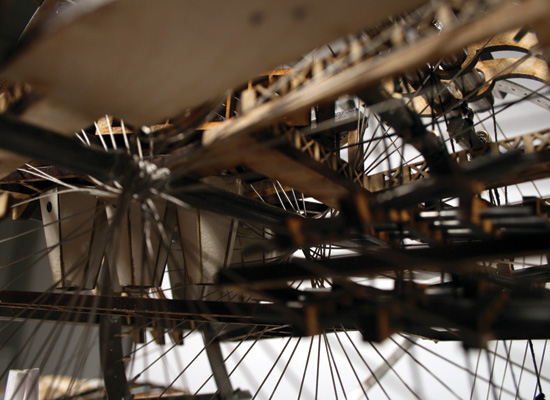
The central element of the design is the Gas Holders, a Victorian-era building since dismantled and now reconstructed here. It is the “space for the factory and its machinery necessary to wash, dry, grind and distill these herbs into their commercial state. There, the visitor finds walkways and look out points completing the experience of this factory and farm.”
In appearance — and this could be mostly due to the model's chromatic choices — the structure looks like a rustic cottage for an apothecary, something the Crusader turned monk-herbalist-sleuth, Cadfael, might have produced if he were at the AA.
Or a steampunk version of Hugh Fearnley–Whittingstall's River Cottage.
It might also be something that came out of Peter Jackson's SFX studio. The Farmacy, after all, seems to be subconsciously engaging in Tolkienesque fantasies. It belongs in Middle Earth, not in a contemporary global city such as London. In fact, the reconstructed Gas Holders reminds one of water wheels, a symbol of industrial progress but now more often a signifier of the pastoral.
All of which could be Lee's central argument, her “urban script”: to “blend” well into the spatial fabric of the city without people turning riotous at the sight of some industrial monstrosity, it's best for urban farms to mine the mythical rural idyll for nostalgia and vernacular forms, reinterpreted.
No one wants the Fordist hell beneath Metropolis. They want the bucolic, peacock-strewn gardens in the sky.
Research into Lou Gehrig's disease has demonstrated that, at least in mice carrying the associated genetic mutation, this neurodegenerative disorder can spatially manifest itself as “very subtle” but detectable behavioral patterns before the onset of symptoms.
Quoting at length a press release from the American Psychological Association:
Researchers led by Neri Kafkafi, PhD, of the Maryland Psychiatric Research Center, part of the University of Maryland's School of Medicine, mathematically analyzed about 50,000 predetermined movement patterns that resulted when rats roamed freely, one by one, in a small arena. The software created an abstract space defined by combinations of behavior such as speed, acceleration and direction of movement. Mining the resulting behavioral data enabled researchers to test many more facets of behavior than they could analyze manually.
After videotaping the movement of two groups of rats – one type with the mutation that results in an ALS-type syndrome, the other type normal controls — the scientists used the computer to "pan" for differences between groups and identified a unique motor pattern in mutant rats two months before disease onset (which would equate to roughly five to 10 years in humans).
Of the multitude of behavior patterns analyzed, the predefined "heavily braking while slightly turning away from the wall" showed a group difference. In two independent data sets, rats with the ALS-type mutation were significantly less likely than controls to brake and turn from the arena wall as they approached.
The benefit of this study is that “by being able to predict more accurately which carriers may express the disease before they experience symptoms (the 'premorbid' state), researchers could test medicines that might prevent symptoms from emerging.”
One wonders whether this sort of research, somewhere down the line, will result in public places getting littered with CCTV cameras data mining for the tell-tale signs of genetic diseases affecting motor functions. Similarly when traffic cameras take a photo of your license plate when you go over the speed limit and then get your ticket in the mail a couple of days later, these outdoor medical scanners take a photo of your face, match it up to a database at the CDC and a couple of days later, you get a diagnosis in the mail.
There will be a specially outfitted plaza where those without health insurance can get their free check-ups. Those with no more sick days can simply walk pass through on their way to work or linger about during their lunch breaks. Hypochondriacs will come in droves and stay there, like skateboarders to a Brutalist plaza.
If there is a predictive behavioral pattern to a pedophile's movements within the spatial confines of playgrounds and parks (that is, if children still go outdoors anymore) as well as the streets bordering schools, you get a court order to receive some psychiatric counseling.
Do terrorists have a genetic mutation that not only affect their cognitive reasoning but also their motor functions, the pattern array of which is so perceptibly different with that of non-terrorists that you can “spot” them?
The world is so unkind to pharmaceutical agriculture that some pharmers have gone underground to conduct their Doctor Moreauvian experiments.
In an article published a little over two years ago in Wired, we learn that a team of scientists from Purdue University, in partnership with Controlled Pharming Ventures LLC, had designed and built a subterranean experimental field inside a 60-acre former limestone mine in southern Indiana.
They did so not to escape the loud protestations of environmentalists and the uncomfortable attention from government regulators and consumer groups but rather for safety reasons, believing that pharming in an enclosed, climate-controlled environment rather than in the “bucolic, sun-dappled landscape” above ground would lessen the chance of their transgenic crops contaminating the regular food supply chain.
But apart from wanting to insure themselves against expensive civil litigation and perhaps even from criminal prosecution, the team of entrepreneurs also wanted to develop more efficient techniques and, with encouraging results, jump start a beleaguered industry suffering from bad publicity and government restrictions. Fortunately for them, the initial year-long trial was indeed very promising. Their experiment showed that their growth chamber generated an average yield of genetically modified corn (267 bushels per acre) higher than that of normal field corn in the U.S. (142 bushels per acre).
In other words, you can indeed grow cash crops in sub-optimal conditions in an underground mine — solid empirical data to excite optimism among pharmaceutical companies. (And Russian doomsday cults.)
If cave pharming does indeed catch on in the pharmaceutical industry, how would that actually be manifested in the landscape?
One could easily imagine, among many scenarios, Monsanto and Johnson & Johnson combining their expertise and their billions of cash to excavate a complex of scalable void farms, some of which are dug so deep that hydrothermal energy can be harvested to power the entire tunnel network, beneath obsolete farms that have been returned back to their pre-agricultural state or converted into either the new Yellowstone to mask the aberrant activities occurring below or a Pleistocene Park as surface evidence of a subterranean biotech utopia.
Going into a somewhat different trajectory, specifically to continue a line of speculation from a previous post on an African bridge house: can someone be fundamentally altered — like the corn they're cultivating to produce cancer cures — while living quasi-permanently in flourescent-lit dampness and hermetic seclusion, detached from the vagaries of weather, time and natural pollination, amidst pure geology?
Paul Torrens is someone after our hearts, for he has developed a realistic computer 3D model that can predict crowd behavior in various spatial configurations.
It can simulate, for instance, how people navigate through busy city streets, shoppers through urban shopping centers, and tourists through unfamiliar landscapes.
For the greenish, this has obvious practical applications. According to a press release from Arizona State University, “the project will develop simulations to explore avenues of sustainability in downtown settings, such as how cities can promote walking as an alternative to driving, and how pedestrian flow can be better integrated with transit-oriented development.”
Of course, you can also use the 3D model to simulate far less quotidian, obscenely more interesting scenarios.
“The goal of this project is to develop a reusable and behaviorally founded computer model of pedestrian movement and crowd behavior amid dense urban environments, to serve as a test-bed for experimentation,” says Torrens. “The idea is to use the model to test hypotheses, real-world plans and strategies that are not very easy, or are impossible to test in practice.”
Such as the following: 1) simulate how a crowd flees from a burning car toward a single evacuation point; 2) test out how a pathogen might be transmitted through a mobile pedestrian over a short period of time; 3) see how the existing urban grid facilitate or does not facilitate mass evacuation prior to a hurricane landfall or in the event of dirty bomb detonation; 4) design a mall which can compel customers to shop to the point of bankruptcy, to walk obliviously for miles and miles and miles, endlessly to the point of physical exhaustion and even death; 5) identify, if possible, the tell-tale signs of a peaceful crowd about to metamorphosize into a hellish mob; 6) determine how various urban typologies, such as plazas, parks, major arterial streets and banlieues, can be reconfigured in situ into a neutralizing force when crowds do become riotous; and 7) conversely, figure out how one could, through spatial manipulation, inflame a crowd, even a very small one, to set in motion a series of events that culminates into a full scale Revolution or just your average everyday Southeast Asian coup d'état — regime change through landscape architecture.
Or you quadruple the population of Chicago. How about 200 million? And into its historic Emerald Necklace system of parks, you drop an al-Qaeda sleeper cell, a pedophile, an Ebola patient, a migrant worker, a swarm of zombies, and Paris Hilton. Then grab a cold one, sit back and watch the landscape descend into chaos. It'll be better than any megablockbuster movie you'll see this summer.
Equally plausible, Chicago does not suffer total critical system failure. In fact, the built environment is surprisingly malleable, so very accommodating to a wide range of extreme radical transformations, that the city actually thrives during this catastrophe and in the end successfully expels the intruders. Far from being a vector of apocalypses, cities will save the world.
In any case, the resulting video from the simulation will be entered into a film festival near you.
“Tiny motion sensors are attached to the walls, doorways and even the refrigerator of Elaine Bloomquist's home,” writes the Associated Press. They were installed there to track any deviations in “the seemingly healthy 86-year-old's daily activity,” any small changes in her routine which could be attributed to the onset of Alzheimer's. “It's like spying in the name of science - with her permission,” we read.
And if the sensors detect any wayward behavior, Elaine Bloomquist gets zapped.
Which, of course, isn't exactly true.
This sensor network is a sort of early detection system for the disease. “The theory is that as Alzheimer's begins destroying brain cells, signals to nerves may become inconsistent - like static on a radio - well before memories become irretrievable. One day, signals to walk fire fine. The next, those signals are fuzzy and people hesitate, creating wildly varying activity patterns.”
Currently 112 homes in the Portland, Oregon area have been retrofitted with the devices. A $7 million grant from the National Institute of Health will expand the project to 300.
Firstly, if the experiment proves successful, should we expect to hear about similar tele-monitoring networks operated at the urban scale? CCTV-Alzheimer's®. An entire retirement community comes under the constant, penetrating gaze of their hometown doctors and medical technicians thousands of miles away, diagnosing every move our grandmothers make or incorrectly make, and administering behavior modification electroshock treatment when so diagnosed.
Secondly, might we also expect to hear of a house or a town patterned after the erratic movements of Alzheimer's patients? Rooms, hallways, corners, ceilings, streets, gardens, parks arranged according to fuzzy and hesitating markings of dementia? What would these spaces look like? Perhaps we've heard about this already?
And thirdly, how about houses for, say, the most obsessive of obsessive compulsives, hacked not to monitor their disorder but rather to cure them? Wherein the faucets, for instance, run skin-peeling, scalding water whenever they sense three or more consecutive washes in the span of 15 minutes, wherein the furniture unaligns itself at arbitrary times of the day, and wherein light switches and door knobs and that tempting patch on the wall electroconduct when they come into contact repeatedly with human skin.


 Mrs. Blumenthal, 55, of Florida, has been driving around the city for hours now. Since landing at O'Hare, she's taken in the fleeting sights of the northern and western neighborhoods. This afternoon, she'll barrel along the inexorable super-linearity of Western Avenue all the way down to the city limit before making a U-turn and returning to her hotel for the night. Tomorrow and for the rest of the week, she'll make the same perambulations.