When I first stumbled upon these poorly scanned data sheets of so-called gravity base stations, I thought they were actual “stations,” that is, actual gravity sensing devices that are constantly taking measurements of local geodetic conditions. Compact machines like those humidity monitors you see in museums and galleries that are sometimes mistaken for art installations.
To protect them from the environment and public tampering, I imagined each device encased in a metal canister, permanently embedded in concrete or stone and topped with a benchmark disk, itself stamped with an identification number and a warning of a fine or imprisonment to anyone who disturbs them.
I also imagined them forming a pointillist sensor network, just another sedimentary layer of a much more totalizing enviro-veillance network superimposed on the surface of the earth. Deployed in the most unassuming corners of the built environment, they pique little interest outside the insular worlds of geologists and geocachers.
But I was giddy with the possibility that they might be like buoy stations set adrift by NOAA not in the open ocean but on “solid” ground. Instead of ocean waves, they surf on invisible gravitational swells and troughs. And instead of the hyperactivities of the weather, they monitor something beyond our lived experience and even beyond their operational lives: gravitational fluxes caused by the million- or billion-year-long gyrations of tectonic storms.
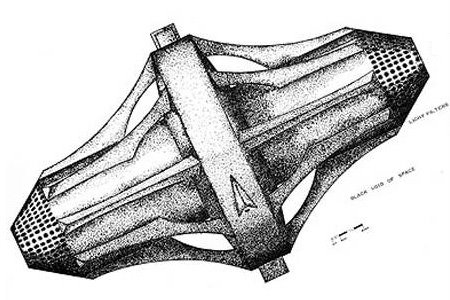
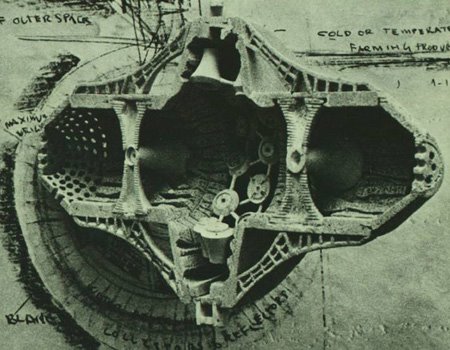
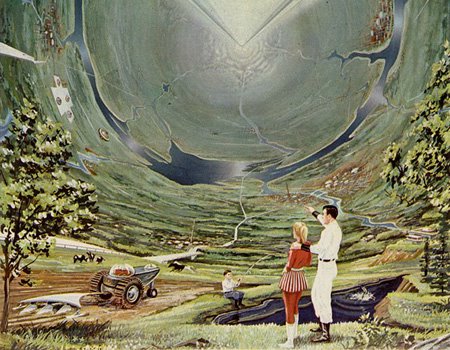
Conceived in the 1960s by architect Paolo Soleri, who coincidentally started the desert techno-ashram Arcosanti, an Asteromo is “an asteroid for a population of about 70,000 people. It is basically a double-skinned cylinder kept inflated by pressurization and rotation of the main axis...the weight of a person will vary from zero at the axis to a fraction of his earthly weight on the ground. He will be able to fly without the need of any power devices.” In other words, to get around this outside-inside ellipsoidal earth, you do a starting jump and then simply float away, guided perhaps by a tether system emulating the trajectories of honeybees. Here where the earth is the sky is the earth, your office might be directly above/below your home, that is, if such distinctions still exist in this spacebound utopia.
For those preferring not to fly, there will be “Dantesque promenades at different levels of physical prowess — from weak (center) to strong (periphery),” which leads us to wonder if there will be class stratification in this arcology-in-space based on gravity.
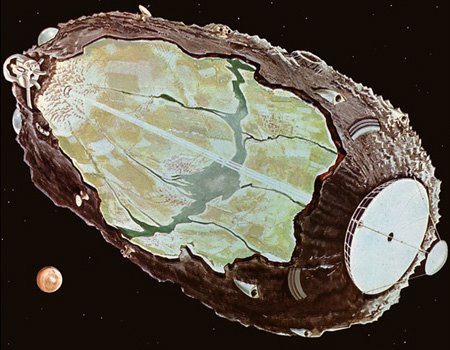
While Soleri's design involved metal-clad cylinders, a prior plan by futurologists Dandridge Cole and Donald Cox proposed using actual asteroids, fusing and sculpting them with the heat from solar mirrors to form the gigantic geodesic interior chamber “in much the same way as a glassblower shapes a small solid lump of molten glass into a large empty bottle.”
As described here, future landscape architects will knock out an asteroid out of its gravitational orbit and then “[d]rill a hole down the middle of [the] asteroid — about a kilometer (3,280 feet) in diameter — and pack the cavity with water ice. Reseal the ends with the original material and heat the mass with giant mylar-film solar mirrors. By the time the heat reaches the center, the mass will be semi-liquid and the explosively expanding steam that results when the ice at the core is heated to the same degree will inflate the molten asteroid like a balloon.”
Moreover, attendant to Asteromo is Cole's concept of the Macro-Life: “This vehicle or creature of the Macro-Life could move (with rocket propulsion), grow (given to a food source under shape of natural resources drafts from other asteroids), could answer to the stimuli through its optical sensors and electronic, to think with the brains of its human colony and its computers, and, finally, reproduce.”
So one asteroid then two then four and pretty soon Earth will have its very own Kuiper Belt of geosynchronous bioplanetoid organisms in constant mitotic cell divisions.
And in death, they'll simply drop down to Earth in a blazing, funerary meteor shower towards their cratered necropolis.
“It could only happen in space,” NASA's interplanetary gardeners explain. “A tiny bubble of air hangs suspended inside a droplet of water. The droplet rests in the cup of a delicate green leaf, yet the stalk doesn't bend at all.”
On gravity-laden Earth, however, “[t]he air bubble, lighter than water, would race upward to burst through the surface of the droplet. Meanwhile, the leaf would be busy tipping the heavy water onto the floor below. Everything would be in motion, the picture a blur.”
As it is, the photo can be upside down or even sideways and still get the same photographic result.
So if and when space gardens have outgrown their primary role as agriculture or a sort of organic HVAC in the early stages of space colonization, and our intrepid colonists attempt a more recreational approach, well, how would they design it when one can float? When a wall is a floor is a ceiling is a floor is a wall in zero gravity. (Except when it's got a door.) A simple gesture like craning your neck up at a tree may no longer be necessary when it's a simple skip and a jump to the canopy. A truly three-dimensional space, not just up to 10 feet off the ground.
And fountains, infamous for their gravity-defying acts, may simply be a billion-dollar lava lamp, which would be awesome actually.
I suppose labyrinths may have to be reimagined as well. As Swiss cheese.