Very Large Structure is a proposal by Manuel Domínguez for a mobile land management mega-machine for Castile and León in Spain. It's a walking city, for want of a better term, though rather than conceived as a global wanderer perpetually moving on to greener pastures, the VLS remains in basically the same place to tend to and improve the pastures that it's got.
To save me the time of summarizing the project, which is impressively researched and fleshed out, I'll direct you to his entire PowerPoint presentation being hosted at Taller al Cubo.
Before you head out to download the file, I want to quickly invoke the opening line of Philip Reeve's Mortal Engines, the first in a quartet of novels about walking cities (on tracts, like the VLS) in a resource-depleted future preying on smaller walking cities and their supplies, literally swallowing them whole when caught —
It was a dark, blustery afternoon in spring, and the city of London was chasing a small mining town across the dried-out bed of the old North Sea.
— and hope that that should cue a parallel world Dakar Rally in which walking cities race against each other. On the dried-out bed of the Mississippi River, Chicago compete against Manhattan once every four years down towards the Gulf of Mexico, and the winner not only will enlarge their hunting ground but also represent North America in the world championship held in the silted expanse of the former South China Sea.
A quick quote from a PBS two-part documentary first broadcast in 2008 and based on the “definitive” book on cold, Tom Shachtman's Absolute Zero and the Conquest of Cold. The scientist quoted is Seth Lloyd, of MIT:
Getting to absolute zero is tough. Nobody's actually been there at absolute 0.000000, with an infinite number of zeros. That last little tiny bit of heat becomes harder and harder to get out. And, in particular, the timescales for getting it out get longer and longer and longer, the smaller and smaller the amounts of energy involved. So eventually, if you're talking about extracting an amount of energy that's sufficiently small, it would indeed take the age of the universe to do it. Also you, actually you'd need an apparatus the size of the universe to do it, but that's another story.
Behold! The world's largest vacuum chamber constructed for vehicle testing of the new Orion spacecraft.
Thermal vacuum testing and electromagnetic interference testing will take place in the vacuum chamber. Thermal vacuum testing will confirm that the spacecraft can withstand the extreme hot and cold temperatures present in space, and electromagnetic interference testing will verify the reliability of Orion's communication and electronic systems.
Adjacent to this chamber is an earthquake simulator that will also subject the ship to the violent conditions of liftoff.
The 75,000-pound craft will sit on a huge vibration table; comprising a 125,000-pound mass that must be shaken with an intensity equal to that of a launch.
And:
Twenty-four horns will blow high-pressured nitrogen gas to match the intensity level of the sounds produced during the launch. Most acoustic facilities have around two or three horns. But for this facility, everything is being built bigger in scale to more accurately assess the spacecraft.
In other words, when fully operational, or even when not, these will be two of the most interesting spaces in the world.
If ever Sandusky, Ohio becomes the unlikeliest host to an edition of Postpolis!, this certainly would be the perfect venue. Cut off from normal air, curators, speakers and audience will don pressurized spacesuits, communicate via crackling shortwave radio, move about and sit through sonic stillness. Can a lively, at times riotously boisterous, conversations be had under threat of suffocation? About such things as the testing grounds for space exploration and the messy historiography of their microearth capsules?
While everyone is waiting for the first high-energy collision of CERN's Large Hadron Collider sometime next month, might we interest you meanwhile with our previous posts on this mega-machine?
In our first, we wondered if all those scientists working at CERN — after having successfully mapped out the landscape architecture of reality, of course — would want to reconfigure The Machine so that it could levitate a grove of trees.
And self-powered lighting fixtures; some artificial turf and mildly meditative Zen boulders; a few dozen rabbits, cute or otherwise; anti-gravity hydrology; and of course, the all-important signage: “Warning: If Not Rapture, May Cause Death.”
And after you push a few buttons, flick one or two switches and drain Europe of all of its electricity, your floating garden then goes on an endless subterranean ringed journey.
It's Dante's unexplored Tenth Circle of Hell, which is reserved for landscape architects designing absolutely boring landscapes.
In our second, we were struck by how cavernous some of the underground spaces are. They are Europe's new naves, domed interiors, barrel vaulted arcades and side chapels, very fitting ecclesiastical vocabulary where Science is the de facto New Religion and CERN its St. Peter's.
We wondered, too, whatever happened to one of its unbuilt basilicas, the Superconducting Super Collider down in Texas, and learned that one company is marketing it out as a server farm to credit bureaus, banks and other industries in need of high security data centers.
In other words:
Where the Big Bang might have been simulated endlessly, extra dimensions observed for the first time, and the fundamental construct of Nature elucidated, it might soon be filled with the buying patterns of ex-urbanites at Wal-Mart, hilariously awful credit ratings of college graduates, and our entire archive of bukkake porn.
You can probably skip our third and last post, but do look at the two photos there — one of which appears above — and let us know who the photographer is, if you do know. We're rather pedantic when it comes to giving credit to all the images that we use.
Tunneling into the abyss to gaze out into the firmament. It's the Super-Kamiokande once more, simply because the whole thing's so incredibly beautiful, here photographed after its reconstruction and before it was filled with 50,000 tons of pure heavy water. Once disused again, can we have it, rent free? It'll be the summer residence for Pruned.
Download some high-resolution photos from here to decorate your websites and blogs.
During a ceremony that must have involved the blaring of Wagner or Don Giovanni's final aria, and with readings from The Divine Comedy, the last of the more than 1700 magnets of the Large Hadron Collider was “symbolically” lowered into the tunnels at CERN.
Where Science is the de facto New Religion, the entire CERN complex its Cathedral, and the paroxysm of atoms incorporated into its Eucharistic rite, a virgin was also sacrificed. Or maybe not.
But seriously, the photos, which can all be viewed here, made us wonder whatever happened to the $12 billion Superconducting Super Collider. Before it was cancelled in 1993, “seventeen shafts were sunk and 23.5 km (14.6 miles) of tunnel were bored.” That is almost as long as the 17-mile CERN tunnel housing the Large Hadron Collider.
As it turns out, “after the project was canceled,” we read in Wikipedia, “the main site was deeded to Ellis County, Texas and the county tried numerous times to sell the property. The property was finally sold in August of 2006 to an investment group led by the late J.B. Hunt. Collider Data Center has contracted with GVA Cawley to market the site as a Tier III or Tier IV Data Center.”
Where the Big Bang might have been simulated endlessly, extra dimensions observed for the first time, and the fundamental construct of Nature elucidated, it might soon be filled with the buying patterns of ex-urbanites at Wal-Mart, hilariously awful credit ratings of college graduates, and our entire archive of bukkake porn. What a pity.
Then again one can hope to persuade the Collider Data Center LLC to sponsor an Artist Residence Program in the mold of CLUI's Wendover Residence Program. What one can contemplate amidst an over-abundance of landscape and monumental geological erasure (not to mention in the context of wasted billions of dollars, hundreds of hurt scientists, and Congressional politics) is potentially breathtaking.
In Jacques Leslie's prologue to his book Deep Water: The Epic Struggle Over Dams, Displaced People, and the Environment, excerpted here at AlterNet, we learn that “between Hoover and the end of the century, more than 45,000 large dams — dams at least five stories tall — were built in 140 countries” and that “the water behind them blots out a terrain bigger than California.” Moreover, Leslie writes that “by now the planet has expended two trillion dollars on dams — the equivalent of the entire 2003 U.S. government budget.”
But here's what could possibly be the most interesting trivia:
The world's dams have shifted so much weight that geophysicists believe they have slightly altered the speed of the earth's rotation, the tilt of its axis, and the shape of its gravitational field.
To repeat: altered the speed of the earth's rotation.
Slightly, that is. But even if the alteration amounts to a mere fraction of a second per day, that dams could shorten or lengthen a year obviously offers a possible solution to a perennial nuisance: earth-bound extinction level asteroids.
In other words, would a hydrological meganetwork of dams hasten the planet's solar orbital journey such that we arrive at the impact point in space and then depart before the asteroid has even arrived?
Trillions of dollars would have to be spent constructing thousands of dams on every river basins in the world, and many trillions more integrating them into urban stormwater management systems; wetland restoration projects; concretized rivers and irrigation channels; fortified lagoons and estuaries; abandoned tunnels; floodcontrolstructures; and every faucets, sprinklers, buckets and rolling 'hippos' throughout the world.
At scheduled times during the year, a transnational governing agency chartered to oversee this Super-Versailles would initiate a carefully programmed sequence of valve openings and closings, of inflows and outflows, of discharge and storage. In soporific trickles and raging Jovian torrents, great volumes of water are shifted across the surface of the earth, against gravity, by sheer human will.
And if the calculations prove correct and the hydrochoreography is followed precisely, the earth would then spin a little faster, and we finish the day and reach year's end early.
Over the course of decades, countless miniscule fractions of seconds are saved, albeit probably amounting to a few seconds. Nevertheless, that just might be enough for us to miss our appointment with the Apocalypse.
In the meantime, before we even know if the whole thing actually works, this apocalypse-averting great flush will be treated as the grand spectacle.
Everywhere fountains will spurt with a little bit more mirth and whimsy. Fireworks will lighten up the night skies over the Three Gorges Dam and Aswan Dam, and barbecue pits will be lit beside a raging Los Angeles River. It'll be the only truly international holiday.
Meanwhile, travelers equipped with the latest edition of The Lonely Planet Guide to Super-Versailles will trek to the Aral Sea, the marshes of southern Iraq, the Everglades or and Owens Lake to witness these ancient landscapes get rehydrated with waters from Greenland's ice caps. To coincide with this event, the local tourist agency will stage a naumachia re-enacting The Deluge.
Those with Fodor's will visit picturesque Venice; those with more adventurous spirit and shun guidebooks at will rappel down behind Niagara Falls.
But most importantly, all the Great Water Wars are averted and resolved.
This is ATLAS, one of the major particle detectors for CERN's Large Hadron Collider being constructed underground in the Swiss Alps. The eight toroidal coils you see form the largest superconducting magnet ever built.
Called affectionately as The Machine, it will become fully operational in November 2007. And when it does, Wired tells us, physicist will try to answer some of the most puzzling questions about the workings of the cosmos.
Why do things have mass?
What is dark matter, that unknown stuff that makes up 96% of the Universe?
And why is there more matter than antimatter?
And barring the creation of micro black holes, strangelets, and magnetic monopoles, all of which could trigger the destruction of the earth, even the entire universe, scientists would also want to find out why gravity is such a weak force.
More intriguingly, they will try seek out evidence for the existence of extra dimensions.
In other words, nothing less than the fundamental construct of Nature and the landscape architecture of reality.
Admittedly, we're curious to know if all those scientists — all 1800 of them from 165 universities and laboratories representing 35 countries — may also want to find out if the Barrel Toroid can levitate a tree. A grove of exiled palm trees magnetically deterrestrialized.
Since nonsuperconducting objects have been shown that they can indeed be levitated, why not throw in some shrubs as well. And self-powered lighting fixtures; some artificial turf and mildly meditative Zen boulders; a few dozen rabbits, cute or otherwise; anti-gravity hydrology; and of course, the all-important signage: “Warning: If Not Rapture, May Cause Death.”
And after you push a few buttons, flick one or two switches and drain Europe of all of its electricity, your floating garden then goes on an endless subterranean ringed journey. It's the new $12 billion dollar theme park.
Or The Tenth Circle of Hell.
Which is reserved for landscape architects.
Now 'gin the rueful wailings to be heard.
Now am I come where many a plaining voice
Smites on mine ear. Into a place I came
Where light was silent all. Bellowing there groan'd
A noise as of a sea in tempest torn
By warring winds. The stormy blast of hell
With restless fury drives the spirits on
Whirl'd round and dash'd amain with sore annoy.
When they arrive before the ruinous sweep,
There shrieks are heard, there lamentations, moans,
And blasphemies 'gainst the good Power in heaven.
And by blasphemies, Dante meant producing absolutely boring landscape architecture.
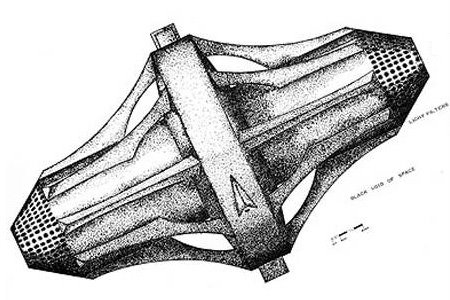
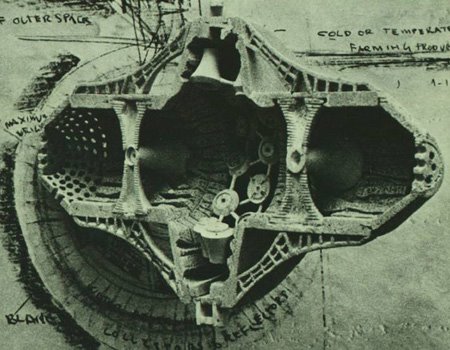
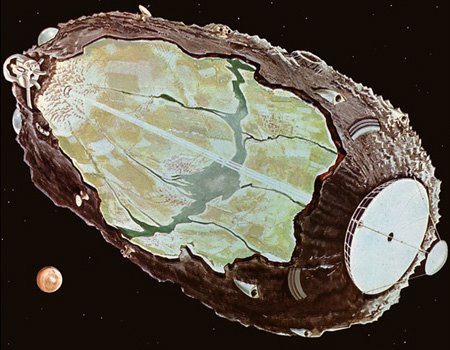
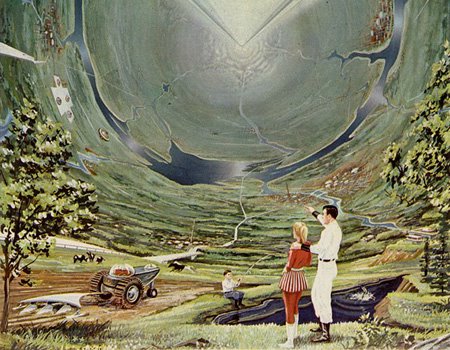
Conceived in the 1960s by architect Paolo Soleri, who coincidentally started the desert techno-ashram Arcosanti, an Asteromo is “an asteroid for a population of about 70,000 people. It is basically a double-skinned cylinder kept inflated by pressurization and rotation of the main axis...the weight of a person will vary from zero at the axis to a fraction of his earthly weight on the ground. He will be able to fly without the need of any power devices.” In other words, to get around this outside-inside ellipsoidal earth, you do a starting jump and then simply float away, guided perhaps by a tether system emulating the trajectories of honeybees. Here where the earth is the sky is the earth, your office might be directly above/below your home, that is, if such distinctions still exist in this spacebound utopia.
For those preferring not to fly, there will be “Dantesque promenades at different levels of physical prowess — from weak (center) to strong (periphery),” which leads us to wonder if there will be class stratification in this arcology-in-space based on gravity.
While Soleri's design involved metal-clad cylinders, a prior plan by futurologists Dandridge Cole and Donald Cox proposed using actual asteroids, fusing and sculpting them with the heat from solar mirrors to form the gigantic geodesic interior chamber “in much the same way as a glassblower shapes a small solid lump of molten glass into a large empty bottle.”
As described here, future landscape architects will knock out an asteroid out of its gravitational orbit and then “[d]rill a hole down the middle of [the] asteroid — about a kilometer (3,280 feet) in diameter — and pack the cavity with water ice. Reseal the ends with the original material and heat the mass with giant mylar-film solar mirrors. By the time the heat reaches the center, the mass will be semi-liquid and the explosively expanding steam that results when the ice at the core is heated to the same degree will inflate the molten asteroid like a balloon.”
Moreover, attendant to Asteromo is Cole's concept of the Macro-Life: “This vehicle or creature of the Macro-Life could move (with rocket propulsion), grow (given to a food source under shape of natural resources drafts from other asteroids), could answer to the stimuli through its optical sensors and electronic, to think with the brains of its human colony and its computers, and, finally, reproduce.”
So one asteroid then two then four and pretty soon Earth will have its very own Kuiper Belt of geosynchronous bioplanetoid organisms in constant mitotic cell divisions.
And in death, they'll simply drop down to Earth in a blazing, funerary meteor shower towards their cratered necropolis.