It's only a matter of time before terrestrial flora and fauna finally find their way to Mars. Though to survive and thrive there, they will need some traditional Frankenstein treatment. As a recent NASA article explains: “On Mars, plants would have to tolerate conditions that usually cause them a great deal of stress — severe cold, drought, low air pressure, soils that they didn't evolve for.” Like humans, the article also explains, plants suffer from stress: “They produce a chemical signal -- superoxide (O2-) — that puts the rest of the plant on high alert. Superoxide, however, is toxic; too much of it will end up harming the plant.” The first step to get plants to grow on Mars, then, is to relieve their anxiety.
And scientists find their Prozac pill in Pyrococcus furiosus, a microbe that “lives in a superheated vent at the bottom of the ocean, but periodically it gets spewed out into cold sea water. So, unlike the detoxification pathways in plants, the ones in P. furiosus function over an astonishing 100+ degree Celsius range in temperature. That's a swing that could match what plants experience in a greenhouse on Mars.”
Scientists also hope to transfer genes from other extremophile organisms that not only will help plants cope with extreme conditions such as drought, cold temperatures, low air pressure, and low light levels but also thrive to be able to sustain settlements on Mars.
Meanwhile, how about some botanical illustrations of these Floral Frankensteins? They would be the most amazing botanical illustrations ever, even if they were to look merely common and not the post-terrestrial species that futurists love to imagine them as.
Labels: post-nature, space
For this slow, languorous Midwestern autumn Sunday, here are some Soviet Glasnost neoavant-garde paper architecture by Brodsky & Utkin.
“In their designs, by turns funny, cerebral, and deeply human, Brodsky & Utkin borrow from Egyptian tombs, Ledoux’s visionary architecture, Le Corbusier’s urban master palns, and other historical precedents, collaging these heterogeneous forms in learned and layered scrambles. Underlying the wit and visual inventiveness is an unmistakable moral: that the dehumanizing architecture of the sort seen in Russian cities in the 1980s and 1990s, and elsewhere around the globe, takes a sinister toll.”


Obviously, the next step is to investigate whether the pair had once lived in a brothel, done the occasional cross-dressing, and cavorted with scantily clad nuns, and if so, then confect a screenplay to complement our Lequeu biopic. It will be a trilogy on visionary builders, the conceit being their works are unbuilt, unbuildable masterpieces thwarted by politics, economics, and gravity.
But who's the third?
Axel Erlandson?
“In their designs, by turns funny, cerebral, and deeply human, Brodsky & Utkin borrow from Egyptian tombs, Ledoux’s visionary architecture, Le Corbusier’s urban master palns, and other historical precedents, collaging these heterogeneous forms in learned and layered scrambles. Underlying the wit and visual inventiveness is an unmistakable moral: that the dehumanizing architecture of the sort seen in Russian cities in the 1980s and 1990s, and elsewhere around the globe, takes a sinister toll.”


Obviously, the next step is to investigate whether the pair had once lived in a brothel, done the occasional cross-dressing, and cavorted with scantily clad nuns, and if so, then confect a screenplay to complement our Lequeu biopic. It will be a trilogy on visionary builders, the conceit being their works are unbuilt, unbuildable masterpieces thwarted by politics, economics, and gravity.
But who's the third?
Axel Erlandson?

On Dubai. Yes, again.
On projet les halles.
On bollards. They now outnumber trees, right? 50 bollards per person?
On gardening superfund sites.
On Manila through Indian eyes.
On lawn furniture. Literally.
Labels: prunings


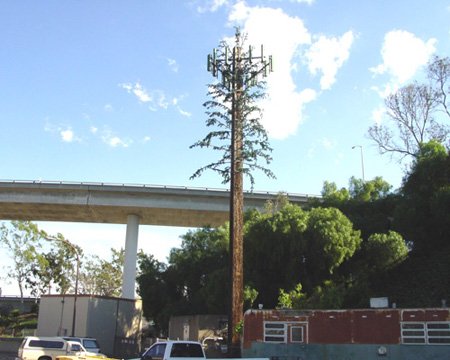
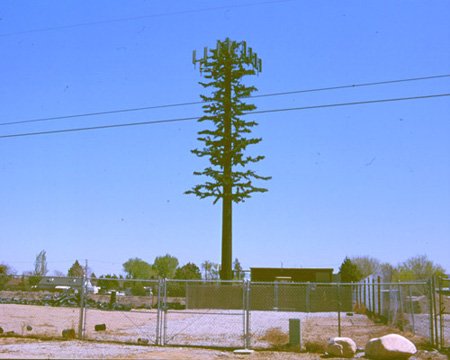
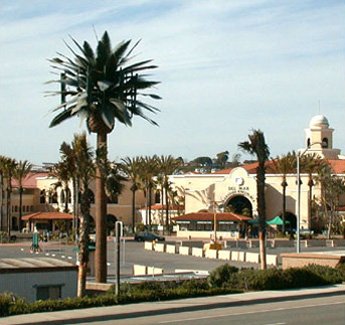
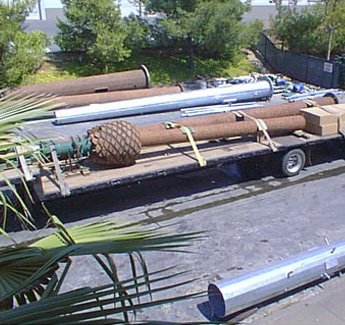
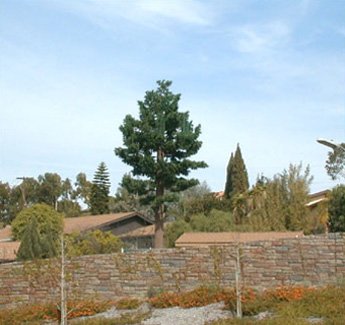
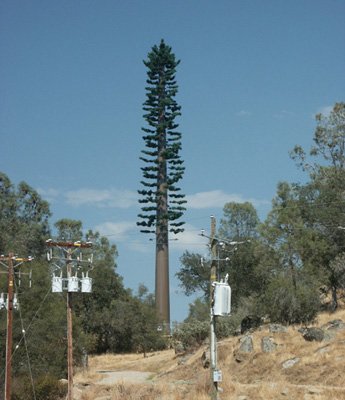
A brief stop at the always marvelous Polar Inertia yielded these two photos of cell towers disguised as trees. A subsequent search on Googledom produced further more photos.


From one company: “The tremendous increase in demand for wireless towers has generated great opposition to the use of conventional, unconcealed structures. Both community and zoning requirements for high quality concealment are on the rise. Today, concealment issues may be the greatest obstacles to obtaining zoning approval. Preserved TreeScapes International's botanically correct tree tower products will help speed the approval process.” Arcadia Ersatz as a function of zoning ordinances.

Verizon Landscape Telecommunication Architecture LLC. “Can you see it now?” Landscape architects will make millions.
POSTSCRIPT #1: As provided by a commenter, more fantastic photos here.

For its new season, PBS's perennial home improvement show, This Old House, takes the task of remodeling its first ever mid-century modern house. In typical TOH fashion, host Kevin O'Connor and his cohorts guide you to every conceivable facet of a total house remodeling project, from the initial client meeting to the post-construction/housewarming party in brutally dense 30-minute episodes. Away from the drawings and AutoCADs and into the trenches. Every trade gets some screen time: architects, landscape architects, carpenters, plumbers, electricians, interior designers, preservationists, suppliers, painters, engineers, etc.
And arborists? Yes, they show you how to cut down a three-story tree safely away from a neighbor's house, though they make it clear that it should only be done by professionals (at quite an astounding price). And historians? Yes, one gives O'Connor a guided tour of Walter Gropius's house in Lincoln, Massachusetts.
In other words, its holistic approach to televised presentation sets it apart in the cluttered world of home improvement shows.
There is even a webcam.

Which inevitably leads us to fabricate a new reality show, The Surreal Life: Bungalow Edition, starring a medley of architects, landscape architects, urbanists, artists, academics, and critics. Their task is to redesign a Chicago bungalow house and its gardens in an historic South Chicago neighborhood, and they must do so amidst cramp conditions and formica kitchen flooring. There is just one bathroom and a half.
EPISODE 1: OPEN BAR
The gang arrives for introduction, booze, and merriment. Highlight of the episode is the first encounter between Peter Walker and Rem Koolhaas. Peter, blinged out in his recently awarded Jellicoe Medal, the designated Nobel of Landscape Architecture, tries to strike up a conversation with the Pritzker Laureate, but was instantly emasculated: “And you are?” asks Rem. Michael Arad, PW's de facto pussy, tries to salvage the conversation and asks: “So, what does Remment mean?” Koolhaas: “None of your fucking business.” And Arad, as it was in the WTC Memorial Project, is never to be seen or heard from in the series again. Peter the Elder blisters into a tirade: “You know, nobody really believes your Lagos fairy tales.”
EPISODE 2: SITE VISIT
The gang moves into the bungalow. Still nursing a massive hangover from last night's bacchanalia, Frank Gehry exclaims: “What this house needs is a little bit of that old time Quaker minimalist sensibility: clear and immediate spatial clarity, but still respectful of its vernacular forms. Straight lines are the new curves.” The Herzog-Meuron agrees: “Yes, but let's change nothing in the kitchen. The laminated floors, red vinyl chairs, formica-topped table, avocado wallpapering, flourescent fixtures — these must all stay.” David L. Hays: “I hate it. I love it.”
But pretty boy Matthew Barney wonders: “What am I doing here?” John Dixon Hunt replies: “Tu ne sais donc point ce que c'est que la matière.” In the corner, delighting in the sight of the former high school football player, Lucy Lippard lets out a mischievous smirk: “Oh yeah, that's what you're here for.”
EPISODE 3: CHARRETTE
The gang gets down to business. But it soon becomes apparent that the multidisciplinary, single team format might not be the best thing.
Thom Mayne: “What do you DO exactly?”
Walter Hood: “You know nothing of context!”
Thom Mayne: “You mean, Nicolai Ouroussoff knows nothing of you?”
Walter Hood: “My gardens will engulf de Young.”
Thom Mayne: “We actually discovered landscape.”
Walter Hood: “5 years ago.”
Kathryn Gustafson: “Don't touch my plaster casts!”
A bit later.
Adriaan Geuze: “Tumuli earthforms again?”
Michael van Valkenburgh: “Post-industrial homage again?”
Adriaan Geuze: “Tell me Michael, were you in Groundswell?”
And still a bit later.
Al Gore: “Have you accepted Nature yet?”
Martha Schwartz: “I hate Nature.”
William A. McDonough: “Lacrimosa dies illa, qua resurget ex favilla judicandus homo reus. Huic ergo parce, Deus.”
Martha Schwartz: “Fuck you!”
At the end of the episode, everyone goes to their corner to lick their wounds.
EPISODE 4: MISTRESS ZAHA
Zaha Hadid, inexplicably with a flock of chinchillas on leashes, arrives a week late: “'Sup bitches!” Inexplicable as well, she heads straight to the above-ground hot tub, which the owners recently won on The Price is Right, in the backyard, and begins to drown down some mai tais. At the end of the day, she leaves for Dubai to wrestle some projects away from the presently preoccupied Rement. No one notices because of a minor incident earlier.
Agents from Toll Brothers were speculating whether it would be better to simply raze the entire bungalow and plop down in its place a mini McMansion, something Colonial or a Mediterranean-style ranch perhaps. “We could even do the same for every bungalow in the neighborhood.” Upon hearing this, James Howard Kunstler implodes, leaving only a bowtie behind to identify the mangled carcass on the sidewalk as belonging to The Kunstler.
EPISODE 5: CAVORTING WITH THE TRADES
The gang meets with the gang from This Old House. Saskia Sassen pairs off with Kevin O'Connor to inspect the master bedroom. No cameraman was with them, but fortunately, they still had their mics on. And in what will certainly become an instant reality TV classic moment, a “slurp” sound is heard.
EPISODE 6: HALLOWEEN SPECIAL
The ghosts of designers past come to haunt the bungalow. Borromini heaps praises upon praises on Gehry: “Guggenheim Bilbao. Que bello, la nuova Chiesa di San Carlo.” And Olmsted on Peter Latz: “Duisburg-Nord is the new Central Park.” But not every spectral emanation was as flattering nor even civil. Ian McHarg takes possession of Ken Smith. Frank Lloyd Wright takes on Norman Foster. Many limbs are twisted, contorted; much sushi and Veuve Clicquot vomited. Double exorcism is ordered. Holy water gets splashed. The room starts to quiver. The house heaves. The garden convulses. And then suddenly, everything contracts into a singularity before finally phasing out of the space-time continuum.
The following day, Sanford Kwinter arrives as a guest critic: “Architecture-less. Landscape-less. Urban-less. Brilliant!”
“No designers. Marvelous!”
This Old House
Labels: surrealism
Since starting this blog, I've developed a certain fetish for botanical illustrations. For one, they're beautiful, stunningly gorgeous. Their colors are often lush in the way that Matthew Barney's Cremaster Cycle is lush; the pigments practically bleed out of the parchment.

Although they are meant to be faithful (nay, exact) replicas of the real thing as demanded by scientific methodology, the process unwittingly translates biological matter into an abstract concept. Cells, tissues, stomata into data, lines, and RGB. The material into the immaterial. And in their uprooted, dissected, defoliated, trimmed, sectioned, decontextualized (yea, the whole shebang) representation, they're practically, to my eyes, extraterrestrial.
Check out this Area 51 post-floral specimen. It's a pineapple, but it might as well be part of the Predator's Torquemadan arsenal or Ellen Ripley's next generation human-botanical-alien hybrid.

And in their Victorian, Linnaean, even Darwinian fetish for cataloguing and display and certainly in their cabinet-of-curiosities sensibilities, these botanical illustrations closely mirror the blogosphere. We had this idea of an installation involving a series of computers, hundreds of them, in a gallery. Or perphaps in hypermedia Times Square or in the TV showrooms of a Radio Shack. Or better still, at a botanical garden, the 4D sibling of botanical illustrations. In any case, each computer would feature one specific blog. As bloggers record their missives, their posts get disseminated immediately onto the computer screens. Rows upon rows of virtually illustrated detritus of contemporary life, each blogger's notion of the natural, lived world. Titled. Dated. Classified. Collated. Barcorded. Catalogued. Ready for perusal.
Which brings up an interesting scenario: you could actually follow a meme or popular news item or even this installation propagating throughout the entire blogosphere, like a pandemic of sorts. Blogs cannibalizing other blogs in real-time.
Meanwhile, here's another extraterrestrial specimen from the Missouri Botanical Library from which the images in this post were taken.

Rare Books from the Missouri Botanical Library
Curtis's Botanical Magazine
Botanical Wunderkammer, Part II

Although they are meant to be faithful (nay, exact) replicas of the real thing as demanded by scientific methodology, the process unwittingly translates biological matter into an abstract concept. Cells, tissues, stomata into data, lines, and RGB. The material into the immaterial. And in their uprooted, dissected, defoliated, trimmed, sectioned, decontextualized (yea, the whole shebang) representation, they're practically, to my eyes, extraterrestrial.
Check out this Area 51 post-floral specimen. It's a pineapple, but it might as well be part of the Predator's Torquemadan arsenal or Ellen Ripley's next generation human-botanical-alien hybrid.

And in their Victorian, Linnaean, even Darwinian fetish for cataloguing and display and certainly in their cabinet-of-curiosities sensibilities, these botanical illustrations closely mirror the blogosphere. We had this idea of an installation involving a series of computers, hundreds of them, in a gallery. Or perphaps in hypermedia Times Square or in the TV showrooms of a Radio Shack. Or better still, at a botanical garden, the 4D sibling of botanical illustrations. In any case, each computer would feature one specific blog. As bloggers record their missives, their posts get disseminated immediately onto the computer screens. Rows upon rows of virtually illustrated detritus of contemporary life, each blogger's notion of the natural, lived world. Titled. Dated. Classified. Collated. Barcorded. Catalogued. Ready for perusal.
Which brings up an interesting scenario: you could actually follow a meme or popular news item or even this installation propagating throughout the entire blogosphere, like a pandemic of sorts. Blogs cannibalizing other blogs in real-time.
Meanwhile, here's another extraterrestrial specimen from the Missouri Botanical Library from which the images in this post were taken.

Rare Books from the Missouri Botanical Library
Curtis's Botanical Magazine
Botanical Wunderkammer, Part II
Labels: archives

What's a studio or an office without the occasional distraction. Stackopolis should provide an addictive alternative to Yahoo! Games. You may even sharpen your spatial perceptive skills and your eye-hand-AutoCAD-web-email-blogosphere-multitasking coordination. Click harder, click faster.
Or how about something less architectural and more horticultural. Try to block GMO seeds from landing on your garden with a flock of super butterflies in the Seed Stewards Game from PBS's P.O.V. Borders series, itself something worthwhile to explore. You could win prizes including a pack of real heirloom seeds. Losers should get GMO seeds. Or winners? Never mind.
Stackopolis
Seed Stewards Game
P.O.V. Borders
Labels: time wasters

Bear with us. The title of today's post will resolve itself momentarily.
Less than a month after handing out this year's awards, ASLA has released its 2006 call for entries for its professional and student awards program. Go here for details.
Meanwhile, we have been rabidly listening to some podcasts from the recent ASLA Annual Meeting, not simply because of the soothing timber, Ira Glass-esque voice of the podcaster but also for the many interesting discussions on issues currently preoccupying landscape architects. So far, only two podcasts have been released.
ASLA ANNUAL MEETING PODCAST, I: Features Jeff Speck, Director of Design for the National Endowment for the Arts, discussing the role of the Mayor’s Institute for City Design in hurricane reconstruction, and the new Governor’s Institute for City Design. Also an interview with U.S. Green Building Council CEO Rick Fedrizzi, who discusses the role of landscape architects in LEED rated projects.
The highlight of this podcast is a roundtable discussion with Gary Smith, ASLA, Peter Del Tredici from Harvard’s Arnold Arboretum, and Gerould Wilhelm of Conservation Design Forum, talking about what, if anything landscape architects know about plants. It starts out as though it would be another gripe fest from the “plant people” (e.g. “Landscape architects don't care about plant”) but it fast turns into a reflection on beauty, on beauty vs. sustainability, on landscape as infrastructure, on being “wild,” on landscape pedagogy, and on the budgetary constrains exerted on landscape management and by extension on landscape design with an ontological philosophical side trip to who we are/were as landscape architects. Unfortunately, it all ended too soon.
ASLA ANNUAL MEETING PODCAST, II: Features Diane Dale, ASLA, discussing sustainability in the residential market, Steve Martino, FASLA, talking about his desert landscapes, and Drew Becher, Washington DC’s Deputy Director for Neighborhood Planning and Development, on what he has planned for the city.
Will there be more? We can only wait.
The podcasts do not have their own webpage, but you can subscribe to its RSS feed.
Labels: ASLA
The assassination of former Lebanese Prime Minister Hariri resurfaced on the front pages of major newspapers this week when the UN Security Council released a report that implicated Syria in his death.
What had resurfaced as well from our archives is the following photo by Stephen Banham of a child's diorama of the Hariri car bomb site in Beirut. It is arguably one of the most remarkable images we've seen online.
Check out the detail of the two toy cars in plastic bags.

We're reminded of two things: 1) Landscape sketching. You take construction paper, scraps from your old models or pillagings from other people's models, whatever materials you can scrounge up, and using these garbage, you cut and glue a concept, a scheme and even a program together. You can even built it up to form the beginnings of a final 3D model. It's cheap and a speedy process in the beginning when you have so many ideas running through your head. Primitive rapid prototyping, if you will. In any case, you'll have a collage to donate for some future silent auction.
And 2) Cancer Gardens or Healing Gardens, which some have called a “clash of nobility of purpose and banality of expression.” Or as we like to call it at Pruned, psychoneuroimmunobabblelogy. Or the tyranny of incomprehensible symbolics and methaphorics. Or the Las Vegas malignancy of landscape design. In other words, we're big fans. But are there enough scientific data on their physiological and psychological benefits to justify expenditures of public funds? We ask, since there seems to be a cheaper alternative, one with extensive field use, i.e., the simple act of drawing by kids after a traumatic event. Making diorama and landscape sketching would be the 3D version.
Assignments: Post-Katrina Astro Dome. Post-Tsunami Banda Aceh village. Post-Earthquake Islamabad. Post-Fire Parisian Immigrant Apartment.
Landscapes blow people into smithereens, but it can cure as well.
POSTSCRIPT #1: Landscapes of “a world gone wrong”
POSTSCRIPT #2: Therapeutic Landscape Database
one plus beirut
What had resurfaced as well from our archives is the following photo by Stephen Banham of a child's diorama of the Hariri car bomb site in Beirut. It is arguably one of the most remarkable images we've seen online.
Check out the detail of the two toy cars in plastic bags.

We're reminded of two things: 1) Landscape sketching. You take construction paper, scraps from your old models or pillagings from other people's models, whatever materials you can scrounge up, and using these garbage, you cut and glue a concept, a scheme and even a program together. You can even built it up to form the beginnings of a final 3D model. It's cheap and a speedy process in the beginning when you have so many ideas running through your head. Primitive rapid prototyping, if you will. In any case, you'll have a collage to donate for some future silent auction.
And 2) Cancer Gardens or Healing Gardens, which some have called a “clash of nobility of purpose and banality of expression.” Or as we like to call it at Pruned, psychoneuroimmunobabblelogy. Or the tyranny of incomprehensible symbolics and methaphorics. Or the Las Vegas malignancy of landscape design. In other words, we're big fans. But are there enough scientific data on their physiological and psychological benefits to justify expenditures of public funds? We ask, since there seems to be a cheaper alternative, one with extensive field use, i.e., the simple act of drawing by kids after a traumatic event. Making diorama and landscape sketching would be the 3D version.
Assignments: Post-Katrina Astro Dome. Post-Tsunami Banda Aceh village. Post-Earthquake Islamabad. Post-Fire Parisian Immigrant Apartment.
Landscapes blow people into smithereens, but it can cure as well.
POSTSCRIPT #1: Landscapes of “a world gone wrong”
POSTSCRIPT #2: Therapeutic Landscape Database
one plus beirut
Labels: health

In a remarkable stroke of decontextualization, our favorite developers in Dubai have concocted the largest indoor snow park in the Mall of the Emirates, itself one of the largest malls in the world.

Ski Dubai, as it is called, comes complete with ski lifts, tobogganing hills, a twin track bobsled ride, and a snow cavern with interactive, multimedia delights. There is even a Swiss chalet. We haven't seen any images of it yet, but we imagine it to be straight right out of Heidi. And for all the southeast Asian migrant workers and desert sheiks unaccustomed to frolicking in the snow, there is the Snow School, the first in the region.
And all of these will be chilled precisely to -2˚ Celcius.


The snow will be 100% real, we are told, meaning you can build real snow men, have real snow ball fights, make real snow angels and perhaps even get real frostbites. We imagine it falling as soft, gentle flurries on Arabian tanned cheeks. It may even bring back fond memories, if you've got some, of winter wonderlands from childhood.
But they should also program a Midwestern zero visibility blizzard and a New England Nor'easter ice storm (you would need defoliated trees for this, preferably ones that break easily for that recognizable twig snapping and crashing sound) and even a Swiss avalanche to match the quaint alpine cottage.
A totality of tundral experience like nowhere else — you've just been on a Lawrence of Arabia desert tour, under the sun for a week, lips blistering and peeling and there's sand in every crevices of your body; you then shower, put on a jacket and a pair of boots; and a mere hour after getting off a camel, you're tearing down the slopes of the Matterhorn.

Even during the bitter winters here in Chicago, it would be quite a chore to replicate most of what you can do at Ski Dubai.
Dubai via Archinect, Los Angeles Times and The New Yorker, or: Post-Oil Middle East, Part III
Here Comes The Rain Again, or: Post-Oil Middle East, Part II
The Palms, or: Post-Oil Middle East
Dubai Update
Labels: Dubai, ice, parks:theme
On news we have neglected lately to cover.The Dirt, Archinect, Land+Living and Planetizen do such amazing coverage that any repeat from us will only clutter the blogosphere.
But for our own records, here's a massive chronological-bibliographical smackdown of news and analysis we have PDFed, saved, printed and collated in the past week.
Steven Lee Myers, “Belarus Resumes Farming in Chernobyl Radiation Zone.” The New York Times (22 October 2005) “The winter rye is already sprouting green in the undulating fields of the state cooperative farm here. The summer's crop - rye, barley and rapeseed - amounted to 1,400 tons. Best of all, the farm's director, Vladimir I. Pryzhenkov, said, none of it tested radioactive.”
Gregory Hahn, “Who pays for growth.” The Idaho Statesman (21 October 2005) For every wetlands from development, 5% property tax increase. For every farm, another 5%. For every ancient stand of woods, still another 5%. Etc. Or so we're hoping.
Robin Pogrebin, “A Challenge for Six Days: Planning Mississippi's Coast.” The New York Times (19 October 2005) “Architects and urban planners have been known to pull all-nighters wrapping up big presentations. But the group of 200 who emerged bleary-eyed on Monday in Biloxi, Miss., had struggled with an unusually daunting task: rebuilding the state's entire coastline.”
“The National Parks Under Siege.” The New York Times (21 October 2005) “[W]hat this proposed policy revision would remove from the very heart of the park system's mission statement: 'Congress, recognizing that the enjoyment by future generations of the national parks can be ensured only if the superb quality of park resources and values is left unimpaired, has provided that when there is a conflict between conserving resources and values and providing for enjoyment of them, conservation is to be predominant.'”
Damon Darlin, “A Journey to a Thousand Maps Begins With an Open Code.” The New York Times (20 October 2005) “A Google map is no longer just a Google map.”
”Russia plans 'millionaires' town'.” BBC News (20 October 2005) “Keeping up with the Jones's could take on a whole new meaning in a town being planned for rich Russians near Moscow.”
David W. Dunlap, “An Elevated Plaza Finally Worth Going Up to See.” The New York Times (19 October 2005) Designed Rogers Marvel Architects and Ken Smith Landscape Architect.
Maureen Jenkins, “Navigating city life without owning a car.” Chicago Sun-Times (19 October 2005) Carefree car-free lifestyle.
Nicolai Ouroussoff, “New Orleans Reborn: Theme Park vs. Cookie Cutter.” The New York Times (18 October 2005) “Optimism is in short supply here. And as people begin to sift through the wreckage left by Hurricane Katrina, there is a creeping sense that the final blow has yet to be struck - one that will irrevocably blot out the city's past.”
Aaron Betsky, “Give GG Park a makeover / New de Young exposes flaws.” San Francisco Chronicle (16 October 2005) The Netherlands Architecture Institute's Aaron Betsky proposes a radical rethinking of Golden Gate Park.
John Gertner, “Chasing Ground.” The New York Times (16 October 2005) “Whether or not there's a real-estate bubble hardly matters for a large company like Toll Brothers. The mega-developer is hungrily buying up land for its market-tested luxury homes and transforming the landscape of America's haves.”
Christopher Hawthorne, “Flight plan soars.” Los Angles Times (17 October 2005) On designs for Orange County Great Park.
Albert B. Crenshaw, “Even With Gas at $3 a Gallon, Metro Isn't Much of a Bargain.” The Washington Post (16 October 2005) Unless you give up your car entirely.
Jennifer Medina, “In New Orleans, the Trashman Will Have to Move Mountains.” The New York Times (16 October 2005) “There are thousands upon thousands of others, totaling 22 million tons of waste, according to state officials. They have baked in the swampy heat for weeks now, making this city look and smell like a landfill.”
Catherine Porter, “The power of Nimbyism.” Toronto Star (16 October 2005) And NIABY and Banana.
Roger K. Lewis, “Betting Against Natural Disasters.” The Washington Post (15 October 2005) “We know how to design structures to withstand Category 5 hurricanes and 8.0-magnitude earthquakes. Yet we rarely design and build to cope with such extreme conditions.”
Labels: prunings

The champagne has stopped swilling, the smooching has dried up, and the egos have stopped clashing, but not before the winners of the 2005 Cooper-Hewitt National Design Awards were announced. In the Landscape Design category, Ned Kahn, our favorite amongst the nominees by the widest of margin (truly a vast chasm between him and the other two), won. Score one for provocative landscape projects. Or for the truly marvelous.
“In environmental designer with a background in environmental science, Ned Kahn explores natural phenomena through his projects. Working out of Ned Kahn Studios in Sebastopol, CA, his projects typically explore fluid dynamics, optics, acoustics, and other features of physics. Kahn's work strikes an emotional chord, reminding the viewer of nature's capacity to inspire apprehension, serenity, wonder, and awe.”
Ned Kahn
2005 Cooper-Hewitt National Design Awards

In an earlier post, we splashed a selection from Hatakeyama's amazing Blast series onto these pages. We return again to him, but this time to a diptych of the Osaka Stadium, former home of a local baseball team. Rather than finding astroturf or athletes or cheering fans or U2, you discover actual houses, a fully functioning neighborhood complete with its own parking lot.
Or if one were to trust Google's translation of this page, which apparently is the only one in Googledom to have much in the way of information on the building, it's actually a “residential display room.” That seems to contradict other sources, but as it is, we must content ourselves with what can be gleaned from Hatakeyama's photographs plus some Yodaspeak and go with model housing showroom.
Still, we'd like to think of it as a new breed of urbanism. Sports Entertainment Real Estate: a city gets suckered into the myth that sports stadiums are economic saviors, builds one, gets tired of it, and stages another baroque operetta between team owners, the politicos, preservationists and tax payers before another one is built. That leaves the former stadium to be colonized. No void left unfilled. A new neighborhood already with a security perimeter, branded identity and history. And mythology: “This was where the White Sox finally ended their World Series drought,” a father tells his son as they play catch.
Landscape as a function of ESPN statistics.
Or better yet: you're bored and lonely and feeling a bit perverted, so you take to the bleachers, beer, chips and binoculars on hand, and watch your neighbors as they dine or argue or have sex. Think Colosseum and mock sea battles.
Ticket revenues will pay for the mortgage.
POSTSCRIPT #1: Comments by the quixotic Geoff Manaugh, here postscripted to the front:
See, that's the thing: it'd be like the Truman Show in real-time, you'd take the subway down to the stadium on Friday night – the Re/Max Dome – and the people there – like Urban Survivor – the people who had volunteered to live there, to live their normal lives, in their normal suburban way inside these houses, sitting silhouetted in windows checking email, cooking pork roast, throwing frisbees outside... they're actually being watched by a stadium full of tens of thousands of spectators. Dwelling as spectacle. "I love the way you clean house!" scream the fans of domesticity.
An anthropology-entertainment complex.
Or it's a new TV show, you put unwitting families into badly designed houses – houses that are surrounded by stadium seating – and then you film and watch and document them every second of the day. Instead of making raunchy videos and pulling each other's bikinis off, or getting into grilled-meat-inspired fist fights beside the swimming pool, they scream at weird doors that won't open, they shout and punch and claw at walls that have no business being there, and is that a shelf blocking the toilet...? The trauma of the built environment – watching others deal with it. Domestic architecture as spectator sport.
Whoever dwells best, wins. Who dwells it, knows it.
Anyway, I was about to post this exact photo but you beat me to it – I should condemn you to a prison built inside a baseball stadium, where everything you do is watched by tens of thousands of screaming fans... The new Panopticon: the live-in prison/stadium complex.
(Though surely this idea could be pitched to ABC? Re/Max, Toll Brothers, Major League Baseball, and perhaps the Urban Land Use Institute will cosponsor it... With a live-in blogger known as Pruned...)
POSTSCRIPT #2: Mr. Blandings Builds His Dream House x The Money Pit x Big Brother x Stadium City.
POSTSCRIPT #3: Today we read on Things Magazine what is there now: the green oasis of Namba Parks.
Naoya Hatakeyama & Geoff's Earth-Fountain©
Labels: adaptive reuse

The Incredible Shrinking Man (dir. Jack Arnold, 1957)
After an accidental exposure to radiation, Scott Carey begins to shrink. Confounding doctors, his family, and himself, he must nevertheless cope with the realities of his downgraded scale: cats and spiders morph into Godzillas, salt shakers into skyscrapers, a dollhouse into an American homestead, and sex into an Almodovar fiesta (or so we think).
Fantastic Voyage (dir. Richard Fleischer, 1966)
A team of scientists is miniaturized and injected into the bloodstream of a famous physicist in an attempt to destroy a clot that threatens his brain. One of the most visually lush SF film.
The Andromeda Strain (dir. Robert Wise, 1971)
When a deadly alien virus turns up in a New Mexico town, a team of scientist is dispatched to isolate and neutralize it before it. They must do so in just a few days or else their research complex, and they, gets pulverized by a nuclear blast.
Tron (dir. Steven Lisberger, 1982)
The inner workings of the computer is reimagined as a totalitarian state.
Honey, I Shrunk the Kids (dir. Joe Johnston, 1989)
An inventor devises a gizmo that accidentally shrinks his kids and their friends. The real treat is the suburban backyard transformed into an endless jungle fraught with dangers, fantamagical creatures and thrilling adventures.
Fast, Cheap & Out of Control (dir. Errol Morris, 1997)
The stories of four unconnected individuals: a lion tamer, a topiary gardener, a mole-rat specialist, and a robot scientists.
MILF:02 Spatializing the Marvelous: The Musicals of Busby Berkeley
MILF:01 Figures in the Field
MILF
MILF:04 The World
MILF:05 “The Best Things In Life Are Free”: Selections of Feature Films from the Internet Archive
MILF:06 Thick City

We first learned of Farouk El-Baz's method for counting large congregation of people from the wonderful Crowds project at the Stanford Humanities Lab. In the Gallery section, click the third thumbnail image in the first column. A quick Googling returned this article from Wired in which El-Baz lays out his methodology. Adopted from those used to count dunes in a desert and trees in a forest, it goes like so:
1. Fly over the crowd at peak times using a fixed-wing aircraft. (Shaky helicopter platforms blur photos, increasing the effort required to analyze them.) Altitude should be 2,000 feet or less.
2. Photograph the area in strips using a digital camera, with 60 percent overlap between successive pictures to allow stereoscopic viewing (helpful for making ambiguous pictures clearer). Image resolution should be about 1 foot per pixel.
3. Load the photos in an image-processing program and co-register them with a 1-meter-resolution US Geological Survey orthophotomap - a perspective-corrected collage of aerial shots of the area with a uniform scale.
4. Superimpose a grid on the image and classify its units by the apparent density of people per unit.
5. Place a cross or dot on each individual head or shadow point.
6. Count or, if necessary, estimate the number of people in each grid unit, then tally the numbers.
7. Calculate error - basically the number of grid units divided by the degree of uncertainty about how many people they contain.


Farouk El-Baz was asked by ABC News to estimate the number of participants in the Million Man March in Washington, D.C., in 1995. The Nation of Islam, which organized the event, estimated attendance at around 1.5 million. The National Park Service, however, reported a peak attendance of 400,000. Controversy naturally followed:
When crowds gather to make political statements, it matters how many people turn out. Crowd size matters to organizers, who invariably say they made their point. It matters to police departments, who insist they fielded the right number of officers. It matters to the media, who often claim they've reported the facts. And it matters to elected officials, who often like to act as if the whole thing never happened.
Who had the largest rally and therefore are the true barometer of public opinion? Anti-war or pro-war supporters? Pro-choice or pro-life supporters? Depose the king or let him reign on? Exile the dictator or burn him in the public square?
The controversy was somewhat resolved when Farouk El-Baz's analysis produced an estimate of 870,000 with a margin of error of about 25 percent. This meant the crowd could have been as high as 1.1 million. Both the National Park Service and the Nation of Islam found this acceptable.

And then it occurred to us: what if the size of the crowd were twice as large as the estimates? What if there were 5 million people or even 10 million? Would the National Mall have coped? How about 150 million anti-war protesters, half the population of the United States? Would L'Enfent's Washington have been able to cope with that many people and survive? Is there a designed landscape that could? Haussman's Paris? Sixtus V's Rome?
Could Chicago's Millennium Park cope with the 1.5 million+ that usually descend to the lakefront for the 4th of July fireworks?
We ask this because when it comes to the generative potential of the crowd in design, it seems that landscape architecture tends to exhibit an engineering or even an architectural mentality. Don't ask us for examples. Let's pretend for now. But think of garden walls, iron fences, hedge rows, bollards, concrete pavers, 10,000 max outdoor seating capacity, tunnels, bridges. By their nature, inflexible.
(Un)fortunately, landscape is anything but rigid.

So introducing the Mimosa-Hedge©. Normally, on a quiet weekday afternoon, it provides the necessary edge condition, regulates foot traffic, or screens sound, visual, and possibly even environmental pollution. But during the 4th of July with its attendant hundreds of thousands of revelers, the Mimosa-Hedge© fluctuates between a solid wall, a permeable membrane and a borderless border. When it senses the presence of a large crowd, it responds by contracting parts of its shruberry thicket to create openings, allowing for freer circulation within the space. Or entirely collapse, uniting previously distinct spaces into a larger, more accommodating one. Later, when the crowd dissipates, it starts to unfurl, unharmed, resuming its normal duties.

And the Fractal-Beach©. Rather than retracting when the crowd multiplies exponentially, it sprouts additional beach territory out into the ocean and defoliates when the crowd departs. In seconds.

And the Prunnel©. As a fundamental condition of their materiality, steel and concrete expand and contract, but these physical events are muffled in architecture and civil engineering. Not Prunnel©. It can response to increases in humidity and heat emitted by the crowd by inflating, and does so exponentially beyond what physics allows. So no more catastrophic deaths of pilgrims during the Hajj. A full-scale evacuation of Manhattan preceding the arrival of a tsunami will go fast and orderly. Whether informed and formed by weather, mass hysteria or political instabilities (e.g. Christian Amanpour's “mass of humanity”), the Prunnel© exploits them all.

We have other patents, but those are for future posts.
But who will fund these projects, you ask? Multi-billionaire Dubai sheiks, of course.
Meanwhile, returning to the first link, check out the other stuff in the Gallery section, such as The Crowd in Cinema, Contagion, and The Moscow Metropolitan.
POSTSCRIPT #1: Zombie Infection Simulation.
POSTSCRIPT #2: Evacuating Manhattan.
POSTSCRIPT #3: Farouk El-Baz is director of the Center for Remote Sensing, Boston University.
Farouk El-Baz, “The [?]-Man March.” Wired (June 2003).
Crowds
Labels: crowds, remote sensing
Guy #3: What's that?
Guy #4: It's a formZ model of an ecologically-friendly abortion clinic?
Olmsted: A Conversation
3:30am: A Conversation
Guy #4: It's a formZ model of an ecologically-friendly abortion clinic?
Olmsted: A Conversation
3:30am: A Conversation

Naoya Hatakeyama. Japanese. Born 1958. Artist extraordinaire.


It's easy to translate Naoya Hatakeyama's blast series as a critique of man's wanton destruction of nature and its capacity to do so in nanoseconds, undoing what has taken millions, even billions, of years to form. And yet, whenever the two confront each other (i.e., Hurricane Katrina, Hurricane Stan, Tsunami of 2004, Pakistan Earthquake of 2005, et al.), it's human frailty that's exposed.
Rocks break bones, crush skulls, extinguish entire families, bury villages.

But this is Pruned, and we're slaves to whimsy.
Introducing Geoff's Earth-Fountain©: “it spits gravel and freshly tilled soil up into the air in dizzying patterns.” It's Busby Berkeley meets the Bellagio meets the Jardinator© meets a disused surface strip coal mine.
While others go on and on about phytoremediation and brownfield parks and research parks and re-wilding the mine as a design program, Pruned will instead be producing a showcase extravangaza to outdo all past and future Olympic Games opening ceremonies. Adventures in the Mantle. The thunderous, gyrating Earth-Fountain© will be the star. Seven shows a week plus a Saturday matinee. Precisely timed and calibrated, something you can't say about Old Faithful.
Some Appalachian mining towns are already privy to a mini-Earth-Fountain© showcase. Each time a section of the nearby mine gets blasted away, pellets fling upwards at supersonic speed only to rain down on Main Street, on houses, on people. Daytime meteor shower. One can argue that they have a greater visceral experience and therefore a deeper understanding of the landscape than say, someone strolling through a park on a Sunday afternoon.
Or in the outskirts of Dubai? Adventures in the Empty Quarter.
POSTSCRIPT #1: Geoff is the purveyor of BLDGBLOG.
POSTSCRIPT #2: Apologies for the poor quality of the images.
Naoya Hatakeyama @ artnet
Naoya Hatakeyama @ L.A.Galerie Lothar Albrecht
La Machine de Marly
Datafountain
Stadium City: or, Naoya Hatakeyama, Part II
Labels: fountains, mines, photography, terraforming

And so we return back to Dubai. How could we not? Archinect started the ball rolling last week when someone asked, “Is Dubai the city of the 21st C?” Mostly inconsequential responses from the lot, unfortunately, except maybe from the pseudononymous “anti”. S/he answers with a question: “How is this any different than Shanghai?” Indeed, questioning its premise, presumptions, proposals, prognosis, and prospects seems to be the only possible response.
Can Dubai sustain such massive construction? Will Dubai become a model of a post-oil Middle Eastern economy? Is it the future? And why Dubai of all places? Why a seven-star hotel? The world? The palms? A pyramid? Who would want to live in a pyramid? Will there be enough people clamoring to live in the world's tallest building, a very tempting target for bomb-laden planes, trains, and automobiles? And where will these people come from? Will the palms bifurcate into fractal self-similar patterning, sprouting or defoliating in response to the global real estate market?
Will the bubble burst, sending British investors and Malaysian migrant laborers back home destitute? Will the sand then creep back in, smothering the refrigerated ski slope along with its Swiss chalet? Will someone write another Ozymandias? And then, only when it becomes an archaeological ruin to rival Luxor and Pompeii, will it become the prime tourist destination in the late 21st century as it was meant to be in the early 21st century?
Anyway, back to Archinect, the gems of that thread are the links. For instance, one link takes you to this article by Mike Davis from TomDispatch.com: “Welcome to paradise. But where are you? Is this a new science-fiction novel from Margaret Atwood, the sequel to Blade Runner, or Donald Trump tripping on acid?” And this article by George Katodrytis from Bidoun.
Another one directs you to sinkingSands, a blog: “Real-estate soup anyone?” “You want more?” “Who's gonna buy all these houses?” “Vested interest in interested rates?” Huh?
And there's a link to this, from which the following images were lifted.


Meanwhile, the Los Angeles Times had something to say about all these zaniness.
“If Americans pushed west to manifest destiny, the Emirates are pushing into the sky. There is a vague consensus here that great cities arrange themselves around ambitious architecture, and Dubai is determined to outdo them all. You feel it when you drive down the highway, eyes assaulted by a string of quixotic slogans: 'The earth has a new center.' 'History rising.' 'Impossible is nothing.'”
And then Christo and Jeanne-Claude will anoint it as the new Paris x Berlin x New York with 390,500 oil drums.

They will install 10 mastabas. Obviously.
And now we come to The New Yorker. The article is not online, but for a taste, author Ian Parker discusses “the architectural weirdness of Dubai” online.
Megan K. Stack, “In Dubai, the Sky's No Limit.” Los Angeles Times (13 October 2005).
Dubai's Mega Projects Photogallery by Brian McMorrow
sinkingSands
The Palms, or: Post-Oil Middle East I
Here Comes The Rain Again, or: Post-Oil Middle East, Part II
Ski Dubai, or: Outside-Inside
Dubai Update
Labels: Dubai

What is a Biblical Garden? “A Bible Garden is any garden that has plants that are mentioned in the Bible. There are more than 125 plants, trees and herbs. There will be a plant for every garden.” For example:
“As the lily among thorns, so is my love among the daughters.” Song of Solomon 2:2
“I am the rose of Sharon, and the lily of the valleys.” Song of Solomon 2:1
“And he spake of trees, from the cedar tree that is in Lebanon even unto the hyssop that springeth out of the wall: he spake also of beasts, and of fowl, and of creeping things, and of fishes.” 1 Kings 4:33
“We remember the fish, which we did eat in Egypt freely; the cucumbers, and the melons, and the leeks, and the onions, and the garlick.” Numbers 11:5, 6
A crocus here, a juniper there, some myrtles, one or two olive trees, but preferably a grove, and there you have a Passion Garden in your backyard.
Or other similarly themed gardens: the Babylonian Captivity Garden, its main feature an allèe of fig trees on a north by north-east trajectory; the Burning Bush Garden, Ground Zero for the periodic, rejuvenative, ecologically essential Midwestern prairie fire or southern California forest fire; the Flight into Egypt Garden strewn with wheat grass, Axel Erlandson-esque date-palm trees bent just so, slabs of rock, pagan idols, ceramic jugs, etc., all arranged perhaps in an English picturesque style, allowing for a narrative progression of experience via an irregular path system; and the Marian Hortus Conclusus to which high school kids trespass to fuck away their virginity on a carpet of irises, hollyhocks, marigolds, daisies, lilies-of-the-valley, violets, cowslips and strawberries.
Wave down a Jardinator© if interested. Act soon as demand will increase exponentially in the present/coming Bush Rapture. Entire cities have already signed up. Green roofs and brownfield reclamation are démodé; biblical gardens, all the rage. The landscape architect's road to riches.
Free samples offered.
Biblical Garden
Labels: hortus conclusus

On the Kaukasus, Tusheti and Khevsuret!
On the East Darling Harbour design competition. Finalists include Hargreaves Associates, Jane Irwin Landscape Architecture, Martha Schwartz, and EDAW. Stop by gravestmor for some terrific entries. He's been quite vigilant. And we of his brief(?) (mis)adventures.
On the writer in the garden.
On the Castleford Project. “Some projects are about improving the quality of life, environment and investment potential of the town; other projects are about supporting neglected neighbourhoods, improving the safety and well-being of the community and providing better opportunities for young people.”
On the edible schoolyard.
On fallen fruits, “a mapping and manifesto for all the free fruit we can find. Every day there is food somewhere going to waste. We encourage you to find it, tend and harvest it. If you own property, plant food on your perimeter. Share with the world and the world will share with you. Barter, don't buy! Give things away! You have nothing to lose but your hunger!” (Of some relevance, the politics of pollen.)
On a clicker happy night, we ended up here. The name will no doubt be familiar to a new group of visitors.
Labels: prunings

Some facts from here:
1. The machine is 95 meters high and 215 meters long (almost 2.5 football fields in length)
2. Weight is 45,500 tons (that's equivalent to a bumper to bumper line of jeeps 80 miles long)
3. It took 5 years to design and manufacture at a cost of $100 million
4. Maximum digging speed is 10 meters per minute
5. Can move more than 76,000 cubic meters of coal, rock, and earth per day
Here's another photo.

Imagine one of these babies grumbling down new suburbia or ex-urbia, prowling through neighborhoods and cul-de-sacs like an ice cream truck or a horse-driven gypsy caravan selling whatnots and thingabobs, their infectious jingle filling the air, calling out over their loudspeaker: “Get your garden here! Frontyard, backyard, sideyard! Fresh and organic!” The Jardinator©.
You pay. They flick some switches, pull some levers and the Jardinator© plops down a garden complete with beds of roses and water features. Or not. Everything's customizable to suit the site's plant hardiness zone or your own peculiar taste in low-maintenance, recycled crushed glass or the prevailing tastes of both Landscape Architecture and Garden Design magazines. At low, low prices.
How about a small park? In seconds! A tree-lined Main Street? In nanoseconds!
Free samples before you commit.
Labels: machines
To compensate for yesterday's lack of decoration, some photographs by Eugène Atget from the freakishly vast Gallica website.


Eugène Atget


Eugène Atget
Labels: archives, photography
When is water just water? Linda Greenhouse of The New York Times summarizes one of the three wetlands cases accepted by the US Supreme Court for review.
Attack on Wetlands?
“The court accepted a third Clean Water Act case on Tuesday that presents a different issue under a separate section of the law. The question in that case, S. D. Warren Co. v. Maine Department of Environmental Protection, No. 04-1527, is whether a dam through which water flows requires certification under the statute even if nothing is added to the water, either from outside or by the dam itself.
“The Clean Water Act requires a 'water quality certification' before making 'any discharge' of a 'pollutant' into navigable waters. The owner of five 100-year-old hydroelectric generating dams in Maine, which provide electricity to a paper mill, is arguing that flowing water does not constitute a 'discharge.'
“The Maine Supreme Judicial Court rejected that argument on the ground that 'water that has left its natural state and has been subjected to man-made control' could be considered a discharge.”
Attack on Wetlands?
Labels: wetlands

The New York Times, USA Today, Financial Times, The Associated Press and many other news outlets are reporting on the US Supreme Court's decision to hear a case over the federal government's power to protect the environment and another two cases involving environmentalists and property owners.
From the USA Today article:
In one of three cases that will be argued at the court next year, a Michigan man, John A. Rapanos, was convicted of violating the Clean Water Act for filling his wetlands with sand to make the land ready for development. He also lost a civil suit, which is at issue in his appeal.
In a second case that will be argued with the Rapanos appeal, justices will decide if the Army Corps of Engineers had the authority to restrict the development of a condominium in Macomb County, Mich. The government contends the work could pollute Lake St. Clair, which connects Lake Huron and Lake Erie.
Justices also agreed to hear a third case involving the same law, the 1972 Clean Water Act. It was filed by the owner of hydroelectric dam projects in Maine which provide electricity for the company's paper mill. Lawyers for S.D. Warren Co. argue that the company should not be required to get permits for some of its operations.
As it has always been in these kinds of cases, the conflict is between the power of the federal government to enact and enforce environmental protection laws and the rights of individual property owners.
Meanwhile, the AP mentions the added relevance of these cases to the aftermath of one widely reported event.
More immediately, it would affect areas recovering from Katrina, said Robin Craig, an expert on the Clean Water Act at Indiana University School of Law. “With swampy areas, you could see this same issue arising. Are these rebuilding efforts going to have to go through Army Corps of Engineers permitting?”
David Stout, “Justices Take Case Disputing U.S. Power Over Private Wetlands.” The New York Times (11 October 2005)
“Supreme Court considers limiting wetlands regulation.” AP via USA Today (11 October 2005)
Patti Waldmeir, “US court to review two cases covering wetlands.” Financial Times (11 October 2005)
Gina Holland, “Court Takes Up Landmark Wetlands Case.” AP via Yahoo! News (11 October 2005)
Labels: wetlands

From Tom Turner, purveyor of the voluminous Gardenvisit.com:
1. We believe landscape architecture to be the most comprehensive of the arts. It has a theoretical and historical continuity running from ancient to modern times, with Senenmut, Vitruvius, Bramante, Babur, Le Nôtre, Brown, Repton, Meason, Olmsted, Jellicoe and McHarg among its leaders.
2. The six grand compositional elements of designed landscape are: landform, water, plants, climate, buildings and paving (= horizontal and vertical structures).
3. Lanship, defined as the condition of friendship between people and places, is our goal. Its characteristics include commodity, firmness and delight.
4. As an art, the practice of landscape architecture rests on the 'imitation of nature' (mimesis) in the classical (neo-Neoplatonic) sense of representing visual ideas about the nature of the world.
5. Landscape design does best when preceded by excellent landscape planning and sustained by good managers. It is therefore necessary to involve clients/communities and other professionals in the planning, design and maintenance of projects which aim to create lanship.
“Landscape architects of the world unite: you have nothing to lose but your blinkers.”
With notes.
Manifesto for an Unblinkered Landscape
Gardenvisit.com
Landscape Architecture: An Apocalyptic Manifesto
The Hippocratic Oath: A Landscape Architecture Version

Continuing our explorations of national libraries and their online offerings, we turned our attention to the British Library. As expected, we were not disappointed. Their online offerings are as vast as the Library of Congress and the Bibliothèque nationale de France. Consider Treasures in Full: Renaissance Festival Books.
“View 253 digitised Renaissance festival books (selected from over 2,000 in the British Library's collection) that describe the magnificent festivals and ceremonies that took place in Europe between 1475 and 1700 - marriages and funerals of royalty and nobility, coronations, stately entries into cities and other grand events.”
And view we did.
Particularly interesting are the illustrations of stage settings for theatrical performances. There are the outside-inside variety:


And also the outside-inside-outside variety:


Illustrations of processions in the streets, plazas, and inside palaces and churches also abound.

Of course, all these beg the questions if any Renaissance thoroughfares were ever designed to ease mercantile flow, if urban planning were not merely a glorified stage design, and if church aisles, naves, and choirs were ever meant for the penitent rather than the settings of power plays.

It all seems plausible that we could go on and on including more images. We have many favorites. But we'll end with a triumphal arch, something a royal entry into a city (or a kingdom for that matter) cannot do without.

Treasures in Full: Renaissance Festival Books
Small-Town America in Stereoscopic
The Enigmatic Jean-Jacques Lequeu
Book of the Hunt by Gaston Phoebus
Panoramic Maps (1847-1929)
Panoramic Photographs (1851-1991)
Labels: archives

This is beautiful, beautiful music to our ears. From its director Ann Forsyth:
“The Metropolitan Design Center Image Bank, with over 28,000 downloadable images, is now fully free. This includes the 18MB high resolution images (that print out at poster size) as well as the medium resolution JPEGs. Several thousand more images are being added during 2005, including many from outside Minnesota.
“To explore the Image Bank go to www.designcenter.umn.edu and click on Image Bank. If you want a preview of the range of images, try the "Best of" slide shows link. In addition, you can now search for images with people, snow, wildlife, and fall color.”
She gets a “The Best Things In Life Are Free” Award, previously awarded to Rick Prelinger of Prelinger Archives, the Library of Congress, the Bibliothèque national de France, the Engineering Geology and Geophysics Branch of the US Army Corps of Engineers, and others we have yet to decide. We've just thought of this, only a few seconds ago. Perhaps we'll even make it an irregular sidebar feature. Stay tuned.
Labels: archives

Earlier in the week we posted about Not A Cornfield, a “living sculpture” cultivated on a brownfield site in Los Angeles. A few days hence we are reminded of Wheatfield by Agnes Denes, a public sculpture/installation/performance/subsidized farmland (take your pick) for a landfill area in Lower Manhattan and where Battery Park now sits.
For about a year, Agnes Denes prepared the brownfield site, removing junk and debris from the construction of the World Trade Center. She uprooted weeds and garbage bags; she even installed an irrigation system. And then, passing through the shadows of the still-standing WTC towers and expertly weaving through Manhattan's notorious traffic, trucks after trucks brought in a new layer of topsoil, a sort of homecoming to where they've been displaced previously by concrete, asphalt and high rises. The following year, New York City—that quintessential modern American city—had its own amber waves of grain to be harvested that fall.


The 1982 project was subtitled A Confrontation, a confrontation between nature (i.e., the wheat, the topsoil, photosynthesis, et al.) and culture (i.e., the nearby skyscrapers, Wall Street, pavement, et al.). In other words, “Wheatfield was an intrusion into the citadel, a confrontation of High Civilization. But then again, it was also Shangri-La, a small paradise, one’s childhood.”
However, we are more apt to say it was a culture-meets-culture non-confrontation. At least for us, farming—in its massively industrialized, complexly regulated American form—is no longer emblematic of nature. And in many ways, farming is far removed from the genteel picture of rural life: a hot summer afternoon in the country, peace, forgotten values, simple pleasures.
As related to us by an agroeconomist friend, the life of a typical American farmer may now consist of an early morning check-up of international futures markets and then the day's weather over high-speed internet connection; a ride on a John Deere equipped with a GPS system to plant/inspect/harvest their GMO crops fed with cutting-edge super fertilizers; a check-up of their livestocks injected with genetically modified hormones; a listen to world news on 24-hour cable news channels, etc. In other words, these are not country bumpkins but 21st century technophiles.
POSTSCRIPT #1: Agnes Denes qualified and so applied and then subsequently awarded monetary subsidies from the US Department of Agriculture.
POSTSCRIPT #2: CornCam
Tom MacEvilly, “Philosophy in the Land.” Art in America (Nov 2004)
Agnes Denes @ greenmuseum.org
Agnes Denes @ Chelsea Art Museum
Not A Cornfield
Labels: agriculture, art installations

Now all those exquisitely designed atriums, corridors, galleries, offices, etc. won't have to be littered with those elephantine tubs of dirt. “This self-watering plant pot's main feature is a medical drip feed. This unique characteristic allows the plant to be nourished with water and food as it is required. The drip feed provides a striking design focus as well as acting as a reminder to its owner as to when it needs topping up.”
Labels: trafficking

On the California coast, its entire length documented with georaphically referenced aerial photographs.
On grasses, a database of over 10,800 world species.
On the National Mall, subtitled Third Century Initiative.
On a stroll through Central Park with some help from CentralPark.com.
On re-wilding the Great Plains.
On the Army Corps of Hubris, a New Yorker article by John McPhee from 1987 on efforts to tame the waters of Louisiana.
On mapping the National Parks, another from the seemingly bottomless archives of American Memory, Library of Congress.
Labels: prunings

No special equipment needed. Cross your eyes, relax them, adjust until the two images join to form a middle third image, and then 12,000 stereoscopic photographs of landscapes, streets, and cities will explode in depth and dimension before your very straining eyes. Go try.
Labels: archives, photography

Why no cinematic biography of Jean-Jacques Lequeu has been produced yet is a mystery to me. All the elements of an Oscar-winning drama are there. You have a genius protagonist, a visionary, who toils not in the hallowed halls of the Academy but in decrepit offices, out there in the margins of the art world. By day, he is surround by bureaucrats and the machinations of the state, but by day's end, he walks home to a brothel.
In post-Revolution and Napoleon France, Lequeu produced some of the most imaginative landscape and architectural designs, some a masterful combination of the Gothic, the Egyptian, the Greek, the Chinese, and a smattering of hallucinations. However, except for two folies in Rouen, none were ever constructed. He was somewhat of a pornographer as well and at least in his self-portraits, a cross-dresser. As there are too few sources to go by, the screenwriter can easily color his life some more. After all, he did create portraits of nuns bearing their breasts.
For some tension, a rivalry between Lequeu and another architect with similar visionary yet unbuilt works, Étienne-Louis Boullée, can be dramatized. By Lequeu (supposedly):
You Artists who demand Justice, Awake! A clique has been formed in the Jury of the Arts set up by the National Convention […] A kind of architectural lunatic, the seventy-year-old Boullée is at the centre of it and has arranged everything to his advantage […] and keep an eye on that humbug Ledoux and the smug charlatan Le Roy.
So in a sort of pseudo-sequel to Peter Shaffer's Amadeus, Lequeu becomes Salieri, seething with envy and animosity at the more celebrated Mozart, i.e., Boullée. But inversely, the bureaucratic draughtsman is truly the more sublime artist, the one favored by God with the gift to fill Man's soul with Divine Grace, though unfortunately, he still dies penniless and in obscurity. As a parallel to the burial scene at a potter's field in Milos Forman's cinematic version of Shaffer's play, an epilogue will show a family member or maybe a co-worker braving the rain and the thrash-strewn streets towards the Bibliothèque nationale de France to which Lequeu's entire oeuvre will be anonymous donated. Or perhaps it will be one of Lequeu's favorite nudist nuns to ensure that posterity will be able to rediscover his genius? As always, it's the profane that sustains the sacred.


I was first introduced to Lequeu when a professor recommended Phillippe Duboy's manuscript on the artist, subtitled An Architectural Enigma for a studio project on boundaries. I was then investigating ritualistic boundaries and the forms and processes in which a unified space becomes delineated in varying levels of sacrality. Seeing Lequeu's sections of interior spaces, I knew it was smooth sailing from then on. But of course, there followed images and images of protruding penises, cavernous vaginas, hairy legs and chests, and more penises and vaginas. What little image I had of landscape architecture as a gentlemanly, quiet profession was erased for good, and it didn't matter whether Lequeu was considered a landscape or a garden designer or not. The deed was done. No holes barred from then on.
I relate this anecdote for two things: 1) In my imaginary movie, this would serve as a prologue... set on the wind-swept prairie of the Midwest, the shocked look of an all-too eager student... fade to black, then a shot of Lequeu in a brothel... perhaps not; and 2) Lequeu's designs seem to have been influenced by the ancient practice of augury - ritualistic, mystical, and highly differentiated. So in the novelization phase of my imaginary movie, Dan Brown will concoct a historical fantamagical story of a super secret religious society guarding a terrifying truth at all cost. The Lequeu Code. Spielberg-Merchant-Ivory will produce the schmaltziest movie ever as only they could. Oscars for Art Direction and Costumes are a lock, and Lequeu's name will forever be ingrained in popular culture.

Anyway, one can peruse the entire collection online at the BNF's Gallica website, which originally was the whole point of this entry.
And for another figure that deserves a cinematic treatment, go here.
Jean-Jacques Lequeu @ Gallica

Can't bear the thought of parting with your minimum-wage-internship-earned, massive-student-load-payment-bound money for a copy of Up from Zero by Paul Goldberger? Grieve not, dear readers, Gavin Keeney summarizes for you all the key moments and players in the “burlesque” “saga” through “05/08/05,” albeit mostly according to NYC-based periodicals (i.e., The New York Times et al.) and the occasional Architectural Record, all quoted, footnoted, endnoted, and hypertexted. You'll laugh before you'll cry.
But all the New York Times articles are no longer freely available, you say? Oh, well. For the alternative to the alternative, go then to the Gotham Gazette's archive (through 6 September 2004). Are there others besides a search through Archinect and Curbed?
POSTSCRIPT #1: If you re-install yourself here and follow a forward-backward-sidestep-restep trajectory maneuvers, you will discover many other gems. Go try.
Empire State Burlesque
Archive-Groto
NIP Paysage and Ekistics Planning and Design were chosen as co-winners in the international design competition for Point Pleasant Park in Halifax, Nova Scotia, Canada. Their designs call for minimal intervention beyond the necessary landscape management plan to recover tens of thousands of trees damaged by a hurricane in 2003 and the thousands more from infestations. No radical changes to the park are planned, and by some accounts, this strategy seems to have pleased much of the public.

Point Pleasant Park
NIP Paysage
Ekistics Planning and Design
Submitted

Point Pleasant Park
NIP Paysage
Ekistics Planning and Design
Submitted
Labels: competitions

Finally, to the delight of countless upon countless of non-Metropolis subscribers around the world, an online copy of Andrew Blum's feature of Walter Hood in the August/September issue of Metropolis has surfaced in the author's website. Go see.
Choice quote #1: “I like public space messy.”
Choice quote #2: "In a way the building [the new de Young Museum] is so loud that no matter what you do in the landscape it's not going to be as loud as the building. At first I thought the landscape has to be its own thing, but there's just no way it can be. It's not large enough; it's working at this in-between scale, in between the park and the building. How do you make this landscape an in-between space?"
Choice quote #3: "Hopefully in the building people will have an appreciation for the park. And then when they're out in the park, through this landscape people will appreciate the building."
Andrew Blum, “The Peacemaker.” Metropolis (August/September 2005)
Labels: heroes

Los Angeles artist Lauren Bon: “Not A Cornfield is a living sculpture in the form of a field of corn. The corn itself, a powerful icon for millennia over large parts of Central America and beyond, can serve as a potent metaphor for those of us living in this unique megalopolis. This work follows a rich legacy of radical art during the 20th century on a grand scale. I intend this to be an event that aims at giving focus for reflection and action in a city unclear about where it's energetic and historical center is. With this project I have undertaken to clean 32 acres of brownfield and bring in more than 1,500 truck loads of earth from elsewhere in order to prepare this rocky and mixed terrain for the planting of a million seeds. This art piece redeems a lost fertile ground, transforming what was left from the industrial era into a renewed space for the public. The California Department of Parks and Recreation is currently designing the historical park this site will become. This design process has taken several years so far and is a difficult process both because of the many communities adjacent to the site they would all like to serve and because of limited funding. By bringing attention to this site throughout the Not A Cornfield process we will also bring forth many questions about the nature of urban public space, about historical parks in a city so young and yet so diverse. About the questions of whose history would a historical park in the city center actually describe, and about the politics of land use and it's incumbent inequities. Indeed, Not A Cornfield is about these very questions, polemics, arguments and discoveries. It is about redemption and hope. It is about the fallibility of words to create productive change. Artists need to create on the same scale that society has the capacity to destroy.”
Not A Cornfield
Labels: agriculture, art installations


Eternal gratitude to Craig P. V. for pointing me to Microscopic Wood Anatomy, a web-based identification key for central European trees, from which the above images were taken, all truly stunning.
Unfortunately, I was reminded of woody plants identification back in college. What would have been fondly remembered in a future old self as my halcyon days may ultimately be thought of as a horrifying experience, exacerbated by memories of pre-sunrise tree runs, unending memorization drills, severe allergy attacks, and the resulting addiction to Benadryl, Claritin, Allegra, and Flonase; I can't wait.
Fortunately, I was soon reminded of Michael Wolf's photographs of Hong Kong highrises, which I was introduced to by bldgblog. The similarities are uncanny. And then not a moment too soon, I was reminded of another bldgblog entry, Das Urpflanze Haus: “You'd plant the seeds – or perhaps just one, like a new, Piranesian "Jack and the Beanstalk" – do some watering, perhaps spread a little fertilizer... and at some point your own house will grow.” But for our own proposal, the end result would not be in the form of a Tolkinesque biomagical cottage but a skyscraper as hinted by the scientists at Miscroscopic Wood Anatomy and elucidated by Michael Wolf. It would take as its context not the rolling countryside of Hobbiton but a supradense extra-super-megalopolis. Perhaps Hong Kong 2046? Beijing x Shanghai x Guangzhou?
Living quarters carved out of ephithelial cells; cable, electrical wirings, plumbing, et al. inserted through resin canals; built-in green roof; exterior pollution scrubbers. All planned from the onset or one can take an anti-architectural approach and subject it to the indeterminacy of landscape. And time, “the crucial dimension of landscape,” can be cultivated to full economic use. Local officials need not wait centuries for the woody skyscrapers to be ready for habitation. With genetic manipulation and super fertilizers, a “sapling” may accomodate single families or individual renters. But as it expands in breadth and girth, additional spaces become available, tempered, of course, by economic forces, structural responsiveness, and environmental conditions. It's landscape, architecture, and real estate all rolled into one. Curioser and curioser.
Microscopic Wood Anatomy
Michael Wolf / Architecture of Density
Labels: archives

Something to see now or wait for in the hopes that it may open in your neck of the woods. Groundworks is a traveling exhibition that will seek to clarify the role of artists in questions of urban nature and culture. It will feature projects that are, in effect, case studies in social, ecological change.
From curator Grant H. Kester:
“We live in an era of unprecedented environmental transformation. Unfortunately the vast preponderance of this change is negative: from the relentless decimation of animal species to the ravages of a global warming so dire that even the Pentagon has admitted it as a real threat. It is not surprising, then, that artists have sought to address ecological concerns in their work. Artists throughout the modern period have turned to natural themes (often through the rhetoric of landscape), and have also claimed a special affinity with the world of nature. What is more unusual in recent art practice is that this essentially representational relationship to nature has been supplemented by a commitment to direct intervention. Building on the tradition established by earth art pioneers such as Helen and Newton Harrison, Agnes Dennis, and Alan Sonfist, artists over the past decade have developed a remarkable range of projects that offer concrete solutions to specific ecological problems ranging from brownfield reclamation to the survival of family farms.”
The first pit stop is at the Carnegie Mellon University, Pittsburgh, Pennsylvania (14 October - 11 December 2005). The tour continues through August 2008.
Groundworks
Labels: exhibitions

On East St. Louis Action Research Project.
On garbage, a timeline from Rotten Truth.
On winners of the 2005 National Preservation Award.
On Forma Urbis Romae, or Severan Marble Plan of Rome. The map measures ca. 18.10x13 meters or ca. 60x43 feet, in pieces unfortunately.
On Transnational Spaces. Bauhaus Kolleg VI.
On superfund, “cleaning up the nation's hazardous waste sites.”
On The River (1937), a “documentary history of the exploitation of the resources of the Mississippi River Valley and the work being done to rehabilitate and reclaim the area” from the US Department of Agriculture.
Labels: prunings

Some time ago we implied that organizers of the Orange County Great Park competition were an unenlightened bunch for not offering images of the entries to the masses on their website. Of course, we were only bitching, something of a common occurrence here, especially with the proliferation of ridiculously miniscule images plaguing the websites of landscape and architectural firms. The thought of having to wait for months, even years, for hyper-priced boutique manuscripts irritates the shit out of us. “Disseminate Immediately, Completely, and Freely” is a motto we would like to see adapted liberally.
Anyway, through some freakish act of telepathy, the organizers of the competition have deciphered, a half a continent away, our displeasure and have now placed the designs of the seven firms online. And not just simply PDF files but videos of the public presentations as well. Go see.
On a somewhat related matter, three of the firms, EMBT (Barcelona, Spain), Royston Hanamoto (Mill Valley, California), and Ken Smith Landscape Architect (New York, New York), were chosen as finalists.
Orange County Great Park
Labels: parks:urban