Over at Friends of the Pleistocene, they have an interview with Michael Madsen, director of Into Eternity. That film is a feature documentary on the world's first permanent nuclear waste repository, Onkalo.
“At the core of Into Eternity,” write Elizabeth Ellsworth and Jamie Kruse, “is an attempt to imagine communicating to humans hundreds of thousands of years into the future (the film is structured as an address to the future). We talked with Michael about why he chose this mode of address and how he hoped audiences of today would respond to it. We also discussed how the circumstances that necessitate the building of facilities such as Onkalo demarcate a fundamentally new chapter in human history.”
Friends of the Pleistocene: Over the course of working on this project, did you sense your own ability to project your imagination into long spans of time increase?
Michael Madsen: Well, I have to say that there is an element of the scientific disease.
While in the tunnel, I was of course looking at notes written on the walls. There are these different tracings measuring cracks and how much water is dripping in. I remember looking at it and thinking if this place is ever opened, which I think it will be, these notes will be the cave paintings of our times. But what will it mean to the persons looking at it? This was strange to think about.
Even if the cave is never marked in any sense, it will be a sign itself. The very construction will be a sign. Deep into time, even the canisters will be gone, but there will still be the scars in the bedrock. The bedrock will still have this hollow, spiral, triangular entry. There will be these symmetrical deposits of high-level or radioactive material. So, any intelligent entity in the future will be able to discern that there is symmetry in this area. Symmetry, I think, does not appear in nature as a natural phenomenon except perhaps in crystals, which are different. So any creature in the future will understand that this has been made. In this sense it will always be a sign.
To see if it's showing in a city near you, check out the schedule here.
While at Friends of the Pleistocene, also check out the first report from their recently initiated long-term project to create a typology of debris basins. Not many can arouse us more than landslide mitigation structures.
More screen captures, this time from a trailer of Roland Emmerich's film 2012, which looks as if it's aspiring to be classified in the bukakke subgenre of disaster porn. Retinal outbursts of apocalyptic carnage will be numerous and their delivery relentless and furious, nonstop until of course the FX shops have exhausted themselves and not because of some narrative obligations.
It would be great if some of the shots in the trailer each provided the basis for a landscape/architecture studio, an ideas competition or the instigation for a series of micro blog posts. For instance, Michelangelo's dome rolling over on top of Bernini's piazza could be the starting point for a studio in which students are tasked to formulate a master plan for a post-apocalypse Rome. They will be following in the footsteps of some of the greatest (or at least most interesting) builders and urban planners in history: the emperors, the popes and the fascists.
With such illustrious precedents, the pressure on students to outdo them will cause sleepless, sweaty and scream-filled nights. However, one will be soundly dreaming about Michelangelo's still decapitated dome, lying on its sides, fully restored and repurposed as public housing, then elevated on a rainforest of recycled columns above Bernini.
Another maybe could explore what urban lessons can be gleaned from the floating, nuclear city of USS John F. Kennedy and speculate on their applicability to landborne cities.
If you can incorporate the aircraft carrier omelette-flipping onto the White House into your proposal without getting pelted by assorted vegetables and laughed out of your final critique, you will win a very plump traveling fellowship.
And lastly, how about landscape architecture via tectonic attenuation?
In our very nascent days, we reported about these community gardens. This is what we wrote:
For over a decade, a group of mostly immigrant families have been tilling a colorful patchwork of thriving farms in one of the most industrialized landscape of Los Angeles. Out of concrete and asphalt, a community of urban farmers have cultivated a whole variety of fruiting trees, cash crops and vegetables. Growing in the shadow of power lines and skyscrapers are avocado, guavas, bananas and peach trees, as are sugarcane, corn, cactus, lettuce, winter squash, broccoli and lettuce. The list surely contains a lot more, but all are harvested not just for food but also for medicine and to supplement low incomes by selling them.
It is by no surprise that we found ourselves imagining what would have been if some pieces of this mosaic of Edens had survived and then wholly transplanted to another place, kept nurtured there and its fruits continued to be harvested until this summer, when it would have been wholly transplanted again all the way to Venice for this year's Architecture Biennale. Rather than a garden installation by Kathryn Gustafson (x2), visitors find a replicant urban farm with migrant workers tilling its soil. Instead of an allegory of earthly dilemmas, one is immediately confronted with the real world of real issues: environmental and social justice, globalization, the geopolitics of displacement, gentrification, etc. And instead of achieving enlightenment through heavyhanded formalism, overly programmed narrative and yesteryear's signification, you enter into a real dialogue with the gardeners and are truly made aware.
In any case, screenings of the movie are very sporadic at the moment and probably will remain so, unless it finds a distributor. We hope a DVD will be released soon.
Calcutta (dir. Louis Malle, 1969) “With minimal narration by the director and very little context this is a kaleidoscope of stunning visuals from Calcutta, a city of 8,000,000 in the late 1960's: rich and poor, exotic and mundane, secular and religious, children and adults, animate and inanimate. Given only the images, the viewer can read any meaning she or he wants into the film.”
What Have I Done To Deserve This? (dir. Pedro Almodóvar, 1984) “A dysfunctional family in Madrid: Gloria is a cleaning lady, hooked on No-Doze, living in a crowded flat with Antonio, her surly husband, a cabby who adores an aging German singer he used to chauffeur; he's also a forger. One teen son sells heroin, the other sleeps with men. Her mother-in-law keeps bottled water and cupcakes under lock and key, selling them to the family. Two alcoholic writers cook up a plot to sell a manuscript as Hitler's memoirs, if Antonio will transcribe it in Hitler's hand. He won't, so they ask the German singer to intercede. Meanwhile, Gloria has given away one son to a sex-crazed dentist, and grandma picks up a pet lizard. Can this chaos be tamed?”
Night on Earth (dir. Jim Jarmusch, 1991) “A collection of five stories involving cab drivers in five different cities: Los Angeles, New York, Paris, Rome, and Helsinki.”
London (dir. Patrick Keiller, 1992) “A travelogue by architect-turned-filmmaker Patrick Keiller captures a year in the life of England's capital through the eyes of the enigmatic Robinson, whose literary reflections and historical speculations are voiced by an unnamed, unseen narrator.”
Café Lumière (dir. Hou Hsiao-Hsien, 2003) “Commissioned by the Japanese studio Shochiku as an homage to its famous house director Yasujiro Ozu, it's a haunting look at Tokyo and the overall drift of the world that's slow to reveal its secrets and beauties.”
Kontroll (dir. Nimród Antal, 2003) “The massive labyrinthine netherworld that is the Budapest subway system provides the stunning setting for Kontroll, a high-style, high-speed romantic thriller in which the lives of assorted outcasts, lovers, and dreamers intersect and collide. One handsome young hero, one mysterious maiden, and one particularly nasty killer must conduct a race against time, trains, and destiny itself in their frantic pursuit of one another.”
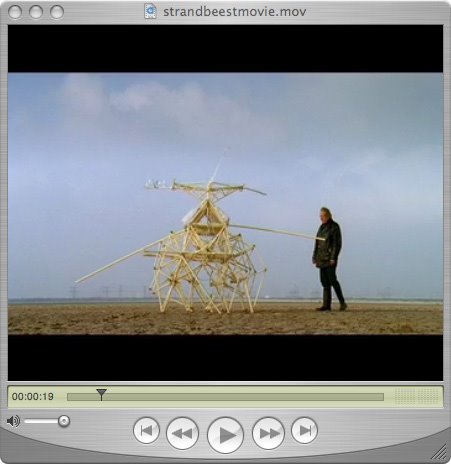
Many of our readers leave comments to posts published weeks or months earlier, and as such often go unnoticed. Or so we suspect. Therefore, we're moving one recent comment to the front, an announcement by Alexander Schlichter alerting us to an upcoming documentary about Theo Jansen and his strandbeesten. The shooting starts today.
“From 22nd June until 6th July we accompany Theo Jansen to London,“ writes Schlichter. “There he has an exhibition at ICA (Institute of Contemporary Art) and the strandbeesten will walk on the Trafalgar Square. I try to write an article each day about our shooting.”
Perhaps it's entirely possible, if one loiters long enough in the general production area, that you could come away with a cameo appearance in the finished film. But anyway, while the team is shooting in London, their diary will be published here.
Le voyage dans la lune (dir. George Méliès, 1902)
This short film from the earliest days of the cinema follows a group of astronomers on a journey to the moon.
Das Kabinett des Doktor Caligari (The Cabinet of Dr. Caligari) (dir. Robert Wiene, 1920)
The great Expressionist classic with Werner Krauss as Caligari, the fairground showman who hypnotizes his servant (Conrad Veidt) into committing murder at night.”
M (dir. Fritz Lang, 1931)
“A series of schoolgirls are murdered by a psychopath who terrorizes a large city and is hunted by the police through a network of beggars. Inspired by the real-life 'vampire of Dusseldorf,' Fritz Lang's great film is one of the key films of German Expressionism. Peter Lorre's performance as the murderer is one of the great screen performances of all time.”
Things to Come (dir. William Cameron Menzies, 1936)
“A global war begins in 1940. This war drags out over many decades until most of the people still alive (mostly those born after the war started) do not even know who started it or why. Nothing is being manufactured at all any more and society has broken down into primative localized communities. In 1966 a great plague wipes out most of what people are left but small numbers still survive. One day a strange aircraft lands at one of these communities and its pilot tells of an organisation which is rebuilding civilization and slowly moving across the world re-civilizing these groups of survivors. Great reconstruction takes place over the next few decades and society is once again great and strong. The world's population is now living in underground cities. In the year 2035, on the eve of man's first flight to the moon, a popular uprising against progress (which some people claim has caused the wars of the past) gains support and becomes violent.”
Swamp Women (dir. Roger Corman, 1955)
“The film follows undercover police officer Lee Hampton after she infiltrates a prison, befriends three female convicts, and helps them all escape. In reality, this planned escape is part of a larger plot to find a diamond stash hidden deep within the swamps of Louisiana.”
Atom Age Vampire (dir. Richard McNamara, 1960)
“A stripper is horribly disfigured in a car accident. A brilliant scientist develops a treatment that restores her beauty and falls in love with her. To preserve her appearance the doctor must give her additional treatments using glands taken from murdered women. His unexplained ability to turn into a hideous monster helps with this problem but does nothing to win her love. The doctor's woes multiply as the police and the girl's boyfriend begin to close in on him.”
I wish. But in the meantime, there is the just released Busby Berkeley Collection, which packages together five of the visionary's greatest works: Footlight Parade (1933), Gold Diggers of 1933, Dames (1934), Gold Diggers of 1935, and 42nd Street (1933).
And it's got everything: dancing skyscrapers; gravity-defying pianos in deterrestrialized spaces; abstracted, disembodied, and dematerialized nubile bodies; ornamental, self-organizing crowds; Depression-era urbanism; hotels and arcadian watering holes teeming with pre-Code connubial bliss; Renaissance perspectives on acid; phantasmagorical stage sets; and a bitchless Bette Davis. You'll feel like singing and dancing afterwards. Marvelous!
For this series, just one film: The World (2004) directed by Jia Zhangke.
Chicago Reader's Jonathan Rosenbaum gives us his blurb: “Suggesting at different moments a backstage musical, a failed love story, a surreal comedy, and even a cartoon fantasy, this beautiful, corrosive, visionary masterpiece by Jia Zhang-ke is a frighteningly persuasive account of the current state of the planet. Set in an eerie Beijing theme park--a kind of Chinese Las Vegas, with scaled-down duplicates of the most famous global landmarks--it follows a bunch of workers as they labor, carouse, couple, and uncouple, but it's really about propping up extravagant illusions through alienated labor.”
If that doesn't temp you to seek it out, perhaps its trailer will.
The Incredible Shrinking Man (dir. Jack Arnold, 1957)
After an accidental exposure to radiation, Scott Carey begins to shrink. Confounding doctors, his family, and himself, he must nevertheless cope with the realities of his downgraded scale: cats and spiders morph into Godzillas, salt shakers into skyscrapers, a dollhouse into an American homestead, and sex into an Almodovar fiesta (or so we think).
Fantastic Voyage (dir. Richard Fleischer, 1966)
A team of scientists is miniaturized and injected into the bloodstream of a famous physicist in an attempt to destroy a clot that threatens his brain. One of the most visually lush SF film.
The Andromeda Strain (dir. Robert Wise, 1971)
When a deadly alien virus turns up in a New Mexico town, a team of scientist is dispatched to isolate and neutralize it before it. They must do so in just a few days or else their research complex, and they, gets pulverized by a nuclear blast.
Tron (dir. Steven Lisberger, 1982)
The inner workings of the computer is reimagined as a totalitarian state.
Honey, I Shrunk the Kids (dir. Joe Johnston, 1989)
An inventor devises a gizmo that accidentally shrinks his kids and their friends. The real treat is the suburban backyard transformed into an endless jungle fraught with dangers, fantamagical creatures and thrilling adventures.
Fast, Cheap & Out of Control (dir. Errol Morris, 1997)
The stories of four unconnected individuals: a lion tamer, a topiary gardener, a mole-rat specialist, and a robot scientists.
The plots are inconsequential. The reason to see these movies are the spectacular musical numbers, Hollywood's secular reinterpretation of Michelangelo's Genesis and Last Judgement frescos in the Sistine Chapel, directed and choreographed by Busby Berkeley.
Surely no one would be able to resist watching dancing skyscrapers; gravity-defying pianos in architecture-less, scale-less spaces; eroticized bodies writhing in pastoral landscapes like Michelangelo's damned souls; Depression-era New York; a hotel filled with pre-Code connubial flesh; anti-Taylor spatial organization; and phantasmagorical stage settings that only Matthew Barney seems fit to appropriate.
The Kid from Spain (dir. Leo McCarey, 1932)
“But We Must Rise” and “Oh, What a Perfect Combination”
42nd Street (dir. Lloyd Bacon, 1933)
“Shuffle Off to Buffalo,” “Young and Healthy,” and “42nd Street”
Gold Diggers of 1933 (dir. Mervyn LeRoy, 1933)
“Pettin' in the Park,” “Shadow Waltz,” and “Remember My Forgotten Man”
Footlight Parade (dir. Lloyd Bacon, 1933)
“Honeymoon Hotel,” “By a Waterfall,” and “Shangi Lil”
Dames (dir. Ray Enright, 1934)
“I Only Have Eyes For You” and “Dames”
Gold Diggers of 1935 (dir. Busby Berkeley, 1935)
“The Words Are in My Heart” and “Lullaby of Broadway”
Greed (dir. Erich von Stroheim, 1924)
Miner-turned-dentist John McTeague could have been happily married if it were not for his wife winning the lottery, but of course, the money paves the way for their downfall with a desultory climax in Death Valley.
Playtime (dir. Jacques Tati, 1967)
Monsieur Hulot fumbles his way through modern Parisian architecture, landscape, and leather furniture.
Aguirre: The Wrath of the God (dir. Werner Herzog, 1972)
The search for the mythical El Dorado in the jungles of South America degenerates into a nightmare.
My Own Private Idaho (dir. Gus van Sant, 1991)
Two hustlers try to survive in the Pacific Northwest. While one is searching for his family, the other is fleeing his.
The Thin Red Line (dir. Terrence Malick, 1998)
Guadalcanal provides the setting for one of the most poetic films of the 90s.
The Wind Will Carry Us (dir. Abbas Kiarostami, 1999)
A media “engineer” from Tehran travels to northern Iran to document the funeral rites for an old woman. But she hasn't died yet, and so must wait and find something to occupy his time around the village.
In need of a movie suggestion? Try a movie or two or an entire series from the Landscape Architecture Film Series [see the full list here (continues in the comments)] at the University of Illinois Urbana/Champaign. Missing from the website are the series from Spring 2004 and Fall 2004. They are listed below.
SPRING 2004 FILM SERIES
Alien Nation or: How I Stopped Worrying and Learned to Live with Foreigners