Here's your chance to have your work be included in the U.S. Pavilion at the 2012 Venice Architecture Biennale. The theme is “Spontaneous Interventions: design actions for the common good.”
This year's curators, from the New York-based Institute for Urban Design, are looking for projects that are “[p]rovisional, improvisational, guerrilla, unsolicited, tactical, temporary, informal, DIY, unplanned, participatory, [or] open-source.” If at least one of those words describes your project, which additionally meets the following criteria, then consider submitting it.
1. project was initiated by the architect/artist/planner/landscape architect/hacker/activist/citizen (in other words, no one asked for it), OR was initiated by an alternative client, for example, a non-profit or a community group
2. project is publicly accessible and serves the common good
3. project improves a problematic condition (solves a problem by making a place more accessible, inclusive, sustainable, beautiful, etc.)
4. project is located in an urban context or tackles urban issues in the United States
5. project is participatory in nature, or open access, and serves an underserved or overlooked constituency
6. project is realized, deployed, in action or use (not theoretical)
7. project may be a physical intervention in an urban context, or an information, communication or digital project that improves people’s comprehension, navigation and access to a city
Specifically, Greek swimming pools. We are always reminded of them now whenever we hear news of the financial crisis plaguing Eurozone member countries. Every time, without exception, news of property market bubbles, sovereign debt, IMF bailouts, governments collapsing and violent street protests, including pipe bombs set off by domestic anarchists, not only from Greece but also from Ireland, Portugal and Spain — they inevitably conjure up Suprematist images of shimmering Aegean exclaves.
This is because, as reported by Spiegel last year, Greece has been using creative ways to boost tax revenues and lessen the country's crippling government deficit. These include using Google Earth to find the swimming pools of tax cheats.
Using police helicopters, Greece's financial crimes squad “fly over Athens' affluent suburbs and make films of homes owned by doctors, lawyers and businesspeople. They use satellite pictures by Google Earth to locate country villas, swimming pools and properties. And these tactics have revealed that the suburbs didn't have 324 swimming pools, as was reported, but rather 16,974.”
...which can abruptly make a detour to George Clooney...
If you haven't already heard, the Hollywood superstar contracted malaria while on a trip to Sudan earlier this month. He was there to observe the voting for independence in Southern Sudan and to draw attention to any humanitarian abuses that might arise during and after the referendum. He has since been cured.
No doubt a far less physically taxing way to draw attention to any conflict is through another George Clooney initiative: the Satellite Sentinel project.
A collaboration between Google, the UNITAROperational Satellite Applications Programme (UNOSAT), Harvard University and celebrity-backed NGOs, the project hires private satellites to monitor signs on the ground that could indicate impending violence, such as troop buildup and movements. The images gathered by the satellites are being made public to let would-be aggressors know that the world is watching them.
“We are the anti-genocide paparazzi,” says Clooney.
...and further deviate halfway around the world to the Amazon rainforests...
Last year we read about the efforts of the Surui Indians in Brazil to protect their land reservation. “Almost three times the size of New York City,” their patch of the Amazon rainforest is constantly threatened by farmers, loggers, ranchers and gold miners from all sides. They've lost some of their forest to deforestation, but managed to save the rest.
In order to protect what's left, they've teamed up with Google to capture high resolution satellite images to better spot illegal activities on their land. Every inch of their forest will be mapped and displayed on Google Earth.
...before getting to the topic at hand: food.
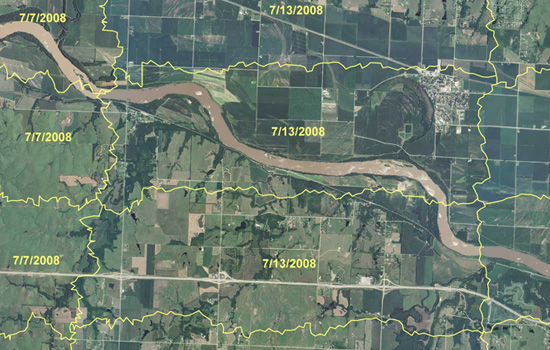
Tax collectors, tech-savvy indigenous tribes and George Clooney aren't the only ones using remote sensing and GIS applications to monitor and catch acts of criminality. There are also the crop cops at the U.S. Department of Agriculture's Aerial Photography Field Office.
Farmers may seem like trustworthy people, but the U.S. Department of Agriculture is taking no chances. It's spending tens of millions of dollars to create an enormous computerized map of every farmer's field in America. The program is intended to make sure farmers are doing what's required to earn their government subsidies.
It's an enormous task, keeping track of those subsidies. They add up to billions of dollars each year and they go to more than half a million farmers, scattered from Maine to California. Some farmers receive payments for protecting streams and wetlands; others, for growing specific crops. In each case, the payments depend on accurate information on the amount of land involved. So the USDA has resorted to a program of overhead reconnaissance — something akin of spy flights.
We mentioned this program, called the National Agriculture Imagery Program (NAIP), a couple of years ago when food prices were at record levels. Because farmers could earn more money by growing cash crops, they started converting the protective greenbelts back into croplands. In the fall of 2007, according to The New York Times, farmers “took back as many acres as are in Rhode Island and Delaware combined.”
Then came the global financial crisis of 2008, and food prices declined. But that decline, reportsGuernica, “seems to have been an anomaly.”
The December 2010 index of global food prices compiled by the U.N.’s Food and Agricultural Organization (FAO) hit a record 215, one point higher than in the spring of 2008. In fact, some food products, including sugar, cooking oils, and fats, are now trading substantially above their 2008 levels; others, including dairy products, grains, and meat, are inching perilously close to record levels.
So we'll we see more conversion of greenbelts into croplands? And will there be that one farmer who's going to keep their plump subsidies, courtesy of foreclosed and unemployed taxpayers, while plowing yet even more riches from destroyed wildlife habitats?
But what's a post without a (regurgitated) proposal: The Distributed Bureau of Agricultural Crime Investigation.
The problem with the National Agriculture Imagery Program is that there's just too many farms and too few analysts. Actually, we don't know if there are in fact too few analysts to pore through all those maps. It may be that just one cartographer is that's needed to comb through all the maps of Kansas and can do it in a couple of days.
But why not crowdsource it? Why not release the maps (that is, wikileak them, as they aren't in the public domain due to privacy matters) to the internet wilderness of distributed grid computing, data pornographers, meme-hungry social networking sites, open source virtuality and web-savvy eco-guerrillas?
It'd be like Einstein@home, a citizen science project which last year discovered a “disrupted binary pulsar” that may be the fastest-spinning of its kind. But instead of surveying the universe for distant remnants of supernovas, the teeming Web 3.0 masses use their collective clicking power to survey much nearer terrains. Imagine thousands of Google Earth addicts as citizen crop cops panning through digital screens in search of horticultural counterfeits, hours on end trying to spot cornfields where there should be reconstructed prairie or wetlands. This may even be the only time they get to interface with that other wilderness beyond the urban periphery — with Nature — for an extended amount of time.
Protecting your tax dollars while saving the environment — and enjoying the outdoors.
Another fascinating project from Paisajes Emergentes in collaboration with Lovisa Lindström, Sara Hellgren and Sebastian Monsalve. Called Clouds, it's a proposed installation to be located in every town that will be flooded by the Ituango Hydroelectric Dam megaproject in Colombia.
Having not yet read any project statement, we can't accurately describe the actual mechanics of this installation. Nevertheless, we like what we think is the intent of the design team. That is, we're imagining this as an act of protest for environmental and social justice — which, if true, would be a refreshing change from the typical Archigram and Buckminster Fuller-inspired apocalyptic and utopian buoyant scenarios.
While cities and villages await the start of dam construction and their inevitable drowning, these ominous clouds will be deployed up to the water level of a future reservoir, forming an archipelago of artificial islands in an absent artificial lake. Their shadows will cast upon forests and mountains to be asphyxiated. They will loom high above lives about to be wrenchingly disrupted.
Since the top is leveled, locals (and perhaps disaster tourists) will hop on and ride these aerial barges. Agents from the hydroelectric company will come to educate the benefits of the dam. Politicians will come to boast this public works project as civilizing and modernizing. And environmentalists will come to praise this new source of clean energy.
But other environmentalists who have actually done their homework will come to counter the engineers and bureaucrats with the dam's monumental destructiveness. Indigenous peoples will come to protest their displacement from their ancestral lands. Downstream localities already suffering from water scarcity will come to claim their water rights. And many more will come to seek redress of unfair compensations for their lost properties.
The views of the surrounding (contested) terrains will be absolutely picturesque, but the air will be highly charged. One false move from any of the factions and things will combust.
But what are they exactly? Sculptures? Follies? Floating parks? Pavilions?
Pavilloons™?
In the aftermath of the deluge, will they be used as diving platforms from which former residents will try to salvage what few they can of their possessions from their submerged cities? And unsurprisingly from where looters will carry out their moon fishing expeditions?
Perhaps while awaiting relocation, some of these hydro-refugees will use these platforms as temporary informal settlements, which then organize organically into permanent island cities.
Last month, a cadre of guerilla architecture critics (or just plain vandals) splashed the white walls of Richard Meier's Ara Pacis Museum with green and red paint, thus rendering the Italian tricolor in an unintentional homage to America's greatest living painter, though permanent Roman habitué, Cy Twombly.
It was presumably the first outwardly visceral manifestation of popular distaste for the building.
Many others no doubt would like nothing more than to deface the museum. The mayor, for instance, has been very vocal about wanting to remove it (minus the altar, of course) and then reconstruct it fuori le Mura. Whether this would mean that the original will be recycled for the new building or entirely torn down into unsalvageable detritus, these urbicidal fantasies of demolition, alteration and displacement are pretty much on par with the spatial history of the piazza.
The new building, for instance, replaced a pavilion partly designed by Vittorio Ballio Morpurgo under Benito Mussolini to house the Ara Pacis, which was discovered somewhere offsite and relocated to its present location. This earlier building was dismantled, because it was deemed incapable of protecting the ancient monument from Rome's damaging pollution and summer weather. However, a stone wall containing inscriptions of the Res Gestae Divi Augusti was saved from total annihilation and incorporated into Meier's building design. A new temple built on top of the foundations of an old temple.
Meanwhile, the demolished pavilion itself was part of a Fascist program of erasure. Mussolini wanted to create a new piazza, the center piece of which would be the Mausoleum of Augustus. At the time, parts of the tomb laid buried beneath several layers of urban fill and topped with a concert hall, the latest in a long line of adaptive reuse programs. The tomb was further “hidden” by narrow streets and dense urban growth. To “liberate” it, Mussolini simply obliterated the surrounding neighborhood.
Left untouched were a couple of churches, one of which, San Rocco, is a fascinating impasto of Renaissance, Baroque, Neo-Classical and Palladian styles. These survivors — together with Morpurgo's pavilion and a complex of new modern buildings for use by Fascist Party functionaries — were calibrated to frame the bounded space of the new Piazza Augusto Imperatore.
It's interesting to note here that embedded on the facades of the new buildings are friezes, mosaics and inscriptions, a decorative program no doubt intended to create a link with the sculptural reliefs on the Ara Pacis on the other side of the piazza. One of those inscriptions, apart from mythologizing Mussolini and Fascism, actually commemorates the restoration of the Mausoleum of Augustus and by extension celebrates the urban pogrom that had to be metted out in order to “liberate” the tomb from its shadowy grave. So perhaps if the mayor were to carry out his own pogrom, then he, too, may commemorate it with yet another set of friezes on the front of his new museum. And obviously these new friezes will also memorialize our liberation from starchitectural stupor.
In any case, to add to these violent, cross-spatiotemporal architectural critiques, Meier stated after the demolition of Morpurgo's pavilion but before the start of construction of his new museum that he wanted (and may yet still want) to tear down the other Fascist-era additions to the piazza. These buildings may have perfectly acted out Mussolini's urban scenography of Fascist ideologies but the resulting piazza is an incredibly failed urban space. It's inhospitable to everyday use and pedestrians avoid it. Meier presumably knows better. And if he gets his way, then there would be another occasion for textual frotteurism and iconographical link-orgy: a sculptural band of friezes in which we see the wannabe urban planner in the guise of the Angel of Modernism — Meier Dux, the liberator of the Eternal City from its own ancientness.
But we're obviously digressing.
When reading about the incident, what grabbed our complete attention wasn't the paint job. What actually spurred us into confecting this post was the porcelain toilet and the two packs of toilet paper left at the scene.
Because these scatological implements aren't the most imaginative form of “activism” (or for no other reason than just because), we set about concocting less facile, though dubiously practical, strategies of protest. We used the following as points of departure.
1) As far as we know, no one has yet come forward to claim responsibility for the vandalism. The presence of Graziano Cecchini in the crowd of onlookers at the scene, however, elicited some very faint accusatory speculations. Cecchini, you might remember, was the artist and member of the neo-Futurist group, ATM Azionefuturista 2007, who dyed the Trevi Fountain red nearly two years ago, an incident which we covered here then. If you can also recall, he turned the fountain's crystal clear waters into a vermillion Nile as a way to protest the obscenely high cost of organizing that year's International Film Festival of Rome — like a self-righteous Moses preaching to a bunch of uber-consumerist Ramesseses.
2) Earlier that summer, another incident occurred at the Trevi Fountain and at other Roman fountains. You can say that it was similarly faintly Biblical: the waters parted — or rather dried up — which is probably the same thing. The culprits that time weren't hydro-anarchists venting out grievances with the hegemonic elite. Vandal-artists weren't enacting one of their staged happenings using the built environment as their canvas and minor urban disasters as their paint. As we reported at the end of last year, the water supply to the fountains was cut short when construction workers across town damaged an ancient pipe while building a private underground car park. The blockage was discovered when a waterborne camera was slithered through the city's rhyzomatic ecosystem of voids to pinpoint its location.
While the tired, sweaty tourists around the city didn't erupt into a riotous mob, this incident left us wondering whether they could be agitated into a pillaging horde, ransacking archaeological sites and museums, by strategically pinching the right combination of ganglial pathways of the city's infrastructural network.
3) Staying in Rome but venturing more than a century back in time: in the 1870s, we read in The Colosseum by Keith Hopkins and Mary Beard, archaeologists dug up the floor of the Colosseum and exposed its basement corridors. This apparently upset so many people, including the Pope, because it meant removing the arena's religious paraphernalia, such as the Stations of the Cross, a huge crucifix in the center and a hermitage and its hermit. The recently unified Italian state, in other words, was seen to be trampling over sacred ground, and the birthplace of so many martyrs and saints, was to be converted into a secular artifact, an archaeologist's play pen.
But of greater interest for us here is the fact that during the excavation, drainage was such a problem that the sewers and underground corridors had filled with water. Harkening back to when it used to host mock naval battles, the Colosseum remained an artificial lake for many years until a new sewer was built to channel the water away.
4) Returning to the present but now venturing out of the city: decorating this post are CC-licensed photos of Stuck Inflatable Zeppelin, one of several installations collectively called Sciame di Dirigibili by the Mexican artist Héctor Zamora at this year's Venice Art Biennale.
5) Further afield: in an article published by The New York Times in 2003, we learned that public works officials in New York sent a self-propelled, submersible Autonomous Underwater Vehicle (AUV) down into in the 85-mile long Delaware Aqueduct that supplies New York City with half of its drinking water. Millions of gallons have been leaking, and they wanted to know where and how it was seeping out.
Leakage of up to 36 million gallons a day was detected starting in 1991. The leaking stretch lies somewhere between the Rondout Reservoir in the Catskills and the West Branch Reservoir, a way station for city-bound water here in Putnam County.
The escaping water is just a small percentage of the 1.3 billion gallons supplied by the system each day, but still equals the daily consumption in Rochester.
Water percolating upward hundreds of feet from tunnel leaks has created wetlands and damp areas in Ulster and Orange counties that endure even in the region's worst droughts.
The city's engineers have been periodically sending, as recently as last month, torpedo-shaped, deep-sea robots to monitor the cracks.
There are important lessons about crumbling infrastructure and the importance of surveillance and maintenance in an age of peak water and climate change that no doubt could be extracted from here, but we have to move on.
So. Instead of leaving cute trinkets next to one's object of disgust, you go for the jugular.
First assemble together a fleet of self-propelled, subterranean dirigibles. Be sure that they can navigate through both water-filled tunnels and more airier ones. To be able to track their location and velocity, implant each one with an iPhone or any cheap, GPS-enabled mobile device.
With maps of the negative labyrinth on hand, you let them loose. At designated strategic nodes, you phone them. They pause in mid-flight. Seconds later, they inflate and wedge themselves very tightly in the tunnel. If the tunnel is too big, then several of your dirigibles will clump together to ensure total blockage. And then finally, using the sewers' miasmic vapour as a reagent, their nylon skins fantamagically fuse with the tunnel walls and turn metallic, nearly diamond-hard. An hour or two later, manholes and storm drains begin venting your furious critique. A further hour or two, an artificial lake lays stagnant next to (or better yet, surrounds) the target building.
Of course, the target needn't be a building. It could be a new plaza as anti-pedestrian as the Piazza Augusto Imperatore. Or an obscenely overbudget hyper-park. Or a grotesquely earnest memorial. Or a similarly ghastly public art installation whose aesthetics suggest it has time-travelled from the 80s. Whatever it is, you consider it a pestilential addition to the built environment in the same way your artificial lake is a deadly public health hazard.
Not surprisingly, others with their own beef and their own agenda will copy your tactics. Sewers all over the world will be swarming with dirigibles, buzzing with the amplified hum of their tiny propellers. Artificial lakes will bubble up and vanish, rising and falling in accordance to the perennially shifting climate of architectural taste.
Not surprisingly as well, officials will try to stop these acts of sabotage. They will take sewer maps out of the public domain. They will even request the federal government to classify them as state secrets. Consequently, all public works employees will have to undergo extensive background checks and sign non-disclosure agreements. Urban adventurers will be charged with espionage if found hiking through the tunnels. Or simply shot on site as they claw their out of the sewers like Harry Lime in The Third Man.
If the public before were oblivious to the vast underground landscape that makes their life possible, only getting a hint of what lies beneath when an underpass is flooded or when a boy mysteriously goes missing while out exploring an abandoned section, then they will now be utterly, completely, permanently ignorant.
When a boy does indeed go missing, there will be no search and rescue and thus no wall-to-wall television coverage of melodrama. There will be no prolonged national hysteria over the fate of the child, and there definitely will be no photogenic heros confected out of the whims of the masses. The missing kid will simply be censored from the day's news, and the parents will be told they never had that child.
The kid, like the sewer maps, will be redacted.
In response, sewer anarchists will outfit their dirigibles with DIY sonars or laser scanners. They will make their own maps.
As a counter-countermeasure, combat engineers will reconfigure the network into an even more bewildering jumble of tunnels. They will dug fake tunnels, tunnel that leads to dead ends, tunnels that impossibly knot into themselves, tunnels with sonar-cancelling pings, tunnels that lead to police headquarters, tunnels that effloresce into a thicket of infinitely bifurcating tunnels, and tunnels that lead to other dimensions.
Alternatively, they will de-tangle the network. Obsolete tunnels will be filled in, others consolidated. Certain segments will be expanded into rationally planned, naturally lighted, cathedral-like vaults. These tunnels will actually be more than what the city needs to funnel its wastewater and stormwater, but at least they will be hard to be barricaded. It's the Haussmannisation of the sewers.
The other side, of course, will simply hack their dirigibles into more sophisticated mapping tools and employ advanced computer modeling techniques to simulate alternative infiltration strategies.
It's one side always trying to outwit the other side.
In our very nascent days, we reported about these community gardens. This is what we wrote:
For over a decade, a group of mostly immigrant families have been tilling a colorful patchwork of thriving farms in one of the most industrialized landscape of Los Angeles. Out of concrete and asphalt, a community of urban farmers have cultivated a whole variety of fruiting trees, cash crops and vegetables. Growing in the shadow of power lines and skyscrapers are avocado, guavas, bananas and peach trees, as are sugarcane, corn, cactus, lettuce, winter squash, broccoli and lettuce. The list surely contains a lot more, but all are harvested not just for food but also for medicine and to supplement low incomes by selling them.
It is by no surprise that we found ourselves imagining what would have been if some pieces of this mosaic of Edens had survived and then wholly transplanted to another place, kept nurtured there and its fruits continued to be harvested until this summer, when it would have been wholly transplanted again all the way to Venice for this year's Architecture Biennale. Rather than a garden installation by Kathryn Gustafson (x2), visitors find a replicant urban farm with migrant workers tilling its soil. Instead of an allegory of earthly dilemmas, one is immediately confronted with the real world of real issues: environmental and social justice, globalization, the geopolitics of displacement, gentrification, etc. And instead of achieving enlightenment through heavyhanded formalism, overly programmed narrative and yesteryear's signification, you enter into a real dialogue with the gardeners and are truly made aware.
In any case, screenings of the movie are very sporadic at the moment and probably will remain so, unless it finds a distributor. We hope a DVD will be released soon.
Last week, Phronesisaical reminded us again of Wafaa Bilal's Domestic Tension, a piece of performance art, which they describe as “a brilliant commentary on war and the complicity of those for whom distance creates a sense of false reality and moral neutrality.”
For 30 days, Bilal lived in a 4.6 by 9.8 metre performance space [at Chicago’s FlatFile Gallery], while people around the world watched – and targeted him – through a webcam attached to a remote-controlled paintball gun, capable of firing over a shot per second at the Iraqi in question.
While it won't be as powerful or even catch the attention of the Department of Homeland Security, how about installing webcams to watch over landscapes as their mineral wealth gets extracted? Next to it would be a garden hose, with which you could target passing miners. Dirt clinging onto them will be washed away; they may even be refreshed by its cool waters. And you, the direct beneficiaries of their labor, will also be cleansed of your consumerist sins. Tele-absolution.
This performance art will be titled It's the least that I could do.
Also last week (and on the same day), Design Under Sky pointed us to TRASH: anycoloryoulike, a public art installation in which “standard piles of trash are replaced with artist-created bags” to decorate the streets of New York. The project simultaneously “beautifies the city and calls attention to waste consumption.”
Next summer, artist Adrian Kondratowicz, with Miuccia Prada's patronage, will cloth the homeless with green ready-to-wear, thus “beautifying urban parks and calling attention to human waste.”
Continuing on with this last week meme, here are two items posted the day before Phronesisaical and Design Under Sky published theirs.
Firstly, BLDGBLOG covered a “bouncy chapel” for the penitent on vacation on the beaches of Sardinia. It “comes complete with an altar, an apse and a confessional.”
It also reminded us of another inflatable church installed this May on a parking lot in Troy, New York. Though not built for traditional worship, it was a 1:1 scale reproduction of the church — “a historic site in the fight to abolish slavery” — that once stood on the same site.
Spectres of Liberty is a public memory, site-specific art project. Beginning with a sense of loss about the changing built environment of Troy, New York, we set out imagining ghosts of demolished buildings and structures. Through imagining inflatable sculptural extensions to buildings whose facades have been destroyed to thinking about recreating vanished historic sites, we decided on creating a ghost of the Liberty Street Church.
Seen through the diaphanous walls of this ghost church, visitors themselves appear ghost-like, ectoplasmic, haunting the same space as the past.
Secondly, Dezeen showed some photos of a stair-like viewing platform, which the Office for Subversive Architecture attached to the 17-kilometer-long, blue fence surrounding London's future Olympic Park. Climb up, and for a moment you can infiltrate “the secrecy surrounding preparations for the 2012 Olympics.”
It recalls to mind Heavy Trash's viewing platforms for gated communities in Los Angeles. Some photos here.
To borrow language from Sites Unseen: Landscape and Vision, they are framing devices for a staged aesthetic experience and to suit a sociopolitical agenda.
Many have posted Michel de Broin's Superficielle before, and it was Vvork's turn last week. It's a lovely sculpture that renders the landscape into a Cubist puzzle.
Quoting de Broin:
Upon invitation to reflect on the notion of transparency, that led me into the forest to envelop the contour of a large stone with fragments of mirror. The large stone, tucked away deep in the woods, became a reflective surface for its surroundings. In this play of splintered radiance, the rock disappears in its reflections. Because it reflects one cannot be mislead by its presence, yet we cannot seize it, rather it is the rock that reflects us.
A horrible, horrible last sentence, but a marvelous, marvelous installation nonetheless.
The famed beaches of Malibu are public; you are the owners.
However, there seems to be a concerted effort to confuse the public, to make one feel like a criminal trespasser in some exclusive enclave of millionaires and celebutants. If you aren't met by security guards at the very few public access entrances, this after navigating through barriers just to get to public parking lots, there are signs warning you that you are passing through “private property” and entering a “private beach.”
There are signs everywhere: “No Parking Any Time”, “No Stopping”, “Right to pass by permission” — the majority of which are false and illegal. It's as if the aristocracy along Central Park West and 5th Avenue has conspired to keep the public away from Central Park.
To see that the public is properly instructed on how to access the beach — your beach — the Los Angeles Urban Rangers provides an easy-to-use field guide [PDF]. From their website, you can also download a reprinted article, by Jenny Price, from LA Observed that gives you more detail.
Having both with you shouldn't necessitate carrying copies of the California Coastal Act and the state's constitution.
For those who are in Los Angeles this weekend, you can also sign up to a “safari” organized by the urban rangers, who will teach you how to navigate those invisible lines separating private-property and public lands. A “public easement potluck” is also scheduled on your beach.
POSTSCRIPT #1: Many have asked for the complete text; we relent: “Dos Personas encadenarons sus brazos al suelo en una galería subterránea a cuatro metros de profundidad para evitar, o al menos retrasar, el desalojo y derribo del inmueble que ocupan en el centro de sevilla.” Original.
A group calling itself the ATM Azionefuturista 2007 has turned one of Rome's most famous monuments into a bloodied protest canvas.
One of its members, in full Futurist glee, “threw a bucket of red paint or dye into Rome's Trevi Fountain on Friday, coloring the waters of the 18th-century monument bright red in front of a crowd of astonished tourists and residents.”
The man escaped, leaving the fountain, which normally runs on a closed cycle, spouting red water. Police arrived and technicians briefly shut off the water before restoring a clear flow.
Experts said the baroque fountain was not permanently damaged and the marble statues depicting the sea deity Neptune on his chariot had not absorbed the color.
At first I thought the guy read an advance copy of The New York Times Magazine's extended report on the neverending water problems of the American Southwest, and so was compelled to carry out this guerrilla attack to highlight the impending climate change disaster to an audience of intensive carbon-producing tourists. Like a self-righteous Moses to a bunch of uber-consumerist Ramesseses.
But alas, based on leaflets found nearby, officials think that he was simply protesting against the “expenses incurred in organizing the Rome Film Festival.” The red waters of the Trevi, then, “symbolically referred to the event's red carpet.”
It was one simple gesture by one person, but the whole world has taken notice. So perhaps next year, another famous fountain will be made to spew vermillion waters — or preferably, made to stagnate and concoct a toxic stew of fluorescent green algae — to successfully call international attention to our present shared hydrological crisis.
Since the fountain is constantly being monitored by CCTV cameras, there is a video of the incident:
From January 10, 2005 to October 22, 2006, or thereabouts, Ledia Carroll retraced the ghostly outline of a vanished freshwater lake in San Francisco as part of her Mission Lake Project.
From a press release, to be read in the past tense, unfortunately: “On October 22, 2006, Ledia Carroll will use a field line chalker to recreate the full perimeter of Lago Dolores, a former freshwater lake that stretched from what is now South Van Ness to Guerrero and 15th to 20th Streets. Drawing the line in reference to maps from the 1800s, Carroll’s chalkline allows the still visible ancient depression of the lake to become apparent to the eye. In conjunction with the re-created lake shoreline, Ledia Carroll presents a 'lakeside' barbeque and perimeter 'alleycat' bike race.”
There were also guided tours later in the year to some of San Francisco’s hidden underground waterways. And if someone could let us know where we might find more info on these hidden waterways online, that'd be fantastic.
National Geographic Newsreported earlier this year that “isolated tribes in the Amazon are now using satellites, computers, and even Google Earth to guard against threats from logging, agriculture, drug wars, and oil operations.”
In another National Geographic Newsarticle, we also read that activist groups in Southeast Asia have been helping indigenous communities “mix computers and handheld navigation devices with paints, yarn, and cardboard to make simple but accurate three-dimensional terrain models.” These models were then used in the courts to fight developers and in gaining political support. Already the Higaunon people in the Philippines have won an ancestral land title, and the Rumah Nor in Malaysia have stopped a major paper company from encroaching on its territory.
With Google spotlighting the continuing genocide in the Sudan on Google Earth, there is much to be enthusiastic about this synergy between high-tech geospatial technologies and human rights activism.
Unfortunately, as with any quasi-democratic government easily prone to corruption and bribery, lawmakers in the Philippines and Malaysia have re-written existing laws to require the use of GIS technologies and “anything related to measuring space” to officially recognized professionals.
While these legislative revisions do not outright forbid indigenous groups from making maps and terrain models, they effectively bar indigenous communities from making high-tech maps. As Mark Bujang, of the Iban people from Malaysia's Sarawak state on the island of Borneo, explains: “Imagine that indigenous communities who are trying to show the location and size of their native customary land in court are not able to do so unless they get someone who is licensed and registered. This is not possible, because most of the licensed and registered surveyors are working with the government or private consultant firms, [and] the latter costs too much for the communities.”
For over a decade, a group of mostly immigrant families has been tilling a colorful patchwork of thriving farms in one of the most industrialized landscape of Los Angeles. Out of concrete and asphalt, a community of urban farmers have cultivated a whole variety of fruiting trees, cash crops and vegetables. Growing in the shadow of power lines and skyscrapers are avocado, guavas, bananas and peach trees, as are sugarcane, corn, cactus, lettuce, winter squash, broccoli and lettuce. The list surely contains a lot more, but all are harvested not just for food but also for medicine and to supplement low incomes by selling them.
“THE MOUSE-EAR HAWKWEED tolerates soil that is nutrient-poor and is drought tolerant. It is very good at stacking its own territory by creating a dense mat that other plants can't penerate: Travel light. It can be found to habitat, carparks and other low-level urban sites (crossing borders in such places can be fairly simple and risk free); railway sides (Passing an active rail tunnel on foot requires the careful observation of traffic for safe passage); urban wastelands, poor meadows and open woodlands.
“NOTE: borders become more defined by the economic movement than that of the movement of persons.”
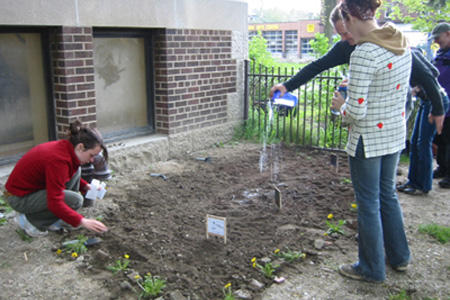
“Without permit or license, we plant seeds and seedlings in all those neglected corners of public space.”
I am heartened to hear that native species are being prescribed. Hope it outgrows its "guerrilla" moniker as it usually implies a transitory act, minimal public participation, and intangible community benefits. But would it then become “community gardening?” A fascinating thread in the urban garden narrative.