It's that time of the year again when Kerb sends out another call for submissions. Overseen once more by an editorial staff of students at the RMIT University School of Architecture and Design in Melbourne, this year's theme is Speculative Stories: Narratives in Landscape Architecture.
Speculative narrative and the potential of imagination are important factors in creative production. It is considered that a multitude of small stories are the “quintessential form of imaginative invention”.
Speculation through narrative offers an apparatus through which we may investigate the concept of ‘reality’. Immersed within our current understandings, speculation is influenced by our contemporary condition. In these fictional dispositions, the variables and constraints of ‘reality’ can be controlled, omitted completely or utilized as key motives for the foundations of new territories.
Speculative Narrative can be an exploration of idealistic scenarios, the fossilization of information, or the creation of fantastical realms.
This allows the model of design to move beyond problem solving, crisis management and project liberation from the constraints of our existence. The augmentation through speculative narrative enables the reshaping of current processes, understandings and disciplines.
Speculative Narrative makes it possible to redefine ‘present’ and ‘future’.
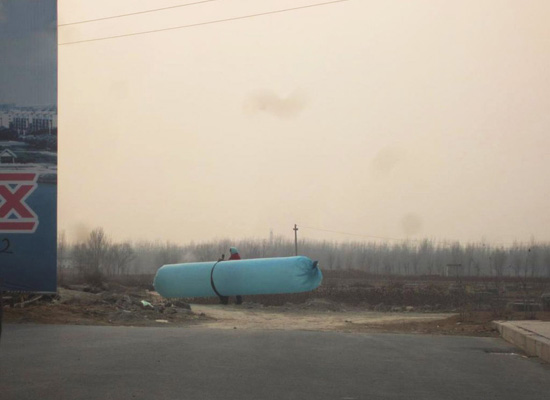
In one version, it's a woman from Binzhou in China's Shandong Province carrying a large plastic bag inflated with natural gas, tapped from a pipeline near some oil and gas wells. It's an illicit hack with “many latent dangers.”
In another version, it's a woman from the coming era of radical sustainability carrying a large plastic bag inflated with methane gas. Filling for about a week or so at the Biogas Farm Co-op, a puffy orchard of wind-fluttered arboreal dirigibles, she's plucked it off the ground as though a fruit off a tree.
Instead of protecting Japan's coastal cities from tsunamis with massive seawalls, a strategy hardly foolproof as evidenced by the spectacular failure of the country's flood barriers during last year's disaster, why not concentrate all that concrete into tower blocks and resettle everyone on top? Instead of moving to higher grounds, you create higher grounds on the low-lying plains where people are too entrenched to consider a mass exodus.
Most islands will be used for residential purposes, with between 100 and 500 houses and apartments. Fuel stations, waste disposal and storage facilities, and car parks are on lower floors. Commercial islands, meanwhile, will house factories and processing facilities for industries such as fisheries and agriculture. As well as lifting residents high above the destructive power of the waves, the design comes with a number of safety features. A reinforced gate at the back of each island automatically closes after a tsunami warning, while steps up the sides let people climb to safety.
Clusters of these islands could thus form towns and cities.
Of course, one wonders what would happen if an even more devastating tsunami comes along and overtops these islands? Would people finally abandon the coast?
While I normally advocate retreat and throw things at the wall whenever I hear the Army Corps of Engineers and entitled beach resort communities funneling billions of tax dollars into coastal fortifications, I am somewhat beguiled here by the image of these islands growing taller and bulkier every time a tsunami comes along, swelling much higher than the previous one due to accelerated sea level rise, and wipe everything in sight. From their original 3-story heights, they accrete each fresh batch of debris into gigantic stalagmites.
Extending this a bit further, perhaps we could imagine these islands growing still higher, tsunami or no tsunami. People will keep adding more and more elevations, not even stopping when they're safe from the reach of freak megatsunamis. Each new stratum will compel them to lay down a new layer. It's a kind of geo-pathology, incubated over all those decades of disaster-proofing their archipelagos. The islanders won't be able to resist such terraforming compulsion, and in only a few more decades, the coastal landscape of Japan will approximate the karst landscape of Guangxi.
Could these be the future feral descendants of Metabolist towers? Modular units of past and future ruins accreting through a perpetual cycle of destruction and reconstruction.
This frequently posed question targets fundamental principles of design, those basic criteria and priorities through which disciplinary stability is ensured. Yet, insofar as relevance is a core value of architecture, in both theory and practice, the contingent nature of the future guarantees that some forms of knowledge not presently considered essential will eventually become indispensable.
306090 15 is thus calling for “contributions that envision possible futures for architecture through speculations about new disciplinary knowledge. What specific methods, materials, or understandings—tools, ratios, formulas, properties, principles, guidelines, definitions, rules, practices, techniques, reference points, histories, and more—not presently considered essential to architecture could, or should, define its future? Pertinent knowledge might be previously forgotten, currently undervalued, generally misunderstood, or not yet recognized. Architects have long looked both to the outmoded traditions of their discipline and to other fields altogether when imagining possible directions for their work. In blurring the boundary between essential and non-essential knowledge, this inquiry seeks not to codify the contemporary state of the art for architecture, nor to assert the value of multidisciplinarity, but to envision, and potentially catalyze, new disciplinary approaches.”
This edition, then, will not be about the state of the art; instead, it's about what the state of the art could be, should be, would be, if...
When I first stumbled upon these poorly scanned data sheets of so-called gravity base stations, I thought they were actual “stations,” that is, actual gravity sensing devices that are constantly taking measurements of local geodetic conditions. Compact machines like those humidity monitors you see in museums and galleries that are sometimes mistaken for art installations.
To protect them from the environment and public tampering, I imagined each device encased in a metal canister, permanently embedded in concrete or stone and topped with a benchmark disk, itself stamped with an identification number and a warning of a fine or imprisonment to anyone who disturbs them.
I also imagined them forming a pointillist sensor network, just another sedimentary layer of a much more totalizing enviro-veillance network superimposed on the surface of the earth. Deployed in the most unassuming corners of the built environment, they pique little interest outside the insular worlds of geologists and geocachers.
But I was giddy with the possibility that they might be like buoy stations set adrift by NOAA not in the open ocean but on “solid” ground. Instead of ocean waves, they surf on invisible gravitational swells and troughs. And instead of the hyperactivities of the weather, they monitor something beyond our lived experience and even beyond their operational lives: gravitational fluxes caused by the million- or billion-year-long gyrations of tectonic storms.